Bank of England Holds Interest Rates Steady But Signals Future Cuts Are 'Likely'
The Bank of England has maintained its base interest rate at 3.75% following a closely contested vote by its Monetary Policy Committee (MPC), while simultaneously indicating that future rate reductions are now "likely" as inflation continues to decelerate. This decision comes alongside a stark warning that the UK's economic growth trajectory is set to be weaker than previously forecast, with unemployment projected to climb higher.
A Narrow Vote and a Shift in Tone
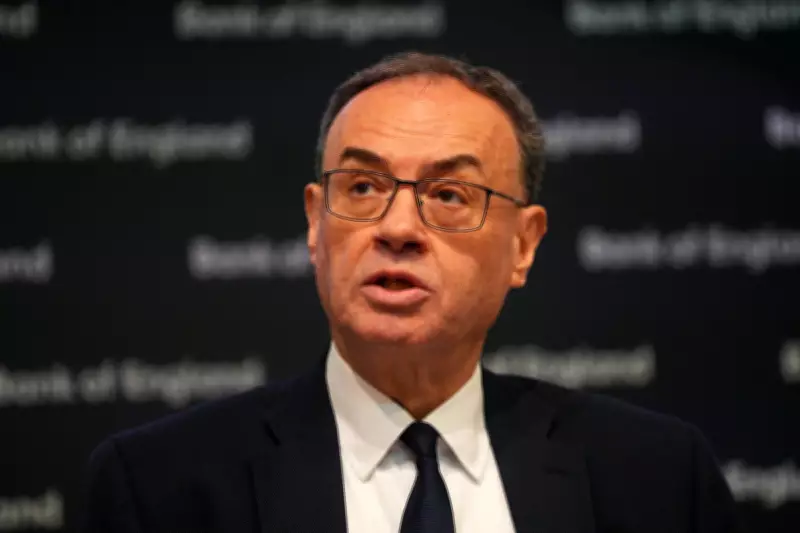
In a tight five-to-four majority, the MPC opted to keep the Bank Rate unchanged at 3.75%, marking a pause just two months after it was lowered from 4%. However, the accompanying report and commentary from officials signalled a clear pivot. Governor Andrew Bailey, who voted with the majority to hold, stated, "All going well, there should be scope for some further reduction in the bank rate this year."
Economists immediately interpreted the narrow vote as increasing the probability of a rate cut as soon as the next MPC meeting in March. The Bank's primary rationale for holding rates steady was to ensure inflation remains anchored around its 2% target.

Inflation Forecasts Revised Downwards
The Bank presented significantly revised inflation projections. It now expects the Consumer Prices Index (CPI) inflation rate to fall to the 2% target this year, a notable acceleration from its previous forecast of 2027. This anticipated drop is attributed to several factors:
- Measures from the Chancellor's autumn budget, particularly a support package for household energy bills from April, which is expected to reduce the typical annual bill by £134.
- These fiscal measures are projected to contribute to a roughly 0.5 percentage point decline in the inflation rate.
- A continued slowdown in wage growth, which Bank officials highlighted as a key contributor.
The Bank forecasts inflation to hover near 2% through late 2026 before potentially dipping to as low as 1.7% in early 2027.
Gloomier Growth and Employment Outlook
Concurrently, the Bank's latest economic assessment paints a sobering picture for UK growth and the labour market. It has downgraded its Gross Domestic Product (GDP) forecasts:
- 2025 growth revised to 1.4% from 1.5%.
- 2026 growth slashed to 0.9% from 1.2%.
- 2027 growth trimmed to 1.5% from 1.6%.
A modest recovery to 1.9% growth is anticipated for 2028. The Bank cited subdued consumer demand, expected to persist "through 2026", driven by rising unemployment and ongoing cost-of-living concerns. It noted that supermarkets reported only "modest" volume growth, with consumers becoming more cautious and "forgoing treats."
Rising Unemployment Projections
The labour market outlook has also darkened. The Bank now expects the unemployment rate to peak at 5.3%, up from its November forecast of 5.1%. It is then projected to decline slowly to 5.2% in 2027 and 5.1% in 2028, which is higher than previous forecasts of 5% and 4.8% for those years respectively.
Expert Analysis and Future Expectations
Financial analysts are now closely watching the data ahead of the March meeting. ING experts predict two further rate cuts in March and June, which would bring the Bank Rate down to 3.25%. James Smith, developed markets economist at ING, commented, "Everything comes down to Governor Bailey's vote in March... if the data follows recent trends – higher unemployment, slower wage growth – then he will swing behind a cut next month."
Matt Swannell, chief economic adviser to the EY Item Club, noted the closer-than-expected vote "clearly opens the door to a rate cut at the March meeting." He observed that the MPC's focus has shifted from "sticky wage and price pressures" towards the subdued growth outlook and its potential impact on jobs.

The Bank of England's latest move represents a delicate balancing act, holding firm for now to safeguard against inflationary risks while explicitly preparing the ground for monetary policy easing in the face of mounting economic headwinds.