
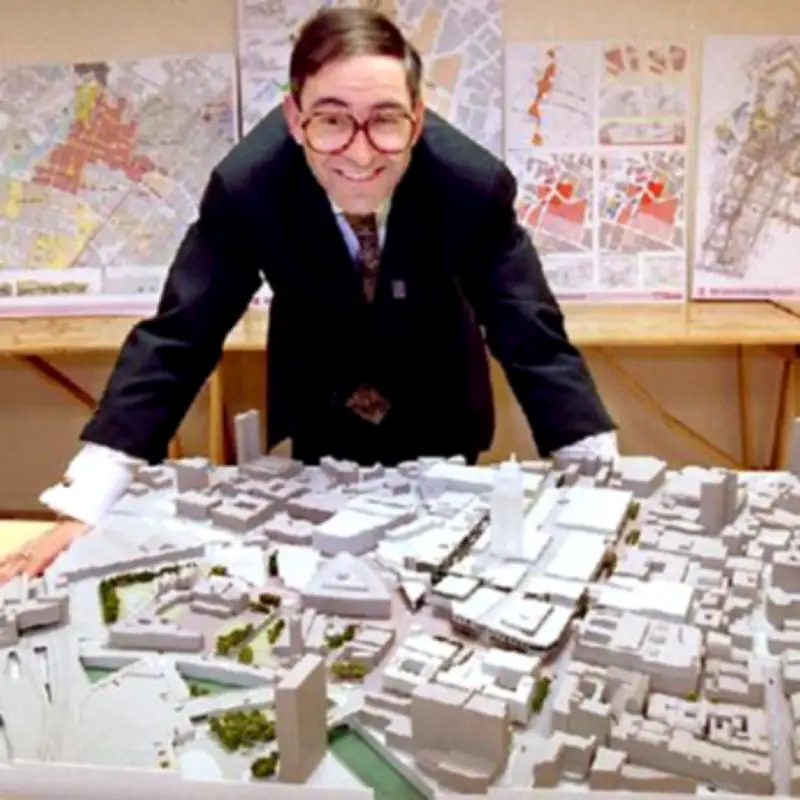
One second was all it took. It would change the face of Manchester forever. But within a week of the 1996 IRA bomb which left large parts of the city centre in ruins, the city's political and business leaders had already begun to plan its rise from the rubble. And three decades later the remarkable renaissance is still ongoing.
The Bombing and Its Immediate Aftermath
More than 220 people were injured when a 3,300lb semtex bomb hidden in the back of a van on Corporation Street was detonated at 11.17am on June 15. Remarkably no one was killed, but an estimated £700m of property damage was caused in the blast. Around 600 businesses were affected, with countless livelihoods disappearing in an instant. The Arndale was a no-go zone for months. Longridge House, home of Royal Insurance, would have to be demolished. Hundreds were bombed out of business in the Corn Exchange and the Royal Exchange. All-in-all nearly a third of the city's floor space had been taken out.
"The first week was pretty devastating," former Manchester council chief executive, the late Sir Howard Bernstein, told the M.E.N. in 2006. "We wondered how we were going to recover. Then that Manchester 'can-do' thing comes back, and you think stuff it. We can do this and will do it in a way only Manchester can."
A City at a Crossroads
Manchester had largely been in the economic doldrums since the collapse of the textiles industry. But by the mid-90s, with regeneration in parts of the city well underway, there were signs Cottonopolis could be about to turn the corner. The GMEX had been enjoying a new lease of life for more than a decade, the Arena had opened a year earlier, Piccadilly was being transformed and Bridgewater Hall would put on its first shows three months after the blast. And the city had already won the bid to host the 2002 Commonwealth games which would prove instrumental in the regeneration of east Manchester.
But parts of town were being left behind, especially in the north, around the top end of Deansgate, Victoria station and the Arndale. It was crowded, difficult to navigate and cut off from Manchester's core. However the bomb presented city planners with a unique opportunity to do something about it.
"Fairly quickly we decided we were not just going to rebuild in the same way," then council leader Richard Leese said. "This was an opportunity to do something about the past mistakes in the 60s and 70s. There was a feeling that we were not going to be beaten that permeated the entire population."
Political Will and Funding
In their ambitions the town hall's Bernstein and Leese found an unlikely ally in the form of Conservative Deputy Prime Minister Michael Heseltine. Over a series of meetings in Whitehall the three men in whose hands the future of Manchester lay thrashed out their proposals. Things were going well until finally the thorny issue of government funding was raised. When the Manchester men volunteered the figure of £90m, Heseltine remained silent. They left to catch their train home unsure as to what Heseltine's answer might be. They hadn't even got to Euston station when Leese's mobile rang. "The money's sorted," said the Deputy Prime Minister. "I've called a press conference."
With public money secure, private financing also came on board. And over the next decade or so the plans began to come to fruition.
The Rebuilding and Regeneration
An international competition was launched to design Cathedral Gardens, the city's first new urban park for 70 years. Marks and Spencer opened its new home in 1999, closely followed by the Iain Simpson-designed New Cathedral Street, which helped to attract big name, luxury stores such as Selfridge's and Harvey Nichols. The Printworks was launched to great fanfare, hot on the heels of the revamped and renamed Corn Exchange, which was badly damaged in the blast. Urbis, now the National Football Museum, opened its doors in 2002 and the first new section of the revamped Arndale followed suit the next year.
And perhaps most famously and ambitiously of all medieval pubs Sinclair's Oyster Bar and the Old Wellington would be upped, turned 180 degrees and moved 70m up the road, to stand in the shadow of the cathedral. All-in-all 59 acres of city centre shopping was redeveloped. And it didn't stop there.
The energy and impetus created by the remarkable burst of reconstruction helped pave the way for the transformation of the world's first industrial city. In the years to come Spinningfields was built, Piccadilly Gardens underwent a divisive revamp and a new tram line was built from Victoria to St Peter's Square. Skyscrapers such as Number 1 Deansgate and Beetham Tower paved the way for dozens more high-rises as tens of thousands of people moved into the city centre. Tourists also began flocking to Manchester as a raft of new hotels were built to accommodate them.
Reflections on the Legacy
It all helped create the remarkable success story that is the modern-day city centre. But those at the heart of the project have long given short shrift to the idea the IRA plot was 'good' for Manchester. "I don't want the story around the IRA bomb just to be what it meant for the city centre afterwards, but it is fair to say that it was a big driver for regeneration," current Manchester council leader Bev Craig told the BBC in the run-up to the 30th anniversary. "The city in the late 80s and early 90s was struggling, there had been hopes and aspirations about making it better, but ultimately what happened post IRA bomb there was a chance to bring some of that investment and regenerate the city centre and begin the journey to what we see today."
The late Howard Bernstein put it in much blunter terms. "People say the bomb turned out to be a great thing for Manchester," he once told the M.E.N.. "That's rubbish. We suffered a grievous blow and it was probably one of our darkest hours. I don't know what it was like in the Blitz but it could not have been much bloody worse."




