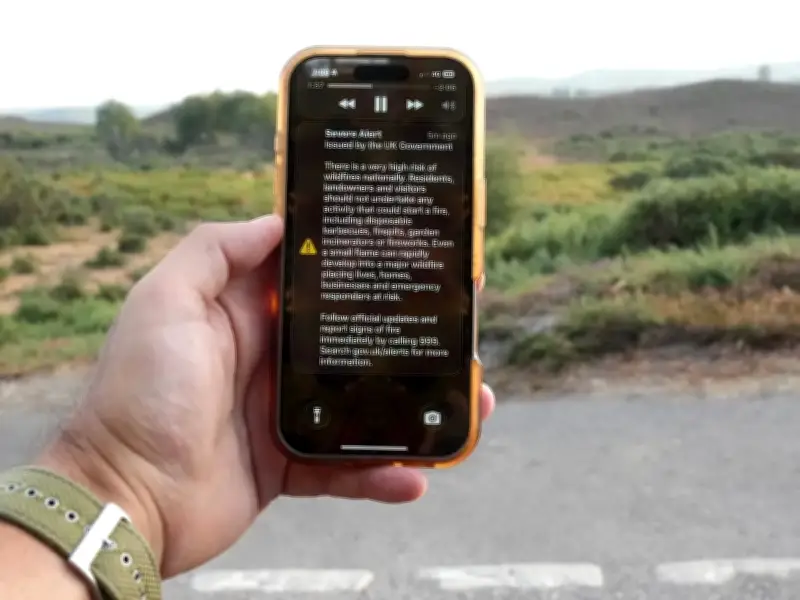
Millions of mobile phones across England and Wales sounded shortly after 7pm on Friday as the Government used the UK's Emergency Alerts system to warn about exceptionally hot and dry conditions and a growing wildfire threat.
Residents, landowners and visitors were told to avoid activities that could trigger a blaze, while firefighters continue to tackle wildfires in several parts of the country. The warning comes as ministers ramp up prevention efforts, with the sale of disposable barbecues temporarily restricted and 100 additional military personnel deployed to areas dealing with major incidents.
What was the emergency warning?
The alert is part of the Government's action to protect communities from wildfires as the UK faces unprecedented, record-breaking wildfire activity following a series of intense summer heatwaves. The country is now experiencing its fifth widespread heatwave of the year, and fire services are under immense strain.
Eleven major incidents were declared simultaneously within a 24-hour period, forcing firefighters and military personnel to tackle active blazes across the country. The Government has warned that even a small source of ignition could have devastating consequences, putting people, properties and emergency crews in danger. Wildfires have raged across the UK this week, including in Stourbridge, West Midlands, where around 40 homes have been destroyed.
What do I do now?
People who received the alert are urged to take extra care and avoid any activity that could increase the risk of a wildfire while conditions remain dangerously dry. This includes using disposable barbecues, fire pits, garden incinerators or fireworks, as even a small flame could develop into a serious blaze.
Anyone who spots a fire or signs that one may have started should move to a safe place and call 999 immediately. People should also continue to follow official updates, as further advice could be issued if conditions change.
Why didn't I get an alert?
Not everyone in England and Wales will have heard the warning sound on their phones. Emergency Alerts are broadcast through nearby 4G and 5G mobile phone masts to compatible devices in range, rather than being sent to individual phone numbers.
The Government says people will not receive an alert if their device is switched off, connected only to a 2G or 3G network, Wi-Fi only, or not compatible with the system. The system works on iPhones running iOS 14.5 or later and Android devices running Android 11 or later, although some older Android devices may also receive alerts. People are also advised to make sure their phones have the latest software updates installed.