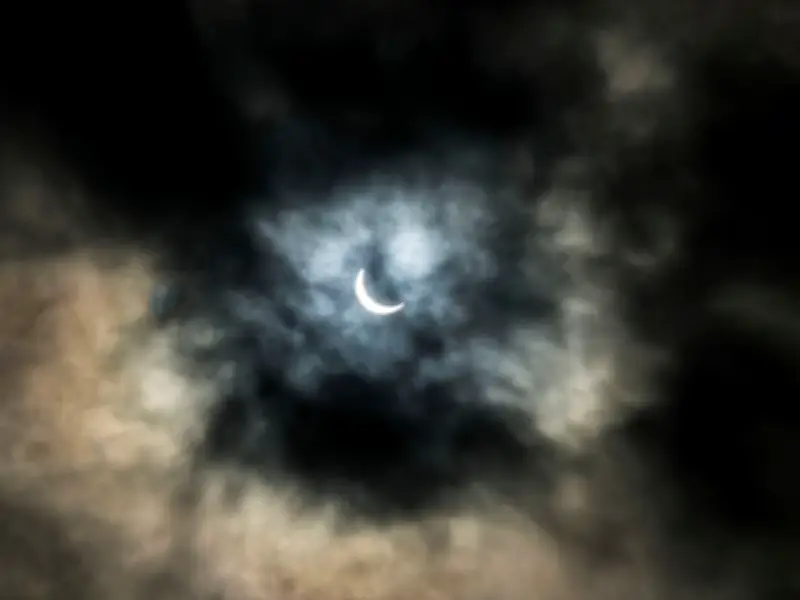
A partial solar eclipse will be visible from the UK and Ireland on August 12, 2026, meaning the Sun's light will not be fully blocked by the Moon. This will be the most coverage seen from the UK and Ireland since the 1999 solar eclipse, which was total for most of Cornwall and Devon.
What to expect
On August 12, the new Moon and the Sun will gradually move closer together in the sky in the late afternoon. The Moon will move slowly in front of the Sun until roughly 90% of the Sun is covered.
Royal Museums Greenwich (RMG) said: "At the maximum, enough of the Sun will be covered to make a noticeable difference in the temperature and light levels. However, unlike with a total eclipse, the sky will not become dark – it will feel more like a cloudy day or close to dusk or dawn. After the maximum, the Moon will then slowly move off the Sun's disk until the eclipse ends."
Visibility and timing
A total solar eclipse will be visible in Greenland, Iceland, Spain, Russia, and a small area of Portugal, while a partial eclipse will be visible in Europe, Africa, North America, the Atlantic Ocean, Arctic Ocean, and Pacific Ocean.
According to Royal Museums Greenwich, getting to a high point with a clear view of the western horizon will allow you to see the whole event. In Liverpool, the eclipse maximum is expected to be around 7.10pm, with first contact happening at 6.13pm.
Safety and other celestial events
During totality, you may view the Sun without proper eye protection, such as solar glasses. However, during all other phases of the eclipse, you should only look at the Sun when your eyes are protected.
Later on Wednesday August 12, the Perseid meteor shower will light up the sky, peaking the evening of August 12 into the early morning hours of the following day. The Perseids happen every year when Earth passes through a debris stream left behind by Comet Swift-Tuttle. As those tiny bits of comet dust hit our atmosphere at high speed, they burn up as bright streaks of light.
After the spectacular partial solar eclipse and meteor shower, people in the UK can look forward to a lunar eclipse. A 90% partial lunar eclipse will be visible from the UK on August 28, around two weeks after the solar eclipse.
2090 will be the next total solar eclipse visible from the UK. The only eclipse that comes close to total for the British Isles will be on September 3, 2081.