Millions across the UK are set to witness a partial solar eclipse tonight, Wednesday August 12, with the Moon covering 90-96% of the Sun – the most coverage from a UK-viewed eclipse since 1999. As excitement builds, safety remains paramount: looking directly at the Sun without specialised eye protection is dangerous.
Why special glasses are essential
A partial solar eclipse occurs when the Moon passes between the Sun and Earth, but the three bodies are not perfectly aligned. This time, the Moon will block over 90% of the Sun, giving it a crescent shape. Unlike a total eclipse, there is no period of totality, so it is never safe to view the eclipse directly without proper eye protection.
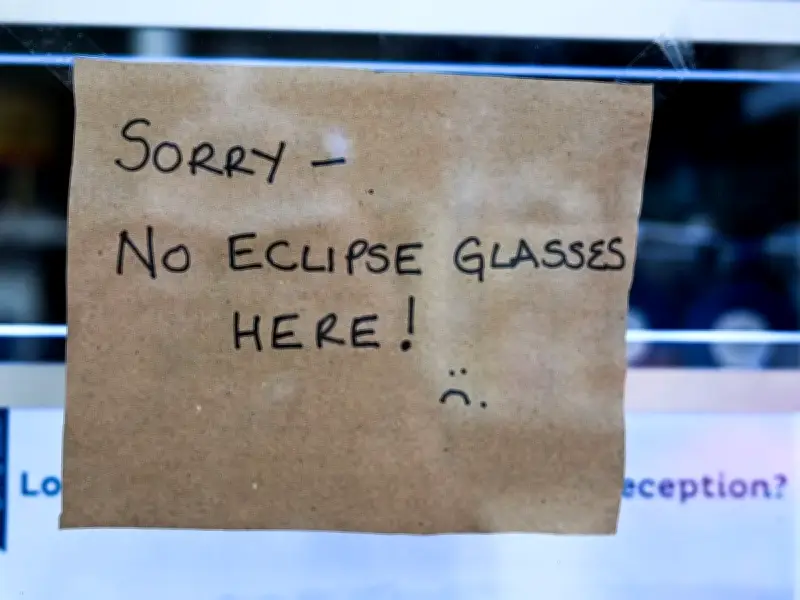
NASA warns on its website that viewing the Sun through a camera lens, binoculars, or a telescope without a special-purpose solar filter secured over the front of the optics is dangerous. With eclipse glasses sold out across the country – from convenience stores to national parks and the Royal Greenwich Society – many are left without a pair.
Three DIY viewing methods
The Royal Astronomical Society has shared advice on how to build a pinhole projector at home, allowing you to see the eclipse by projecting the Sun's light onto another surface. Here are three simple methods:
- Two pieces of paper: Make a small hole in one piece of paper and hold it above another piece of paper to see the shadow of the Sun replicated in miniature.
- A colander: Hold a colander over a piece of paper and look at its shadow.
- Tree leaves: The gaps between leaves act as natural pinhole projectors – simply look at the shadows cast by leaves on the ground.
Eclipse timings for the UK
The entire event is set to last about one hour and 50 minutes, starting around 6.20pm and finishing by 8.10pm. The same eclipse will be visible across Europe, appearing as a total eclipse in parts of Greenland, Iceland, and Spain. In Liverpool, the Moon first covers the Sun's disc at 6.13pm, with maximum eclipse at 7.10pm, ending at 8.03pm when the Moon no longer covers the Sun.