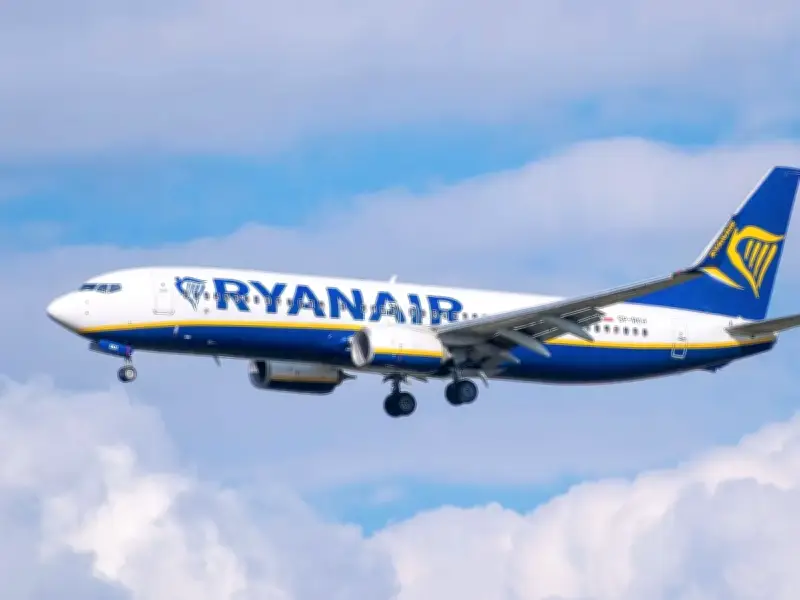
A Ryanair flight with 171 passengers on board declared a 'Mayday' alert after a major fuel incident, eventually landing safely at Manchester Airport. This followed three aborted landings at two other airports, a new report reveals.
The flight, which was caught up in Storm Amy in October last year, finally landed at Manchester 'with a fuel quantity significantly below the final reserve fuel', according to a report by the Air Accident Investigation Branch (AAIB).
Pilots increasingly concerned about fuel
The report says the pilots were 'increasingly concerned' about the level of fuel and the third failed landing prompted the declaration of a 'MAYDAY, MAYDAY, MAYDAY, MAYDAY FUEL' alert to air traffic control, along with the 'request for an immediate diversion to Manchester'.
"There was no further discussion by the pilots about the expected fuel remaining on arrival at Manchester, except that they realised they would not have enough fuel for another go-around," says the report. An earlier request to divert to Manchester was refused after a 'breakdown of communication', it adds.
Three aborted landings during Storm Amy
The Boeing 737-800 plane, with six crew also on board, was on a scheduled flight from Pisa International Airport in Italy to Glasgow Prestwick Airport on a day when 'significant winds had been forecast' due to Storm Amy. Extra fuel was pumped into the plane as a result.
The plane twice tried to land at Prestwick but two 'windshear escape manoeuvres' led to the pilots carrying out go-arounds. A go-around is an aborted landing of an aircraft on final approach, or one which has already touched down. Pilots are often forced to use the procedure if they experience a late, sudden gust of wind.
Following the two go-arounds, the crew requested a diversion to Manchester Airport but it 'was not accepted'. The plane then diverted to Edinburgh Airport but the pilot again couldn't land and reported a 'further windshear escape manoeuvre'. The emergency was then declared and the plane was flown to Manchester, where it landed safely but seriously low on fuel.
Communication breakdown at Manchester Airport
Investigators said a 'breakdown of communication' within Manchester Airport led to the first diversion request being refused. In conclusion, the AAIB said: "Although the airport and handling agent policies at Manchester meant that the diversion should have been accepted, a breakdown of communication within the airport led to it being refused."
The aircraft diverted instead to Edinburgh, where the crew was required to perform another windshear escape manoeuvre. The pilots were concerned that if they remained at Edinburgh there was a possibility that their low fuel state and the wind conditions could mean they had no option other than to fly through a windshear warning while on approach. They calculated that if they diverted to Manchester, they would land with between 500 and 700kg of fuel, and, subsequently, the flight management system calculated the expected arrival fuel to be 300kg.
"Both calculations meant that the aircraft would land below the final reserve fuel of 1,100 kg, but the commander considered the safest option was to divert to Manchester where the aircraft landed with 363kg," the report says. The flight, FR3418, departed from Pisa Airport at 3.28pm and landed at Manchester at 7.52pm on October 3 last year.
Manchester Airport said it noted the contents of the report and was evaluating its contents. Ryanair has been approached for comment.