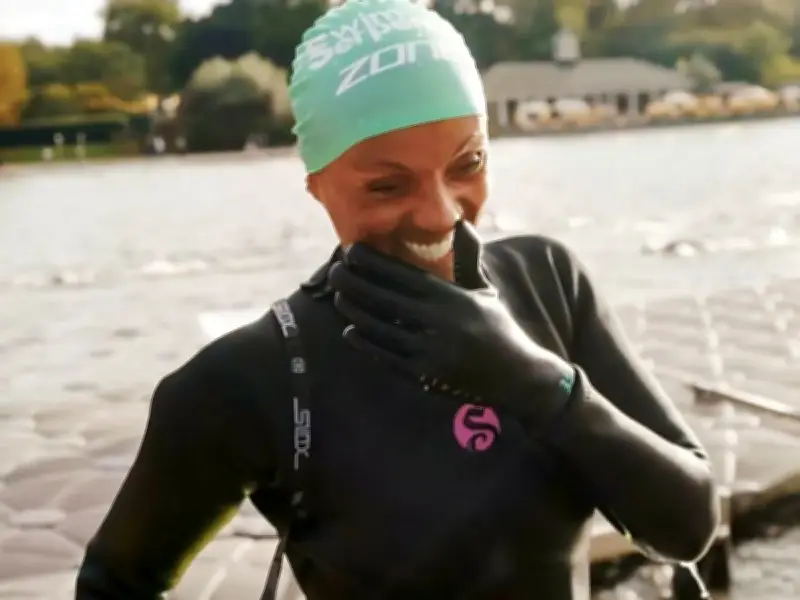
Lee Bailey, a 54-year-old swimmer who works with the Black Swimming Association (BSA), is set to return to the Serpentine for a two-mile open water challenge to highlight inequalities faced by Black communities. The swim comes amid growing calls for stronger water-safety education, with campaigners warning that Black children remain disproportionately at risk of drowning.
Bailey swims almost every day and had spent months preparing for the challenge she knew she was physically capable of completing. But standing at the edge of the Serpentine last year, she was left feeling sick to her stomach and barely able to speak as she prepared to enter the open water.
Despite being a strong swimmer, Bailey had carried a fear of open water for years, uncertain about swimming in water where she could not see what was beneath her. She told the Mirror: "When I go in the water for a couple of minutes, it feels like panic and I'm having trouble breathing. I forget everything I know, then I have to remind myself that I know what I'm doing."

Overcoming a lifelong fear
That fear stretched back to childhood, when wave pools and the dark grills behind the machines would leave her uneasy. Bailey said: "I love the sea, I love water, I love fish and things like that. Like, I just don't want to be with them."
Last year's swim became a chance for her to confront that fear head-on alongside her sister and a colleague. It also gave Bailey a fresh perspective on the people she works with through the BSA, many of whom are trying to overcome their own fear, trauma or lack of confidence around water.
Bailey said: "Because we do the process for so long, you can forget what fear means for someone." Once she finally settled into the swim, however, the nerves began to ease. She said: "Then once that was done I felt like a fish, literally felt like I was floating, so I got into my groove and I loved it every minute of it."
Drowning risks and prevention efforts
As local engagement manager for the BSA, Bailey works directly with people who may have never learned to swim, lack confidence in the water or have had frightening experiences in the past. The inequalities can have devastating consequences. The latest National Child Mortality Database analysis found children of Black ethnicity in England had more than three times the risk of drowning compared with White children between April 2019 and March 2025 - 8.19 deaths per million children each year compared with 2.30.
Seren Jones, 32, Chief Executive Officer of the BSA, said: "Drowning is preventable, but water safety is still not prioritised enough across society. Black children in England are three times more likely to drown than White children, while aquatic participation remains lower amongst Black and Asian communities. Our work focuses on breaking down barriers and providing the knowledge and confidence people need to be safe in and around water."
Despite being surrounded by swimming every day, Bailey said she still notices how few Black people she sees when she goes for her own early-morning sessions. She has, however, noticed a difference. She said: "What I can see from parents now with children that they're making conscious effort to promote swimming, especially in Black and Brown households and trying to break this cycle. As well as a lot of adults now doing adult swimming lessons, which I've never seen so much before, which is great to see."
Barriers and calls for education
Bailey believes some of the barriers around swimming within Black communities have roots stretching back generations. She said: "If we go back, it's because water spaces were segregated making it hard for Black people to use public pools - and it only stopped in the late 60s, which is terrible and wasn't that long ago. Obviously that gets passed down."
She said the inequalities affecting different communities go far beyond simply teaching people how to swim. Bailey said: "It's not about swimming, it's about safety. Water safety and confidence, they're the main two things I always take from it because once you have those two things I think swimming should become quite easy."

The warnings come after another devastating summer around Britain's waterways, with the Mirror tracking more than 50 deaths linked to incidents in open water in recent months. The Mirror launched its Save Lives for Sam campaign after a spate of drownings in May, calling for tougher safety measures at high-risk waters and better water-safety education in schools. Inspired by 16-year-old Sam Haycock, who drowned in 2021, the campaign is pushing for a Sam's Law to make lifesaving equipment mandatory near dangerous stretches of water.
Bailey believes more needs to be done much earlier to teach children how to stay safe around water outside of teaching them to swim. She said: "Children don't even know the water safety code - I didn't even know it until I started working for BSA. But I know the green cross code, how to cross the road, how to be safe, because we were taught that."
She wants water-safety education to become a much more routine part of school life rather than something that is discussed only when warmer weather arrives or after another drowning. Bailey said: "We should be talking about water safety and it should be part and parcel of school curriculum and I think that would make such a big change."
She said the need for better education is particularly clear when people enter rivers, lakes or other open-water spots without understanding what may be beneath the surface or how quickly conditions can change. She added: "Right now, it's just lack of knowledge, lack of education."
The London Marathon Foundation has been funding the BSA since 2022, with more than £1.5million committed to increasing its water-safety awareness programmes. Group Funding & Impact Director Mike Diaper said: "The work Lee does with the Black Swimming Association plays a vital role in making water safer more accessible for everyone. The London Marathon Foundation has supported the BSA since 2022, and this summer has underlined the importance of its work in helping ethnically diverse communities develop potentially life-saving skills, build confidence, and enjoy the benefits of being active in and around water."
This weekend, Bailey will return to the Serpentine for another two-mile swim as she raises awareness of inequalities surrounding swimming and water safety.