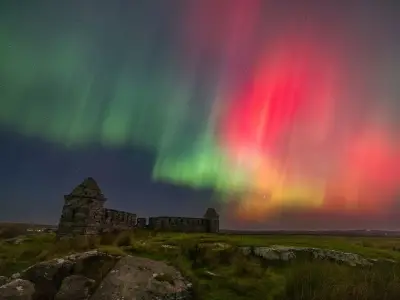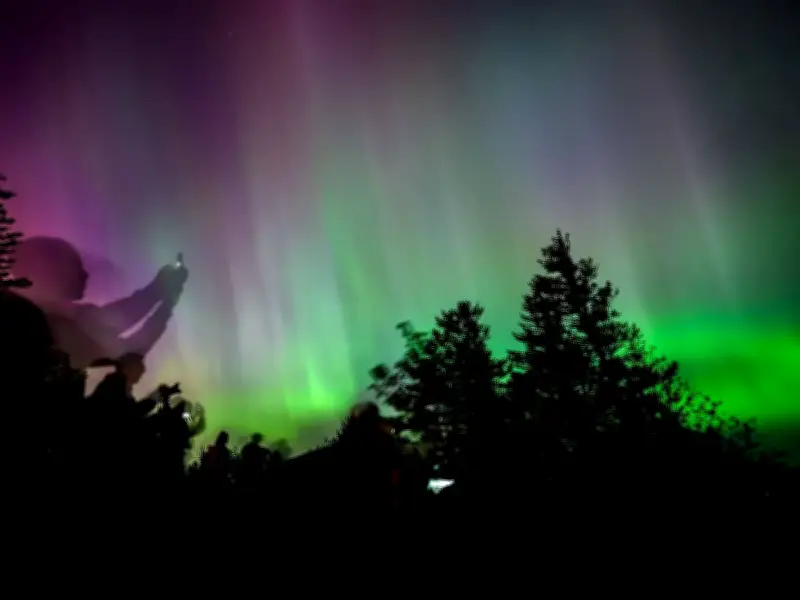
The Met Office has revealed where in the UK you could catch a glimpse of the Northern Lights tonight (October 10). The UK is set for 'fantastic viewing opportunities', according to the weather body.
Forecasters say the aurora borealis 'may be visible' across northern parts of the UK, with some 'fantastic viewing opportunities'. A red alert was issued by Aurora Watch UK for sightings of the natural phenomena on Saturday night.
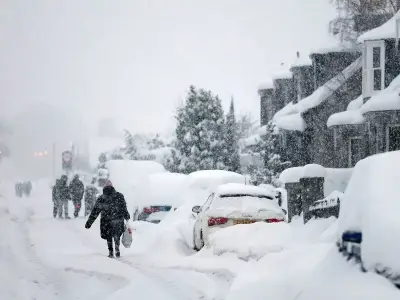
It comes as temperatures in Greater Manchester are forecast to plunge as low as 6C over the coming week as the Met Office warns the UK is likely to see "frost" over the weekend.
What causes the Northern Lights
The Northern Lights are caused by large explosions of activity from the sun which throw out huge amounts of charged particles into space. When these particles are captured by the Earth's magnetic field, they can collide with gas molecules in the atmosphere in an event called a geomagnetic storm. These collisions give off energy as light, forming spectacular colourful displays in the sky.
While typically confined to northern latitudes, the Met Office says 'building geomagnetic activity' could make the aurora more visible in southern latitudes, including the UK.
Met Office forecast for the coming days
The Met Office said on social media: "The Northern Lights may be visible across parts of the north tonight. With skies clearing in places, there could be some fantastic viewing opportunities."
Between October 10 and October 13 there will be possible daily sightings across Scotland and similar geomagnetic longitudes where skies are clear, according to the Met Office. It said: "Two glancing coronal mass ejections followed by a coronal hole high speed stream bring a daily chance of enhancing the auroral oval, with sightings possible across Scotland and similar geomagnetic longitudes where skies are clear between 10-13 Oct."
How to see the Northern Lights
You need a clear night with no cloud cover. Find a dark location with no light pollution. Look toward the northern horizon. Be cautious that geomagnetic activity can cause disturbances to satellite navigation (GNSS/GPS etc).