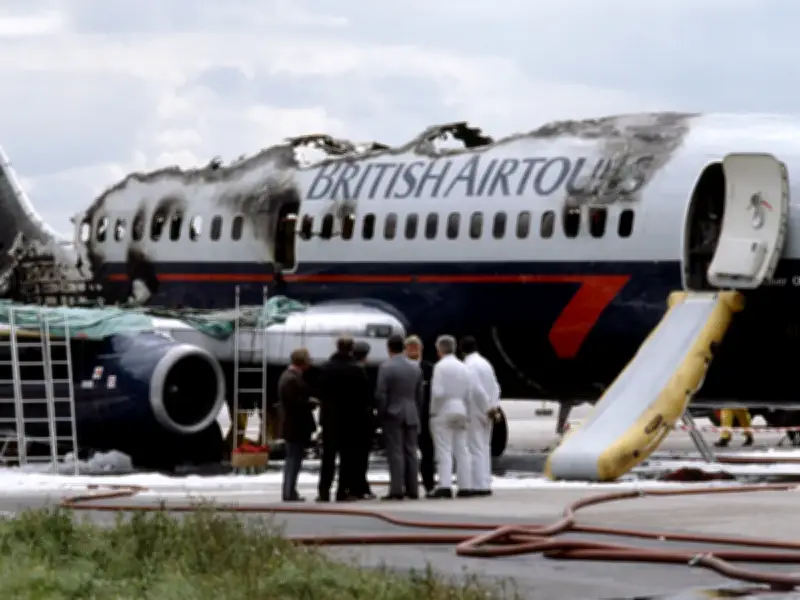
A catastrophic fire that engulfed a plane packed with holidaymakers as it prepared for departure transformed air travel safety standards forever. On August 22, 1985, 53 passengers and two crew members aboard a jet departing from Manchester Airport died tragically in one of Britain's deadliest aviation disasters.
They were travelling on the Corfu-bound British Airtours 737 when flames broke out while still on the runway. The majority of those killed succumbed to toxic smoke inhalation. For the survivors, their lives changed forever.
The disaster unfolds
The disaster unfolded when the jet, carrying 131 passengers and six crew members, was accelerating along the runway in preparation for take-off. The aircraft was reaching 140mph when the port engine exploded and debris pierced both the wing and a fuel tank.

The captain managed to abort the take-off and, adhering to protocol, steered the aircraft off the runway in the direction of the fire station. However, this manoeuvre inadvertently caused the fire to spread rapidly towards the back of the plane.
The layout of seating around the emergency exits hampered evacuation efforts as lethal fumes rapidly filled the cabin and the rear escape slides could not be deployed.
A survivor's account
John Beardmore, one of those who survived the crash, spoke to the Manchester Evening News in 2015, recalling his own distressing account of the horrifying sequence of events. John had boarded the flight at Manchester Airport alongside his wife Pamela, then 37, and their two sons Simon, 14, and David, 12, who were buzzing with excitement ahead of a family holiday abroad.
However, with Pamela and the boys seated in a row directly above the wing and engine while John sat across the aisle next to another family, he was immediately gripped by a sense of unease. He said: "I felt uncomfortable. I was just staggered by the number of people on the aircraft. When I sat down in row 13, my knees were pressed into the seat in front. There were over 130 passengers. I remember thinking 'this is going to be an uncomfortable flight', but I was thinking of the holidays."
As they began to pick up speed on the runway and were about to take-off, passengers heard a big thump. "I think we all thought it was a tyre bursting, but within seconds someone on the left side of the cabin shouted the engine was on fire. I could see through a window black fumes coming out of the engine. There was orange and red fire, all streaming backwards. At that point I knew there was serious problem."
Escape and aftermath
The aircraft braked sharply and came to a stop - before continuing to taxi back. "Passengers got out of their seats and went towards the exit at the front on the side not affected, they behaved very well indeed," John added. "My wife got our two children up and went straight to the front - she had a good view of the fire and knew how serious it was."
But by the time John got up, the gangway was totally blocked - and the plane continued to taxi at very slow speed down the runway. "The plane turned right and as it did I heard people screaming at the back because the wind was blowing the flames from the engine directly on to the cabin," he said. "The windows began to break and black toxic fumes were coming into the cabin at the back."
After they stopped, a chute jammed in one of the doors, losing valuable time - and another door had to be opened. Finally, the aisle queue began to move. Passengers began escaping from the wing exit too. "I was near the back, a black cloud of dense fumes and smoke started to roll down the cabin. When it hit you, you just choked, one or two breaths and you knew you'd collapse. They just blocked every air way, I started to choke and my knees went, I just saw white air, I thought it was a window and made my way towards it - it was the front door, there was a shoot in front of me and I went down it."

John was the last person to escape from the aircraft. The family seated next to him did not survive. He added: "The scars never heal - sometimes even when I'm driving or doing things something will trigger off a flash point and your memory and you just can't help that and you just have to learn to live with it. That's going to be with you for the rest of your life. But I hope we never forget it because people around us weren't as lucky as my family - people I was sitting next to died. I never want to forget even though it's painful when those flashbacks occur."
Impact on safety
Firemen were at the scene within minutes and many of the people sliding down the two front chutes on the aircraft were smothered in foam being used to put out the flames. 82 people managed to escape but 55 others, including two cabin crew, were killed. An ITN news report in the days following the disaster revealed a hangar at the airport had been turned into a makeshift mortuary, where relatives had the heart breaking task of identifying those who had died.
The tragedy had a profound effect on the plane's captain, Peter Terrington, who died just months after the 30th anniversary of the tragedy in 2015. His wife Joan said he thought and talked about it almost every day, as he struggled to come to terms with survivor's guilt. Joan, who worked as cabin crew before she retired, said: "Technically what he did was exemplary. He did his best. But procedures are very different now. He was completely devastated that passengers lost their lives."
Peter, who had lived with Parkinson's for many years, also attended a memorial every year at Manchester Airport. Joan added: "He always questioned if he should have done more. Many welcomed the fact he did as much as he could - some thought he could have done more."
There were many accounts of bravery from the air crew who remained on board, despite the flames and choking fumes, to help as many passengers exit the plane to safety as they could. One air hostess, Joanna Toff, physically dragged passengers from the blazing aircraft. She was awarded the Queen's Gallantry Medal for bravery after crawling to reach choking passengers and drag them to the escape chute of the wreck. She saved many passengers that day, including a young girl who was trampled underfoot in the stampede to escape.
Following the disaster, investigations showed that cracks in part of the engine led to the fire, which was to prove a turning point in air safety, spurring the introduction of fire-blocking seat covers, floor-level lighting and alterations to seating. The incident, subsequent report, and safety changes, marked a milestone in investigation of survivable aircraft incidents. Among the changes, the disaster's legacy now means that an aircraft on fire will now always stop on the runway rather than taxiing away from the strip - ensuring passengers are evacuated more quickly.