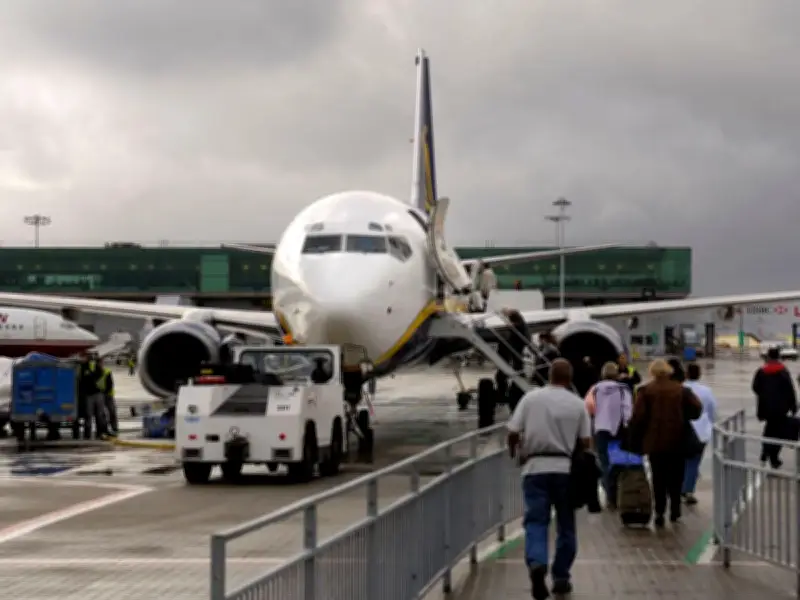
A Malta Air Boeing 737-800 landed at Manchester Airport with just 363kg of fuel — enough for less than six minutes of flight — after being initially refused permission to land there. The aircraft had been forced to divert from its planned destination in Scotland due to severe storm conditions.
Storm disruption forces multiple go-arounds
The aircraft, registered 9H-QBD, was operating a scheduled flight from Pisa International Airport to Glasgow Prestwick Airport. According to a report by the Air Accidents Investigation Branch, significant winds had been forecast for the day, prompting the crew to take on extra fuel to allow for possible delays and diversions.
During the approach to Prestwick, the crew performed two windshear escape manoeuvres that transitioned into go-arounds. A request was then made to divert to Manchester Airport, but the crew were informed the airport was too busy and the request was not accepted. The aircraft diverted instead to Edinburgh Airport.
Emergency declared after further windshear
While approaching Edinburgh, the crew carried out another windshear escape manoeuvre. Following this, they declared an emergency and diverted to Manchester, where the aircraft landed with a fuel quantity significantly below the final reserve.
The report stated: "9H-QBD was on a scheduled flight from Pisa International Airport to Glasgow Prestwick Airport on a day when significant winds had been forecast. The crew took extra fuel to allow for possible delays and diversions due to the weather."
It continued: "Following two windshear escape manoeuvres that transitioned into go-arounds at Prestwick, the crew requested a diversion to Manchester Airport, but the request was not accepted and the aircraft diverted to Edinburgh Airport. Following a further windshear escape manoeuvre at Edinburgh, the crew declared an emergency and diverted to Manchester where they landed with a fuel quantity significantly below the final reserve fuel."
Airport reiterates diversion policy
Following the incident, Manchester Airport reiterated to stakeholders its policy of accepting diversion requests if the airport has the capacity to receive the aircraft, and that the decision on accepting the diversion does not rest with the handling agent.
Winds can directly change a plane's ground speed and total flight time, which determines how much fuel the aircraft burns to reach its destination. Airlines carry extra fuel in case unexpected headwinds force a slower trip or a diversion.