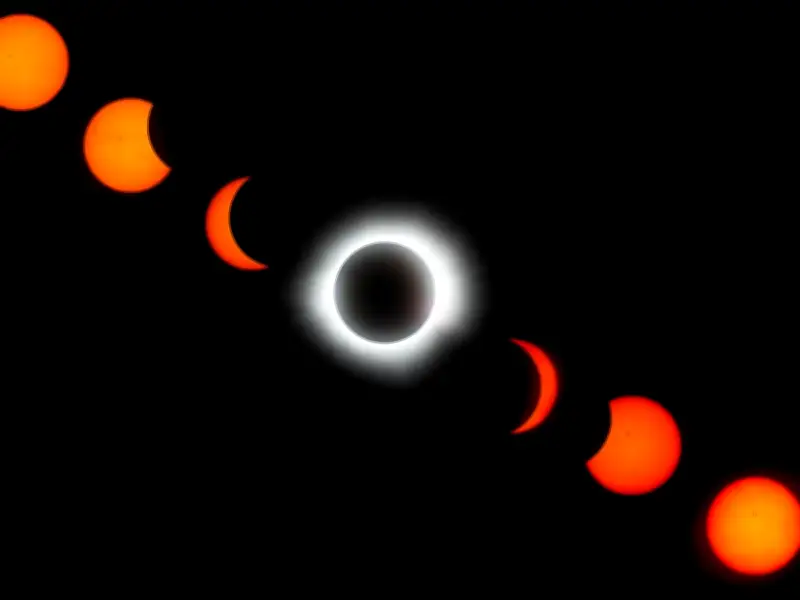
More than 90 per cent of the Sun will be obscured by the Moon today in the deepest partial solar eclipse seen in 27 years. It will be the most the Sun has been blocked in UK skies since the total solar eclipse in 1999, which was total for most of Cornwall and Devon, while other UK areas with clear skies saw a partial eclipse.
A solar eclipse happens when the Moon passes between the Sun and Earth, blocking the Sun’s light for viewers on Earth. During the 2026 eclipse, sky watchers in parts of Spain, northern Portugal and Iceland will see a total eclipse, where the sky will darken dramatically.
UK skies to dim, but not as dramatically as a total eclipse
Since up to 96 per cent of the Sun will be obscured in UK skies, the sky is expected to dim, but not as dramatically as during a total eclipse. The next total solar eclipse visible from the UK will not occur until September 23, 2090, with only the South West and southernmost parts of England set to see totality.
There will not be another solar eclipse this deep for more than half a century. On September 3, 2081, up to 99 per cent of the Sun will be obscured by the Moon, and again Cornwall and the south coast will be the best place to see it, according to Royal Museums Greenwich.
Eye safety warnings from health officials
Health officials have warned that those viewing the eclipse must not directly look at the Sun, or risk damaging the retina – the thin, light-sensitive layer of tissue that lines the back of the eye. Mohamed Elalfy, a consultant ophthalmologist and president of the Royal College of Ophthalmologists, said: “The safest way to enjoy the eclipse is to observe it indirectly, such as by watching a live broadcast.
“Looking directly at the Sun during a solar eclipse can cause damage to the retina, potentially damaging the cells responsible for sharp central vision. Crucially, the retina has no pain receptors, so people will not feel the damage as it happens.
“Symptoms may only become apparent several hours later and can include blurred vision, a central blind or dark spot, distorted vision, reduced colour perception and increased sensitivity to light. While some people recover over weeks or months, others can be left with permanent visual impairment.”
Proper eclipse glasses are essential
For anyone who has purchased solar eclipse glasses, it is essential to ensure they are ISO 12312-2 certified. The UK Health Security Agency (UKHSA) also warned that sunglasses – no matter how dark – do not provide adequate protection for viewing a solar eclipse.
“They reduce glare, making it feel more comfortable to look at the Sun for longer, while still allowing harmful solar radiation to reach the retina,” it wrote in a blog post. “Never use regular sunglasses to look at the Sun during an eclipse.”