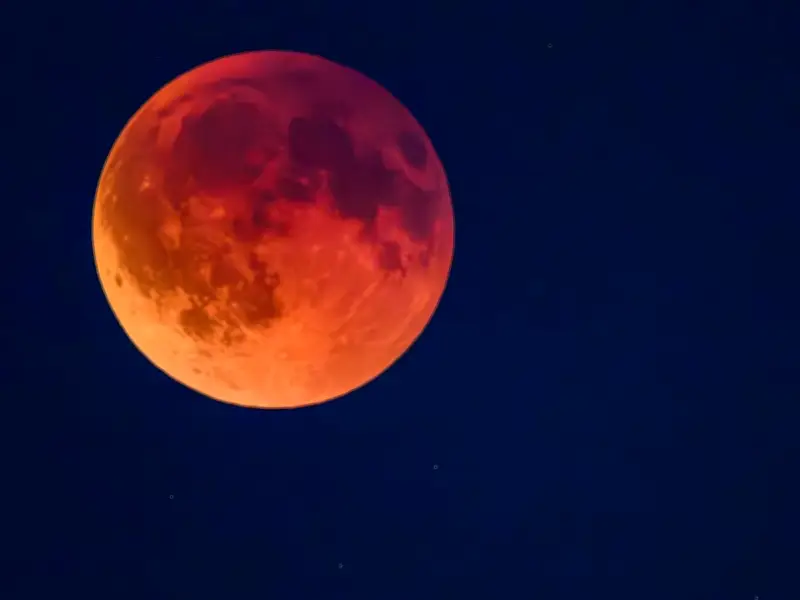
A partial lunar eclipse will be visible from the UK and Ireland in the early hours of Friday, August 28, with the Moon expected to glow a striking reddish colour. The celestial event follows a partial solar eclipse observed on August 12, capping an eventful month for astronomy enthusiasts.
Timing of the eclipse in Ireland and the UK
The eclipse will begin at 2.24am on Friday, August 28, as the Moon enters the outer region of Earth's shadow, known as the penumbra. During this initial phase, the change will be subtle, as the outer edge of the penumbral shadow is faint and the Moon may appear largely unchanged at first.
As the Moon moves deeper into the shadow, a more noticeable darkening should gradually appear across part of its surface. The most striking phase starts at 3.34am, when the Moon slips into Earth's inner shadow, the umbra, and can begin to take on a reddish or coppery hue. The eclipse will peak at 5.13am, when about 93% of the Moon's diameter will be covered by Earth's umbral shadow.

For observers in Ireland, the Moon will be low in the west-southwestern sky as dawn approaches, and is expected to set roughly an hour after the peak, before the partial phase has fully ended.
Why is it called a Blood Moon?
Lunar eclipses occur when the Sun, Earth and Moon align so that Earth blocks direct sunlight from reaching the lunar surface. However, some sunlight passes through Earth's atmosphere and is refracted toward the Moon. The atmosphere scatters much of the blue light, allowing more red and orange wavelengths to pass through, which can give the Moon a rusty red, orange or copper appearance — hence the name "Blood Moon".
The exact colour and brightness can vary depending on conditions in Earth's atmosphere, including the amount of dust and other particles present. During this eclipse, the Moon will travel through both the penumbra, where only part of the Sun's light is blocked, and the darker umbra, where Earth completely blocks the Sun as seen from the Moon.
How to observe the lunar eclipse
Unlike a solar eclipse, a lunar eclipse is safe to view with the naked eye, with no need for special eclipse glasses. Stargazers simply need to look at the Moon, weather permitting. Binoculars or a small telescope may offer a more detailed view of the shifting colours and shadow, but neither is required.
The best chance to see the eclipse depends on clear skies and an unobstructed view toward the west-southwest, as the Moon will sit progressively lower on the horizon in the hours before sunrise. This event follows a month that included a total solar eclipse over parts of Spain on August 12, with observers in Ireland and other parts of Europe seeing a partial solar eclipse. That solar eclipse also coincided with the peak of the Perseid meteor shower, making August a remarkable month for skywatchers, and it is set to conclude with this final display as the Moon enters Earth's shadow on Friday morning.