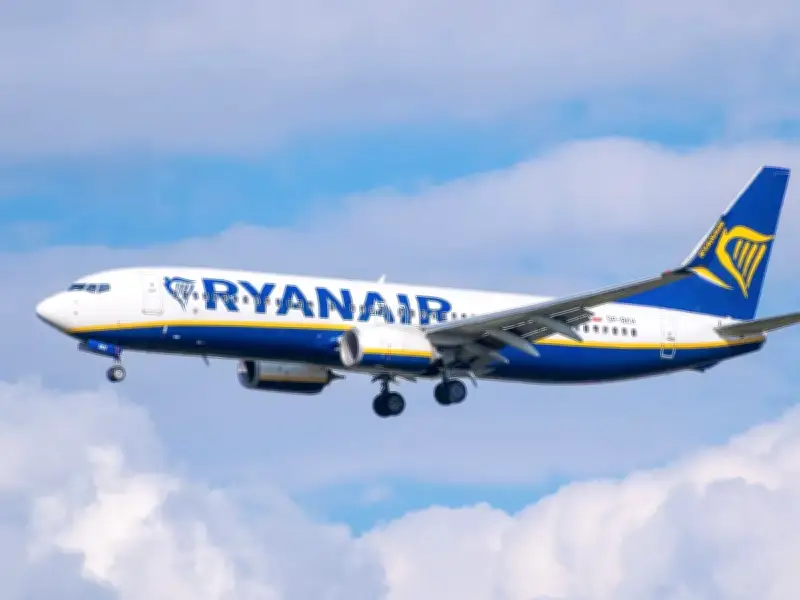
A Ryanair flight bound for Dublin turned back to Porto after the pilot reportedly transmitted a squawk code signalling a possible hijacking or cockpit intrusion. The incident occurred on flight FR7073, which took off from Porto Airport at 10.25pm on Tuesday.
A 48-year-old woman is said to have handed a flight attendant several "sheets of paper" shortly after take-off. She reportedly claimed she was being followed by three people and asked the flight attendant to pass the papers detailing her claim to the pilot. The woman was removed from the Boeing 737 after it landed back at Porto and was identified by local authorities.
False security report
A Ryanair spokesperson told the Mirror that the flight returned to Porto shortly after take-off "due to a false security report". They said this was "quickly resolved" and the flight left again for Dublin. The plane departed again shortly before 1.30am on Wednesday and arrived in the Irish capital at around 3.15am, about two and a half hours later than scheduled.
Portuguese newspaper Correio da Manha reported that the woman returned to the plane after being identified by authorities, "without police verifying her allegations". However, other Portuguese news outlets reported that the passenger caused the plane to turn back after displaying "disorderly behaviour", and claimed she was escorted from the airport by police.
Pilot's squawk code
Those outlets also claimed that the pilot transmitted squawk code 7500 before turning the plane around. The code is used to discreetly signal unlawful interference, such as a hijacking or cockpit intrusion. Former TAP Air Portugal pilot and aviation author Jose Correia Guedes appeared to corroborate those reports on Wednesday.
Referencing Flight Level 120, meaning an altitude of 12,000 feet, he wrote on X: "Upon passing FL120, the captain entered code 7500 into the transponder, signalling an attempted hijacking or intrusion into the cockpit."
"The crew requested radar vectors to return to the airport and asked for the authorities to be notified. With the assistance of Air Traffic Control, the B737 landed without problems at Porto near midnight, and the PSP police took charge of the incident."
"When code 7500 is entered into an aircraft's transponder, an alarm is automatically triggered on the air traffic controllers' panels. This is followed by a confirmation because sometimes the code is entered by mistake, after which notification is made to the authorities and emergency services."
"Then, air traffic control establishes a privileged communication with the crew and provides all possible support until the problem is resolved. So far, I haven't been able to confirm whether there was an attempted hijacking or if it was just a misbehaving passenger who caused this incident. In either case, the aforementioned passenger now has a big problem to deal with."
Portugal's civil police force could not be reached for comment early this morning.