A five-day walk along a section of France's newest long-distance hiking route, the GR736, through the Gorges du Tarn reveals a wealth of wildlife, medieval villages, and architectural curiosities. The 300km route officially opened in 2023 and runs from the Tarn's source in the Cévennes national park to the city of Albi. Three days of the route pass directly through the Gorges du Tarn, Europe's longest and most dramatic canyon, a 33-mile (53km) limestone gully with rock formations and towering cliffs often rising 500 metres above the river.
Wildlife Encounters Along the Tarn
While sipping chestnut kir on a terrace overlooking the Tarn River, a beaver the length of a leg was seen swimming upstream. The Tarn is so clean that almost every fish, frog, pebble and ribbon of weed can be seen with the naked eye. The river is home to trout, perch, carp, otters, frogs, toads, kingfishers and herons. Above, huge vultures drift all day, cruising the thermals in groups of nine or ten. The area is also an orchid hotspot, with 30 varieties recorded, including monkey, bee, military, butterfly, pyramidal and fragrant orchids. The gorge is home to more than 3,000 vultures, as well as cuckoos, nightingales, red-billed choughs and owls.
Starting the Walk: Le Pont-de-Montvert
The walk begins in Le Pont-de-Montvert, a bustling historic town amid the expansive heathery uplands of Mont Lozère, from where the Tarn springs. For two days, hikers traverse an unpeopled, wind-blown wilderness of menhirs, boulders, broom and heather, before descending to wildflower meadows and forests of beech and pine. They walk about 10 to 15 miles a day, unimpeded by bulky backpacks as luggage is transported in a minivan that arrives promptly at 9am every morning.
Human-Made Curiosities in the Gorge
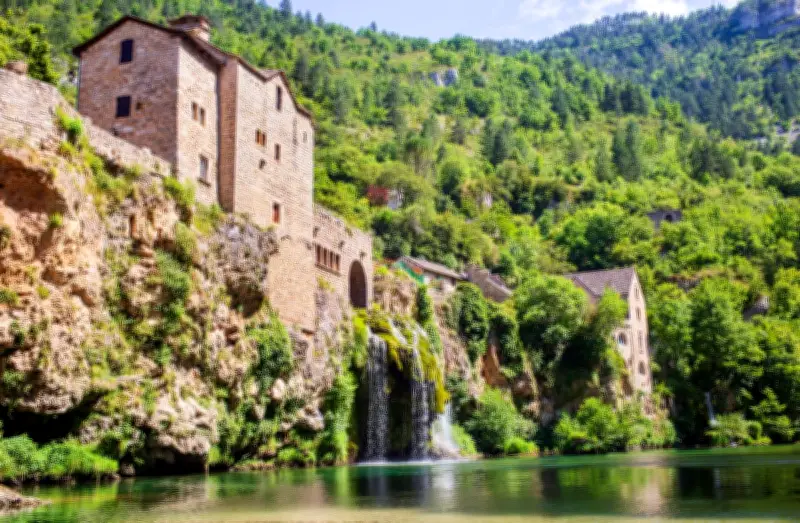
On day three, hikers encounter a myriad of human-made curiosities. The first is Castelbouc, a semi-troglodytic hamlet of narrow, cobbled streets, watched over by the remnants of a castle balanced on a vertiginous spur. From there, they briefly cross the gorge to Sainte-Enimie, one of France's celebrated 'plus beaux villages', with steep cobbled streets lined with honey-coloured houses hung with pink roses. Then it's back to the left bank with its single-file footpath and cooling canopy of chestnut trees. They stop for the night in the restored village of Saint-Chély-du-Tarn, which has an original village bread oven, waterwheel, 12th-century church and miniature chapel carved into the rock. Dinner at Auberge de la Cascade features Tarn-caught trout and ice-cream made from the local châtaigne, a small sweet chestnut used in the region's aperitif, kir à la châtaigne.
Jurassic Landscapes and Abandoned Villages
The following day's gorge walk feels weirdly Jurassic, thanks to sulphurous-yellow rocks, thickly mossed tree trunks and enormous ferns. At the hamlet of Hauterives, a rigged cable-and-basket for hoisting goods over the river suggests someone lives in this isolated spot. A couple of miles of ascending and descending brings hikers to the waterside town of La Malène, where a professional batelier (boatman) named Clément punts them four miles downriver, pointing out beaver families that inhabit every half-mile of riverbank, and four varieties of resident vulture (griffon, black, bearded and Egyptian), whose young fledge throughout the summer.
Clément puts them ashore at Cirque des Baumes, where they scramble up the almost sheer bank using a series of ropes. Here, they encounter another hauntingly abandoned village where miniature houses perch precariously on limestone plinths. Signs of life (washing on a line) suggest someone also lives in this ghost village without electricity, gas or mains water.
Final Stretch: Les Vignes to Peyreleau
They stroll on, past miles of neglected retaining walls which once held terraced orchards of cherry and chestnut trees; now the place is home to deer, boar, pine martens and muskrats. After a cooling dip in the river, they walk to Les Vignes and their charming hotel, Le Parisien, with pink-and-white striped walls, vintage framed photographs, and antique brass beds. The chef, Amélie, says she hopes the new GR736 will bring more people to the area, providing new life for these dying villages.
On the final day, the gorge slowly unfolds and flattens, opening out into a verdant valley of twisted triffid-like trees draped in luxurious moss, and glistening banks of black volcanic stone spill across the path. They follow the river to its confluence with the Jonte and spend their last evening in Peyreleau, a designated 'une petite cité de caractère', strolling ancient cobbled streets and exploring medieval churches and towers with far-flung views. From the terrace of Hôtel Doussière, they watch swallows and swifts skimming the river below, and agree that Robert Louis Stevenson was right when he wrote: 'If the garden of Eden exists, it's in the valley of the Tarn …'