Bavaria's autumn road trip offers vibrant foliage, Oktoberfest, and 900-year-old harvest festivals, with highlights from Würzburg to Passau. The state, Germany's largest, is at its most beautiful in autumn, according to a travel writer who recently explored the region.
A Franconian welcome
Bavaria covers approximately 27,240 square miles and has a population of around 13.2 million. Around 4.5 million live in Franconia, a cultural and historical region in the northern part of the state, defined by wine-making traditions, medieval history, and fairytale architecture. People here identify as Franconian rather than Bavarian because the region was added to the Kingdom of Bavaria in 1815 after the Napoleonic Wars.
After landing in Nuremberg and taking a one-hour Deutsche Bahn ICE train, the writer arrived in Würzburg in Lower Franconia. It's beautiful, but steeped in dark history: In March 1945, a British air raid destroyed roughly 90% of the city. Today, must-sees include the Würzburger Residenz, a UNESCO World Heritage Site Baroque palace, and the 13th-century Marienberg Fortress, perched on a vineyard above the Old Main Bridge on the River Main.
A city in the shadows
One of the best things about road trips is detours. This was how the writer stumbled across Forchheim in Upper Franconia, a true hidden gem overshadowed by its famous neighbour, Bamberg. With half-timbered houses — some dating back to the 1300s — cobbled streets, and forested hillsides, it's considered the Gateway to Franconian Switzerland.
Beer is big business here. After a tour of the town, where the writer was told Upper Franconia has the highest concentration of breweries in the world, she headed out on the apt 'Walk of Beer.' It passes the town's remaining four breweries and ends at the Kellerwald, a woodland area with a network of beer gardens where she enjoyed a Seidla (a Franconian term for a half-litre mug of beer).
Just 20 minutes down the road in Bamberg, the writer managed to catch Sandkerwa, the town's largest and most popular traditional folk festival, held annually over five days in August in the historic UNESCO-listed Old Town. The fest has come a long way since its 14th-century origins, which celebrated the founding of the local St. Elisabeth Church.
A UNESCO World Heritage City
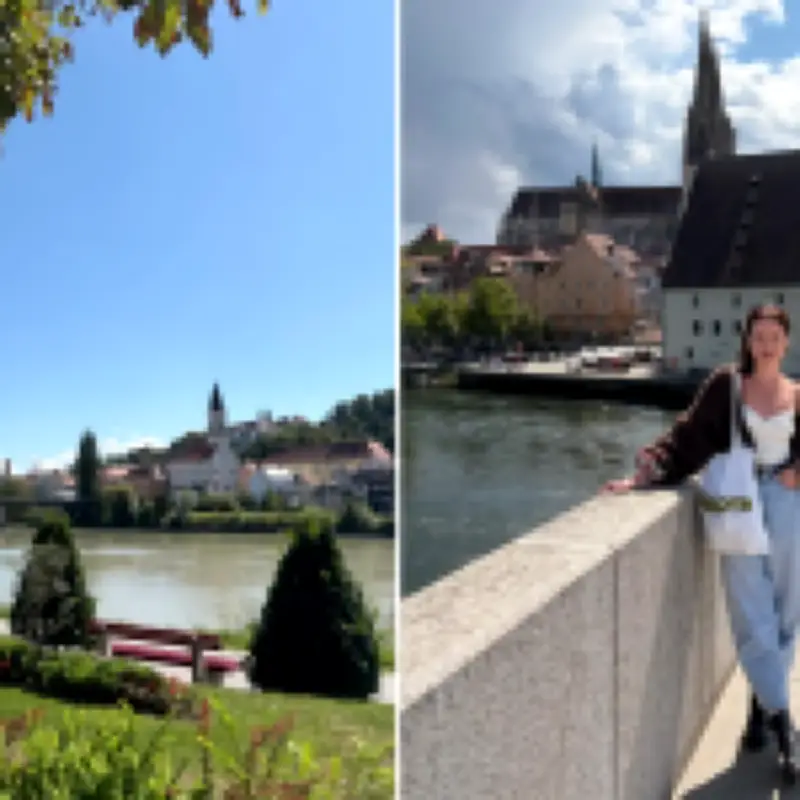
Few cities worldwide can boast two UNESCO World Heritage titles, but Regensburg belongs to this exclusive club. Located in eastern Bavaria, the city sits on the pretty Danube River and is thought to have one of the best-preserved medieval Old Towns north of the Alps. It was awarded its first World Heritage title in 2006 for Regensburg's Old Town. The second is for the Roman Danube Limes, remnants of ancient Roman fortifications, watchtowers, and military infrastructure from the Roman Empire.
The writer arrived on Saturday morning in late August (but it's just as beautiful in autumn). A day well spent in Regensburg goes something like this: grab a cappuccino at Cafe Prinzess, Germany's first coffee house that opened in 1686. If you're still hungry, grab a bite at Wurstkuchl, the historic cafe below the 12th-century Old Stone Bridge, which serves up grilled sausages and sauerkraut with Regensburg sweet mustard. From there, you can take a sightseeing cruise aboard the Regensburg Crystal Fleet to the Walhalla Memorial, one of Germany's most important national monuments, which houses marble busts and plaques honouring famous Germanic artists, scientists, and leaders like Goethe, Mozart, and Beethoven.
A city on three rivers
Passau, a city on the Austrian border, completed the trip through Bavaria. It's known as the 'City of Three Rivers', where the Danube, Inn, and Ilz rivers meet. On the Three-River city boat tour, you can see where the rivers connect, as the water changes colour.
Back on land, Passau's architecture has a Mediterranean Baroque flair. Ornate pastel buildings stand side-by-side, while in Residenzplatz, the intricate Wittelsbach Fountain stands proudly in the main square. The fountain was built in 1903 to mark 100 years of Passau being part of Bavaria. Hikers and history lovers can climb the hundreds of steps up to the Veste Oberhaus, a vast fortress founded in 1219, and one of the largest and best-preserved castle complexes in Europe. But perhaps the jewel in Passau's crown is St. Stephen's Cathedral, a Baroque church with white towers and blue-green domes, the most beautiful ceiling frescoes and large windows that flood the interior with natural light. If you can, catch an organ concert here on the largest cathedral organ in the world.
Though short and sweet, the writer's Bavarian road trip exceeded any expectations she had. From breathtaking scenery, moreish food, and impeccably preserved culture, it's a region that should be on everyone's bucket list.