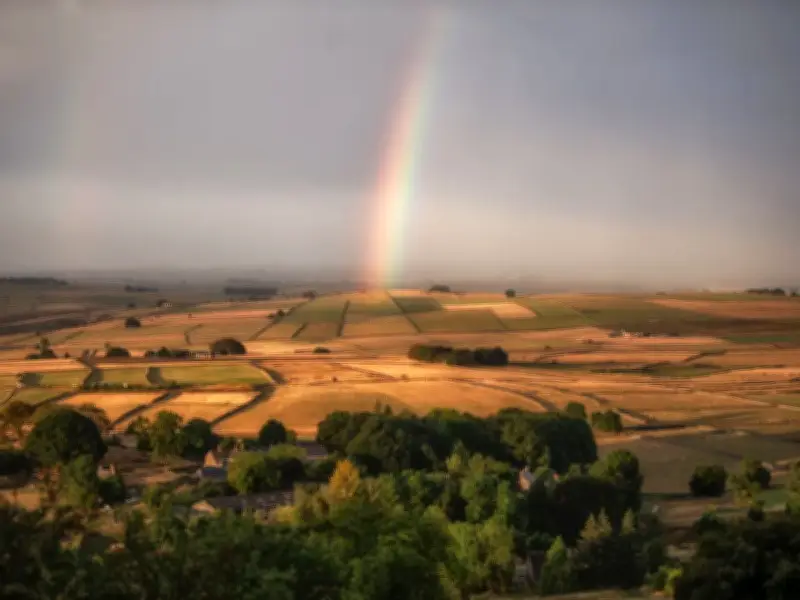
Rain is finally forecast across parts of the UK this week after a long, arid summer, bringing relief to drought-stricken lawns and gardens. However, weather apps often show a percentage chance of rain rather than a simple yes or no, and sometimes the forecast can be inaccurate for a specific area.
How to tell when it’s going to rain
Grahame Madge, a spokesperson for the Met Office, said he would love for the public to understand more about how meteorologists get from their complex range of data points to the little emoji that shows up on the app to tell you if it's going to rain.
He said: “We're not expecting people to become meteorologists overnight, but if the next day's symbol for the weather shows rain and you want the day out, just look below that and look at the hourly rainfall, because that will give you a good idea if there's a good usable part of the day.

“If it's only light rain, does that stop you? Could you be weather ready and take an umbrella or raincoat for the children and wellies?
“Let's not let the weather be a block just because you see a rain symbol, it doesn't mean to say that you're gonna get rain at the particular time that you want to go out.”
How do meteorologists calculate the forecast?
Madge said that the percentage figure is the result of a lot of complex calculations. He explained: “We will get billions of weather observations coming in from weather stations, from satellites, from ships, from ocean buoys, from aircraft, and what that does is that gives you a snapshot of the atmosphere and the ocean at a particular point in time.
“Then what our very hugely sophisticated computer models will do is they will actually take a snapshot of the atmosphere and ocean as it is at a precise moment in time.”
From there, they create what’s known as an ensemble forecast. He explained: “Ensemble forecasting, basically it's like running several weather forecasts with slightly different starting positions, and if 70% of those forecasts show rain, then that is where the 70% chance of rain will come from.
“Some people think it's by area or some other metric, but actually if you run a forecast 10 times, and seven of those runs show rain, then that is where the 70% rainfall comes from.”
How accurate is the prediction?
Madge said: “You'll notice on the app that we only go down to around 5% or up to 95% because calling 100% in meteorology is not technically possible, because you can always get something that's just outside of the forecast.”
According to Madge, the models are so sophisticated that the resolution goes down to 2.2 kilometres. He said: “So if you imagine the UK covered in a grid of 2.2 kilometre squares, that's the resolution to which we are monitoring. There's a lot of talk in the industry about whether we can get to.”
The current goal is to get it down to a kilometre resolution.