Stargazers across the UK and Ireland are set to witness a partial lunar eclipse this week, with the Moon expected to take on a striking reddish hue during the early hours of Friday morning. The event follows just over a fortnight after a partial solar eclipse was visible on August 12, capping off an active month for astronomy enthusiasts.
When and where to see the eclipse
The partial lunar eclipse will occur overnight on Thursday, August 27, extending into the small hours of Friday, August 28, and will be observable throughout the UK, Europe, Africa, North and South America. While the timing is not particularly favourable for Irish watchers, as the Moon will be descending towards the horizon as the eclipse reaches its maximum, those with unobstructed skies may still see a remarkable celestial spectacle.
The eclipse will commence at 2.24am on Friday, August 28, when the Moon passes into the outer portion of Earth's shadow, known as the penumbra. At this point, the change is likely to be challenging to detect, as the outer boundary of the penumbral shadow is comparatively subtle, and the Moon may at first seem largely unaltered. As the Moon progresses further into the shadow, a more discernible dimming should gradually emerge across one portion of its surface.

The peak of the eclipse
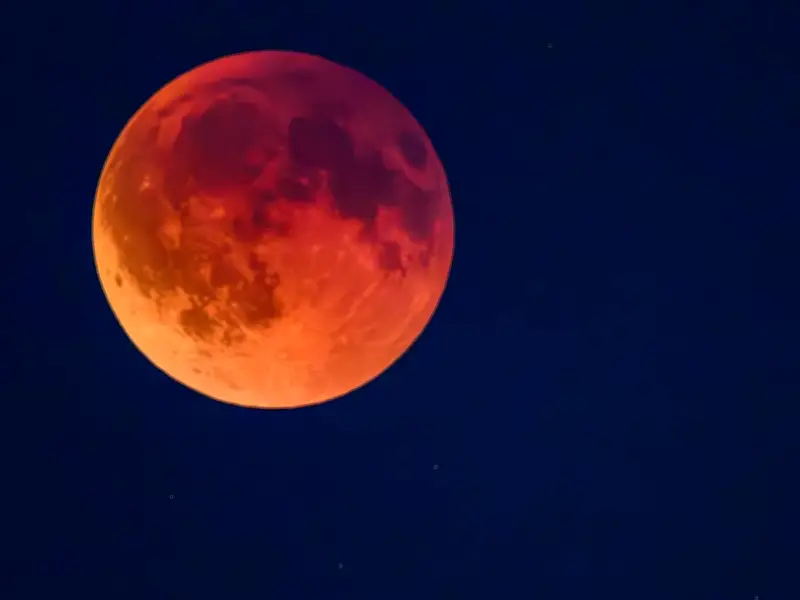
The most striking phase begins at 3.34am, when the Moon passes into Earth's darker central shadow, termed the umbra. During this phase, the Moon can start to adopt its characteristic reddish or coppery colouration. The eclipse will reach its peak at 5.13am, when approximately 93% of the Moon's diameter will be obscured by Earth's umbral shadow.
For observers in Ireland, the Moon will be positioned low in the west-southwestern sky as dawn begins to illuminate the horizon. The Moon is anticipated to set roughly an hour afterwards, before the partial phase of the eclipse has fully concluded.
Why is it called a Blood Moon?
Lunar eclipses occur when the Sun, Earth and Moon align in such a way that the Earth prevents sunlight from directly illuminating the lunar surface. However, the Moon does not simply vanish into darkness. Some sunlight travels through Earth's atmosphere and is bent, or refracted, towards the Moon. The atmosphere disperses much of the blue light, while more of the red and orange wavelengths penetrate through. This filtered light can lend the Moon a rusty red, orange or copper-coloured hue, resulting in the popular nickname "Blood Moon".
The precise colour and luminosity can differ depending on atmospheric conditions on Earth, including the volume of dust and other particles in the air. During this week's eclipse, the Moon will traverse both the penumbra, where only a portion of the Sun's light is blocked, and the darker umbra, where the Earth entirely blocks the Sun as viewed from the Moon.
How to watch the lunar eclipse
Unlike a solar eclipse, a lunar eclipse is entirely safe to observe with the naked eye. Special eclipse glasses are not required, so stargazers only need to glance towards the Moon, provided the weather cooperates. Binoculars or a compact telescope might provide a more detailed view of the shifting hues and shadow traversing the lunar surface, though neither is necessary.
Your best opportunity to witness the eclipse will depend on cloudless conditions and an unhindered view towards the west-southwest, especially as the Moon will sit progressively lower on the horizon in the hours leading up to dawn. This celestial event follows what has already been a remarkable month for astronomy. On 12 August, a total solar eclipse swept across portions of Spain, while observers in Ireland and other European locations witnessed a partial solar eclipse. The solar eclipse also aligned with the peak of the Perseid meteor shower, rendering August an exceptionally memorable month for those gazing at the night sky. Now, the month is poised to conclude with one final spectacular display, as the Moon passes into Earth's shadow during the early hours of Friday morning.