US Spring Weather Delayed by Polar Vortex Split, Experts Warn
With spring officially set to begin on March 20, Americans are being cautioned not to pack away their winter wardrobes just yet. Climatologist Judah Cohen has issued a stark warning that warmer weather may take longer to arrive this year, following a brutal winter season that saw record snowfalls and frigid temperatures across the Northeast.
Polar Vortex Split to Impact Seasonal Transition
Cohen explained to the Daily Mail that a significant meteorological event is unfolding. 'Something different is happening,' he said. 'There's gonna be a polar vortex split. One piece is going to go to Asia, another piece is going to come to North America. Usually the impacts from that are delayed quite a bit.'
Initially, this split could bring warmer temperatures to the Eastern United States, providing some relief after a harsh winter. However, Cohen warns that as late March and April approach, temperatures may dip again. 'It could kind of delay real, true spring,' he noted. 'I think that's something that could be a big factor and needs to be watched.'

Recent Weather Events and Historical Patterns
This scenario mirrors last year's phenomenon, often called Fool's Spring or False Spring, which left many Americans complaining about a cold start to the season. The warning comes on the heels of a devastating 'snow hurricane' that battered the East Coast last weekend, resulting in two fatalities, 11,000 canceled flights, and 500,000 power outages. New York City alone received over 20 inches of snow.
Despite this slow start, both The Farmer's Almanac and the National Oceanic and Atmospheric Administration (NOAA) predict a warmer-than-average spring for much of the United States once true spring conditions establish themselves.
Regional Forecast Variations Across the US
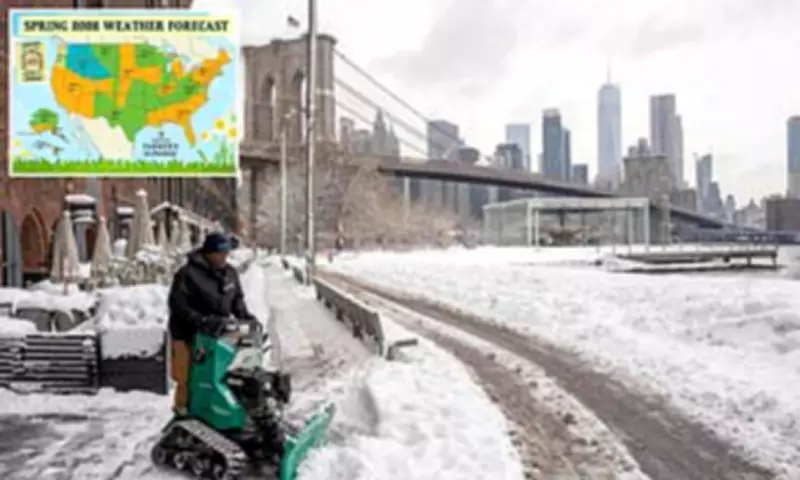
The Farmer's Almanac provides detailed regional predictions:
- The Northeast and Atlantic Corridor are expected to see temperatures three degrees above average with lower precipitation in April and May.
- The Southeast, Florida, and Lower Lakes regions will experience warmer weather and below-normal rainfall.
- The Ohio Valley shows a split, with eastern areas seeing normal precipitation and western areas likely below normal.
- The Deep South could see temperatures four degrees higher than normal.
- The Texas-Oklahoma border may experience slightly colder temperatures, about two degrees below normal, with potential tropical storm activity in late May.
- The Pacific Northwest will see colder temperatures and drier weather, while the Pacific Southwest gets above-average temperatures and rainfall.
NOAA's predictions align closely, forecasting above-average temperatures for the South and much of the West, with below-average temperatures in northern parts of North Dakota, Wisconsin, and Minnesota. Precipitation is expected to be above average in the Midwest and below average in lower western and southern regions.
Implications for Gardeners and Summer Outlook
Gardeners must remain vigilant with these fluctuating conditions. Those in colder areas should delay planting to avoid stressing crops, potentially facing slower growth periods. Conversely, warmer regions might see early growth spurts, though drier areas could struggle with establishing strong root systems.
Looking ahead to summer, Cohen expresses concern for residents in the Northeast and Great Lakes regions. 'Spring is going to be kind of frustratingly slow to develop across the Great Lakes and Northeast,' he said. 'People are going to say: "Oh, it's the Spring Equinox, we should be out in shorts and T-shirts." I'm not sure that's going to be the case.'
However, once summer arrives, Cohen predicts it will be hot and humid across most areas. 'I pretty much would predict a warm summer everywhere,' he stated. 'It's hard not to just get a hot, humid summer.' This follows last summer's pattern of cooler weather in the Eastern US and hotter conditions in the West.

Americans are advised to monitor weather updates closely as this unusual polar vortex split unfolds, potentially delaying the full arrival of spring while setting the stage for a warmer season ahead.