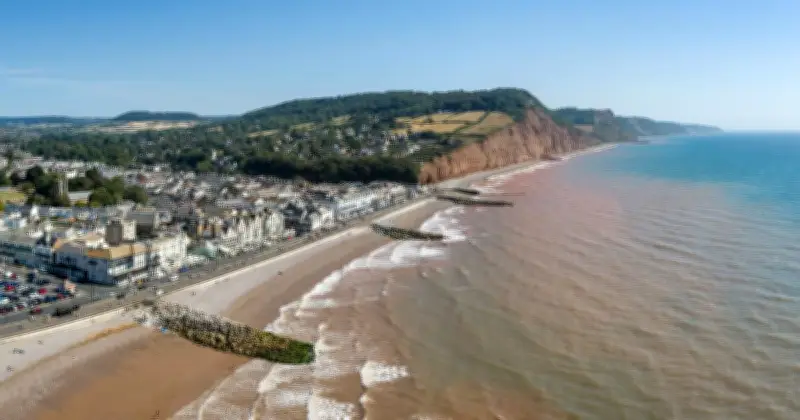
Sidmouth in East Devon is facing severe coastal erosion and rising sea levels, prompting a £21 million coastal defence scheme to protect the town for the next 100 years. The project includes offshore breakwaters, beach improvements, sea wall repairs and flood protection measures designed to defend the coastline from erosion, flooding and rising sea levels.
Residents on Cliff Road above East Beach have already watched chunks of their gardens disappear into the sea as the cliffs steadily retreat. Resident Paul Griew said his garden is disappearing at a rate of almost 3.3ft a year, adding that the rate of erosion at his clifftop property had sped up “10 times [the amount]” since he purchased it around 30 years prior.
Cliffs 'collapsing' above East Beach
Chris Lockyear, a Sidmouth Town Councillor and vice-chair, who is also a member of East Devon District Council's Project Board for the Sidmouth and East Beach Coastal Defence Scheme, said the threat is already visible. He explained that local residents can see the cliffs retreating and are therefore much more conscious of erosion, whereas flooding remains a more distant concern because the town is not currently experiencing major coastal flooding.
Cllr Lockyear said Sidmouth's cliffs are "collapsing," with around four metres potentially lost over roughly the past 15 years. He said: "The people who live on Cliff Road are worried, because they're seeing their gardens disappear daily. There's a big concern about the risk of people losing their gardens and their houses - that's a very active concern."
Cllr Lockyear recalled how a Cliff Road resident's garden shed became a famous example of the erosion. As the cliff edge crept closer to the shed, its owner jokingly put up a “for sale” sign. A few months later, the shed fell into the sea.
Design work and construction timeline
Providing an update on the scheme, Cllr Lockyear told the Express: "Design contractors are working on the final design. Atkins Realis are the appointed contractors and they're working with Boskalis Westminster. At this stage, they're looking at the detailed design."
Engineers are examining whether two or three more offshore breakwaters should be added, and are modelling different designs to determine where they should go, how large they should be and how they should be positioned to best help protect the coastline. The detailed design and modelling work is expected to continue until summer 2027, before the scheme is taken through the necessary planning and consenting process.
The scheme is being led by East Devon District Council, with Boskalis Westminster appointed in July 2026 to progress the project through its first stage. The council is also working with the Environment Agency. Cllr Lockyear said construction is planned for 2028.
Planned measures and sea level rise
The planned scheme includes new offshore breakwaters, beach recharge on Town Beach and East Beach, a new 120-metre groyne to the east of East Beach, improved flood gates on the Esplanade and a new access ramp. There are also plans to improve the River Sid wall and replace or strengthen the foundations of the existing splash wall.
The splash wall has previously been one of the most controversial aspects, with concerns from local residents that a much higher concrete wall could cut the town off from its seafront and prevent people from seeing the sea. The current proposal is instead to replace the existing wall at roughly the same height, while strengthening its foundations so it could potentially be raised in the future when necessary.
Cllr Lockyear said it is estimated that sea levels could rise by around 0.8 to 0.9 metres over the next 100 years. The scheme will not prevent the natural processes of coastal erosion altogether, but is intended to slow them significantly and protect the town and its coastline over the long term.
Climate talks and town's appeal
Climate change, its impact on Sidmouth and the Southwest, and some possible responses will also be explored in a series of talks at this year’s Sidmouth Science Festival, running from 9 to 18 October. Four talks will look at different aspects of the changing climate, from the historical climate of Sidmouth and possible future changes to the challenges facing the town’s coastline and the potential of floating offshore wind as a source of renewable energy.
Sidmouth is a gateway to the Jurassic Coast World Heritage Site, and a large part of the town has been designated a conservation area. Last year, the seaside town claimed third place in the Which? top-10 UK seaside destinations for 2025. It was also named again as one of the best seaside towns in the UK this year, earning a 75% destination score, with 4/5 scores for its beach, seafront/pier, scenery and shopping.
Ian Gregory, chairman of the Sidmouth Chamber of Commerce, said the chamber represents more than 70 independent shops in the town, though he added that the vast majority of Sidmouth’s high street is made up of independent retailers, with only a small number of chains. He previously told the Express: “We’re bucking the trend here. We don’t really have any empty shops.”