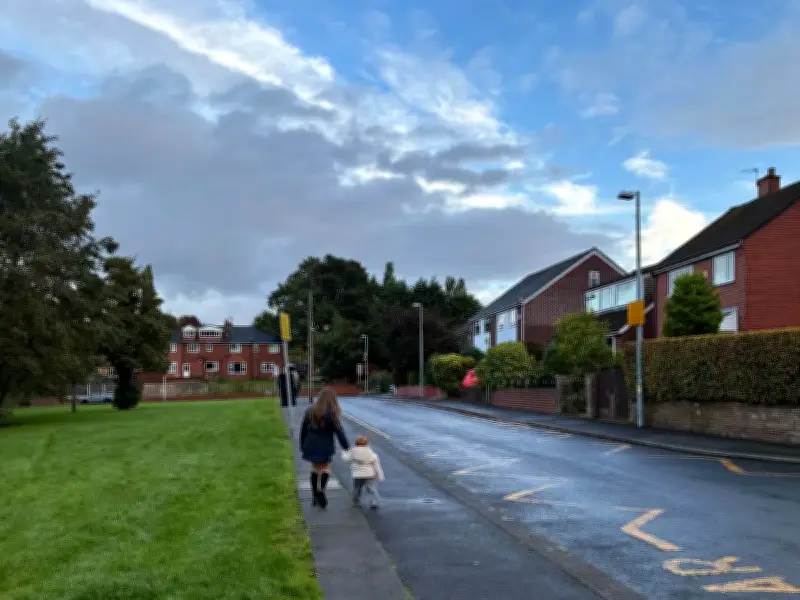
The road outside Peel Hall Primary School in Little Hulton has been transformed after a 'school street' scheme banned cars during drop-off and pick-up times, ending what one parent described as a 'dangerous nightmare' at the school gates.
Up until recently, parents faced chaos almost every day when collecting their children at the primary school on Greencourt Drive. Kids were yanked out of the way of reversing vehicles, cars mounted curbs on both sides of the road, stressed parents struggled to find parking, and horns beeped constantly.
“It was very, very dangerous,” said Farah Furnivan, a local mum, whose five kids have all attended Peel Hall, with her youngest, Adonis, currently in year three. “In defence of the parents, because everyone was so used to it, they didn’t really see or feel the danger. It’s only now when we look back we realise just how horrendous it was.”
Headteacher saw 'nightmare' at school gates
Most parents of the school 'wouldn't think' to walk or cycle to school with their kids, as it simply seemed too risky. Headteacher Mr Lawler-Smith added: “As soon as I became the head, I could see how busy it was down here, and quite dangerous. You had people coming late, driving too fast, people reversing around the corner and not looking if children were passing, it was just a nightmare really. We knew something had to change straight away, so we started working with the local authority.”
In February, the road outside the primary was turned into a 'school street', a Transport for Greater Manchester (TfGM) scheme that bans cars from the road during school drop-off and pick-up times. Greencourt Drive is guarded by an automatic number plate recognition (ANPR) camera, and parents are sent warning letters, then fines, if they don't stick to the new rules. The school is one of fifty-one across Greater Manchester to have received a school street.
Parents 'a lot more relaxed' after change
“Generally, people have taken it well,” said Farah. “I would never have let Adonis off my hand before now, but because I know it's safe, he can run ahead to meet his friends. The parents are a lot more relaxed too. And I don't think anyone's been fined yet.
“We all do groan and moan sometimes, because it does cause more of a traffic build-up on the main road – because sometimes you can't help but drive, if you've got to head straight to work afterwards. But there's no alternative, it's so much better than it was.”
TfGM forging ahead with expansion plans
School streets have not been adopted as smoothly everywhere. Earlier this year, residents on the streets around Tyntesfield Primary School complained 'inconsiderate parking and unsafe driving' had simply been pushed into their driveways, instead of the school gates. A school street was adopted on Alma Road after three kids were hit by cars outside the school. The school street resulted in the number of youngsters walking jumping from 34 to 81 per cent, according to the council. But the solution also left residents on Ainsdale Drive, Mayfair Drive and Birkdale Drive feeling 'fobbed off'.
But TfGM is forging ahead with plans to hit 100 school streets by 2028, adding a further 49 in areas where they're 'most-needed'. While the streets are being 'evaluated', most have seen a significant increase in the number of kids choosing active or public travel over drop-offs by car.
Greater Manchester's Active Travel Commissioner Dame Sarah Storey, who visited the school on Wednesday, October 7, to mark the halfway milestone of the 100 school streets, said: “Largely, parents tell us that these schemes are needed because it just doesn't feel safe outside of school. Currently, there's a bit of a postcode lottery when it comes to how safe the school run is across Greater Manchester. We want to make sure there's more of a consistent approach across schools in the region.
“If vehicles are removed and it does feel safe, people feel more confident walking or cycling to school, and it also makes it safer for those who don't have a choice but to walk.”
City Mayor Paul Dennett, who also attended the event, added he is particularly keen to see more school streets added in Salford, which along with Rochdale (one), Tameside (two), and Bury (three), has the smallest number of school streets across the district.
Mayor Dennett said: “The idea is to roll a lot more of these out across Salford and make it a much more child-friendly city. After all, Salford was the Local Authority that first invented play streets, so this really resonates with our legacy.”