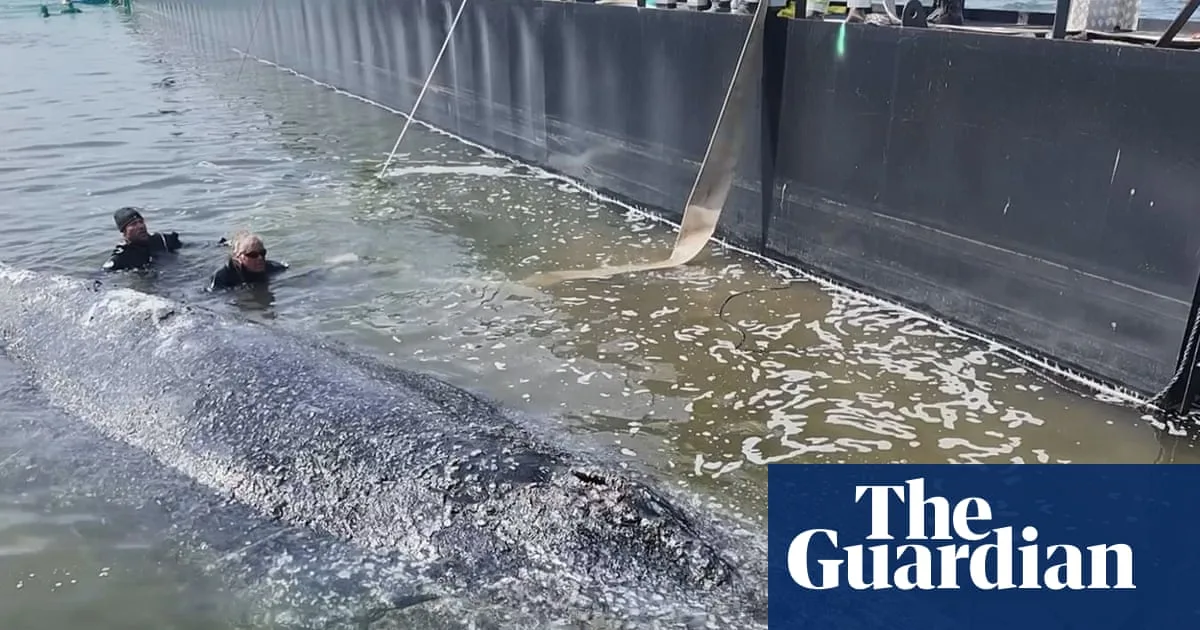
A deceased whale has been discovered off the coast of Denmark, sparking speculation that it could be Timmy, a humpback whale rescued earlier this month in a £1.3 million operation. Timmy, whose health had severely deteriorated after being stranded near Germany since March, was released on May 2 after being transported in a water-filled barge by rescuers.
However, just days after Timmy entered the North Sea off Denmark, and following a lack of tracking data, the German Oceanographic Museum determined he did not survive the transition to deep water. Now, the Danish Environmental Protection Agency has reported that a whale, likely dead for some time, was spotted off the island of Anholt.
A warden with the agency told Danish TV that the whale is probably a humpback, measuring 10 to 15 metres long. Locals have been warned not to approach the animal, as there is a risk it may explode due to the accumulation of gas inside the body. Dead whales can also carry diseases. Local news outlet Ekstra Bladet reported that tissue samples will be taken from the whale on Friday.
Controversial Rescue Mission
Scientists had disagreed with the mission to save Timmy, insisting he was unlikely to survive rescue attempts due to his health, and that the more ethical approach would be to let him die peacefully. Despite fierce warnings, a motley crew of veterinarians and rescuers, spurred on by national frenzy in Germany to save the whale, proceeded with the operation.
The rescue effort was privately funded by two millionaires: MediaMarkt co-founder Walter Gunz and horse racing entrepreneur Karin Walter-Mommert, who said they were prepared to pay 'whatever it costs' to release Timmy. The creature had been described as lethargic and covered in blister-like blemishes, with parts of his mouth believed to be caught in a fishing net.
Timeline of Events
Timmy first became stranded on a sandbank in Wismar Bay near the city of Lübeck nearly six weeks ago. As his health deteriorated, German authorities abandoned attempts to save the mammal, insisting he could not be freed. However, following a spike in national interest—with supporters baking whale-shaped cakes and getting tattoos of the mammal—officials were persuaded to approve the privately-funded operation.
Initial attempts to save Timmy, involving inflatable cushions and pontoons, were unsuccessful. Divers eventually managed to coax the whale onto a flooded barge, towed by the Fortuna B ship. The whale left the barge in the North Sea at around 8:45 a.m. local time on May 2 and was later observed blowing through its blowhole and swimming freely 'in the right direction,' according to Walter-Mommert.
Hope remained alive days later when the whale's GPS tracker apparently sent several signals in the morning, indicating that Timmy had surfaced to breathe. But experts now believe the GPS transmitter was faulty, lacking the necessary capabilities to detect signs of life, and Timmy's fate seems far less certain.
Criticism from Experts
Attempts to save the mammal had been criticised by the International Whaling Commission (IWC) as 'inadvisable,' with experts saying the creature 'appeared to be severely compromised' and was 'unlikely to survive' attempts to move it into deeper water. Continuing to try to save the creature amounted to 'pure animal cruelty,' according to Burkard Baschek, director of the Oceanographic Museum in Stralsund.
'A rescue attempt … is no longer worthwhile … this has been confirmed to us repeatedly by international colleagues,' he warned prior to the mission. Thilo Maack, a marine biologist at Greenpeace, said earlier this month: 'I believe the whale will die very soon now. And I would also like to raise the question: What is actually so bad about that? Yes, animals live, animals die. This animal is really, really, very, very, very sick. And it has decided to seek rest.'
The Danish environment ministry has told German TV broadcaster Deutsche Welle it was not planning to rescue Timmy if he becomes stranded again, describing whale beaching as a 'completely natural phenomenon.'