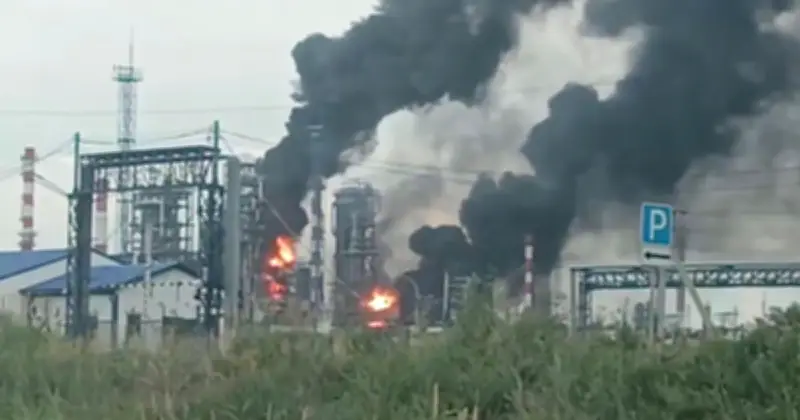
Ukrainian drones struck Russia's largest oil refinery in Omsk, Siberia, on Monday, July 6, 2026, marking one of the deepest attacks on Russian territory since the full-scale invasion began in 2022. The refinery, operated by Gazprom Neft and located about 1,550 miles (2,500 km) from the Ukrainian border, was shown in NASA satellite imagery and social media footage to be burning in multiple locations.
Attack Details
Ukraine's General Staff confirmed the strike in a Facebook statement: “An impact with subsequent fire was recorded on the territory [of the refinery]. The extent of the damage is being verified.” The statement also noted, “This is the last of the 11 largest gasoline producers in Russia that have been hit.” The attack marks the first time the Omsk region has been targeted by Ukrainian drones since the 2022 invasion.
Omsk region Governor Vitaly Khotsenko told The Moscow Times that “several drones” broke through layers of Russian air defense and struck the refinery, with emergency services dispatched to the scene. The refinery processed approximately 23 million metric tons (460,000 barrels) of oil daily last year, according to Reuters.
Deep Strikes Across Russia
Ukraine’s HUR military intelligence agency also reported a deep-strike operation on the Slavneft-Yanos refinery in the Yaroslavl region, about 435 miles (700 km) from the Ukrainian border. Ukraine’s General Staff documented “explosions and smoke” at that facility.
In northwestern Russia’s Leningrad region, Ukraine struck the Novatek natural gas producer’s Ust-Luga complex on the Baltic Sea and a deployment point of a Russian missile brigade. Ukrainian forces also attacked petroleum storage facilities in the port city of Kerch in occupied Crimea, a key transport corridor, and a drone warehouse in the occupied Luhansk region.
Impact on Russia's Energy Sector
These attacks are part of a sustained Ukrainian campaign to destroy Russia’s oil refining capacity, which funds the Kremlin’s war effort and powers its tanks and fighter jets. The strikes have knocked out roughly a third of Russia’s refining capacity, triggering a severe domestic energy crisis. More than half of Russia’s regions, including occupied Crimea, have imposed fuel rationing, leading to long queues at petrol stations, stranded transport vehicles, and a booming black market. Russia has been forced to ban gasoline exports and import fuel from neighboring countries to keep its domestic economy running.