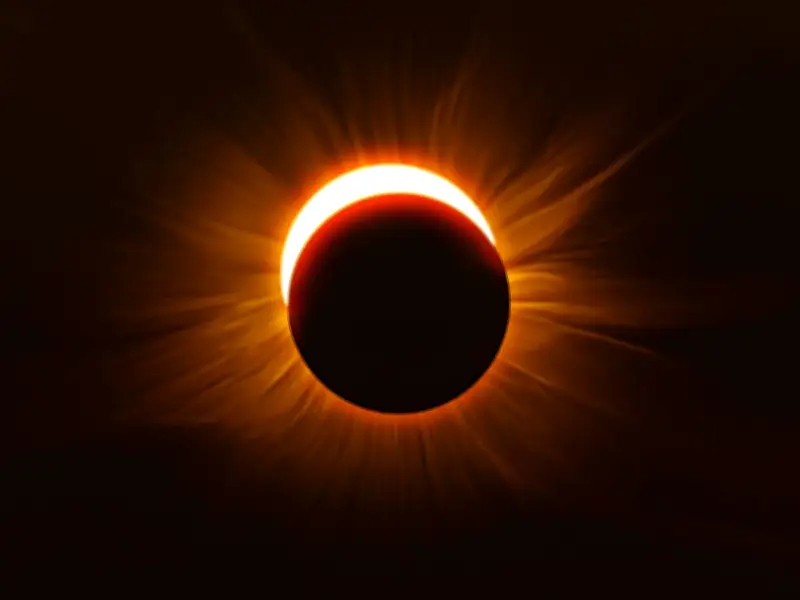
The UK is set to experience its first near-total solar eclipse in more than half a century tonight, as the Moon slides in front of the Sun, blocking out more than 90% of it in Britain and creating a crescent shape in the evening sky.
Exact timings depend on location, but the event begins shortly after 6pm, with the maximum eclipse occurring shortly after 7pm before the Sun gradually re-emerges. In London, the eclipse starts at 6.17pm, peaks at 7.13pm, and ends at 8.06pm.
Safety warnings: no sunglasses or phones
Experts have warned that looking directly at the Sun without proper protection can cause permanent eye damage, and ordinary sunglasses are not enough. Only special solar eclipse glasses that are ISO 12312-2 certified should be used. They also advise against using phones to view the eclipse, as this can damage both eyes and the device.
Kyla Black, director of optical practice for Boots Opticians, told Metro: "You should not watch the eclipse directly through your camera or phone camera due to the lenses not having specially designed solar filters. While it's tempting to look up and enjoy the moment, it's important to remember that viewing a solar eclipse incorrectly can cause serious and permanent damage to your eyes."
Pointing either the back or front-facing phone camera at the sun for an extended period can also damage the device.
Queues for glasses and DIY alternatives
Hundreds of people have queued for hours in a last-minute scramble for special eclipse glasses, with lines spotted in Weymouth, London, Wrexham, and Kent. One man, Tony Bhai, said he waited three hours to buy three pairs. A camera shop in Wales sold 500 pairs within hours; owner Joel Longbone of Cambrian Photography in Colwyn Bay told the BBC: "We could never have expected this in a month of Sundays."
For those without glasses, a pinhole viewer can be made at home using a cardboard box, kitchen foil, and scissors. A step-by-step guide has been shared by Twinkl Resources on TikTok.
Driving and health precautions
The RAC advised drivers to turn on headlights if their car doesn't have automatic lights, to boost visibility in twilight conditions. RAC head of policy Simon Williams said: "While total darkness is unlikely, those with vehicles that don't have automatic headlights or daylight running lights may need to switch on their dipped beams to ensure they are easily visible to other road users. The best advice to enjoy this rare event is to pull over somewhere safe and watch with specialist glasses."
Moorfields Eye Hospital listed potential symptoms after looking at the sun, including eye pain, redness, grittiness, blurred vision, distorted vision, new dark spots, and sudden changes in sight. Consultant ophthalmic surgeon Alex Ionides said: "If someone has looked at the sun and subsequently develops any of (these) symptoms, they should seek urgent medical attention."
Experts also warned against using old eclipse glasses from before 2015, as materials may have degraded. Jake Foster, astronomer at the Royal Observatory Greenwich, said: "Many solar eclipse glasses manufactured before 2015 were made from materials that degrade over time, compromising the safety of their use."
Power shortage and global visibility
The National Energy System Operator (Neso) issued an "electricity margin notice" for between 6pm and 8pm, expecting a shortfall of 1,200 megawatts. The alert urges other generators to activate additional capacity.
A partial eclipse will be visible from much of Europe, parts of Africa, North America, the Atlantic, Arctic, and Pacific Oceans. A total eclipse will sweep across parts of northern Spain, eastern Greenland, western Iceland, northern Russia, the Atlantic Ocean, and the north-east corner of Portugal.
The next total solar eclipse in the UK is not until September 2090, but Spain will see one on August 2, 2027, and an annular eclipse on January 26, 2028.