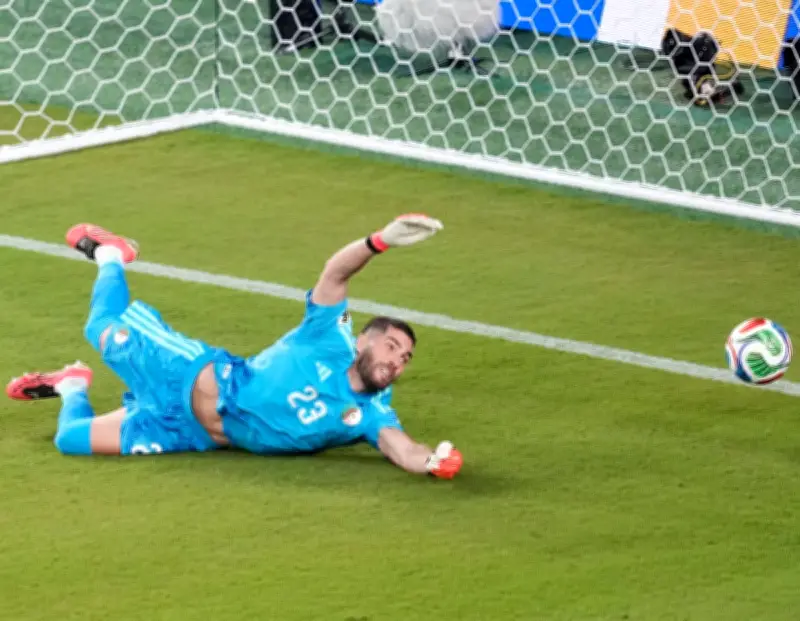
Algeria goalkeeper Luca Zidane has had a turbulent start to the 2026 World Cup, conceding five goals in two matches. Two of those—first from Lionel Messi, then from Jordan's Nizar al-Rashdan—slipped through his fingers, drawing attention to a potential issue with the tournament ball.
Zidane is not alone. Senegal's Édouard Mendy and Iraq's Ahmed Basil have also got hands to shots but failed to stop them. BBC pundit Joe Hart has repeatedly pointed out that goalkeepers are struggling to read the speed of the Adidas Trionda ball. "The ball is coming into the keepers a lot faster than it feels when it comes off the foot," Hart said. "Zidane is more than capable of saving that ball [from Messi]. When goalkeepers get up to speed with these World Cup balls we're going to see these shots saved."
Academic Study Confirms 'Drag Crisis'
Help for goalkeepers comes in the form of an 18-page paper by South Korean and Japanese academics, titled "Orientation-Dependent Drag Crisis and Flight Response of the Fifa World Cup Match Ball Trionda." Researchers from Seoul Women's University and the University of Tsukuba fired the ball through a wind tunnel from six angles and found a consistent outcome: regardless of where the ball was struck, if it reached a certain velocity, it would fly faster. This is due to an effect called "drag crisis," which occurs when airflow around the ball shifts from smooth (laminar) to turbulent, reducing drag and allowing the ball to move faster.
The researchers noted that the Trionda's "upstream seam and groove arrangements" make drag crisis possible at lower speeds. They also found that the level of crisis shifts depending on whether the ball is hit on a seam or panel (seam hits create lower drag) and varies with altitude—higher games see less drag crisis.
FIFA and Adidas Defend Ball Design
FIFA highlighted the ball's aerodynamic innovations at launch, including a four-panel construction—a first for the tournament. "The four-panel construction incorporates intentionally deep seams," FIFA said, "creating a surface that produces optimal in-flight stability by ensuring sufficient and evenly distributed drag as the ball travels through the air." Adidas stated the Trionda underwent more than 300 laboratory tests, with the design ensuring "a more predictable trajectory."
This recalls the 2010 Jabulani ball, which was smooth and criticized by goalkeepers like Iker Casillas ("horrible") and Gianluigi Buffon ("absolutely inadequate") for its erratic flight. The Trionda, with its seams, aims to avoid such issues, but the drag crisis effect may still catch keepers off guard.
The academic paper, freely available in the journal Fluids, may prove a useful distraction for goalkeepers during downtime.