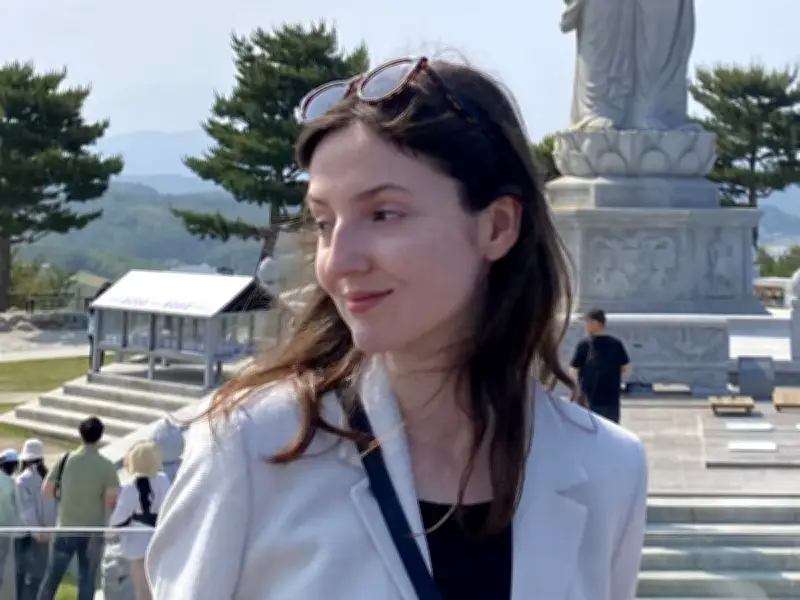
Robyn Mansir, 27, who previously struggled to save money while living in Manchester, now pays just £300 a month for accommodation and less than £50 a month on energy bills in South Korea. She moved from her one-bedroom flat in Ardwick to take up a teaching role in the country four years ago.
Ms Mansir, originally from Bristol, moved to Manchester for university and stayed after graduating. Despite having a steady job as a scientific research paper editor, she found it impossible to save due to high living costs.
Struggling to save in Manchester
She said: "I had a good job as a scientific research paper editor and lived in a neighbourhood I loved in Manchester, but I was always having to watch what I spent and couldn't save any money, like most 23-year-olds out of university. It was hard to see how my financial outlook would improve."

Research from international bank services provider bunq found Manchester is the fifth most expensive city in the UK to live in, with average living costs of £1,720 a month. Her home city of Bristol was more expensive, at £1,908 a month. The figures come from bunq's Working Abroad Index, which compares the cost of living across 75 cities worldwide. London was the most expensive city in Europe, with average bills of £2,810 a month, ranking fourth globally behind New York, San Francisco and Boston.
Making the move abroad
Ms Mansir decided to try living abroad while she was just getting by in Manchester. She said: "I was 23, without kids or pets, and I wanted to do something exciting with my life rather than just settle into a routine. It felt like a now-or-never moment."
After completing a TEFL course, she chose South Korea as her destination. She said: "South Korea kept coming out on top - it's consistently rated one of the most liveable countries for being safe, clean and offering a high quality of life. I'd never been before, but that almost added to the appeal."
Lower costs and new home
Ms Mansir secured her first role in Suwon, about 45 minutes south of Seoul. Her accommodation was included in her teaching package, saving her £350 a month immediately and allowing her to save money and travel across Asia for the first time.
Four years later, she lives in Seoul's Dobong-gu neighbourhood with her husband, a Korean UX designer, and works part-time at a private English academy. The couple uses South Korea's jeonse system, paying £300 a month in loan interest for a three-bedroom apartment.
Her everyday expenses have dropped sharply. Transport costs are "negligible" compared with the UK, thanks to cheap and extensive subway, bus and taxi networks. During August, the most expensive month due to air conditioning, their three-bedroom apartment cost roughly £49 total (£6 for gas, £35 for electricity, and £8 for water). They do not pay council tax. A night out including a meal and alcoholic drinks costs around £10–£15, and taxis home are similarly inexpensive. Healthcare is funded via a 3 per cent salary tax for employees. She said: "While you do pay at the point of service, the costs are significantly reduced. The wait times are much faster and the quality of care is really high."
There are some financial drawbacks - salaries are generally lower than in the UK and fresh produce is notably more expensive.
Return visit and safety benefits
Ms Mansir recently returned to the UK for a couple of weeks, her first visit since spring 2025. She said: "It's a mixed picture to be honest. Public transport has actually improved - the capped fares in Manchester and on the London Underground make it feel more reasonable than I remembered. But eating and drinking out has increased dramatically. There's a slightly daunting feeling when you're handed the bill and you genuinely don't know what the damage is going to be - that's not something I experience day to day in Seoul anymore."
She was shocked by how much prices in Manchester city centre have increased. She said: "The more expensive areas now feel more comparable to Bristol in terms of eating out, which was definitely not the case when I was at university there. It makes you realise how much you recalibrate your sense of normal when you've been living somewhere else."

She also highlighted the relative safety of South Korea. She explained: "The crime rate is remarkably low and for the first time I could walk around the streets at night without feeling nervous - something I'd never really experienced living in a UK city. It's a freedom that sounds small but actually changes your daily life in ways you don't anticipate until you have it." In South Korea, leaving laptops or bags unattended on café tables is common practice, something she said would be "unthinkable" in Manchester or other UK cities.
For anyone considering living abroad, she said it is worth a go. She said: "Living somewhere so different teaches you an enormous amount. One of the biggest things is perspective - you quickly learn that life can be organised very differently and still work well, which challenges a lot of assumptions you didn't even realise you had."
She added: "You stop taking things for granted. Things like the right to vote, or being able to do your banking on an app - you don't think about those until they're not automatic anymore and you have to go through a whole process just to access basic services. But there's also a real freedom to it. I love being a foreigner in the sense that there's an anonymity to it - I'm not expected to live up to Korea's societal expectations as much and it's really interesting to interact with people from an angle of curiosity about each other's cultures. I sometimes feel like I live in my own bubble, which is fun."