Erratic Fireball Over Texas Defies Conventional Explanations
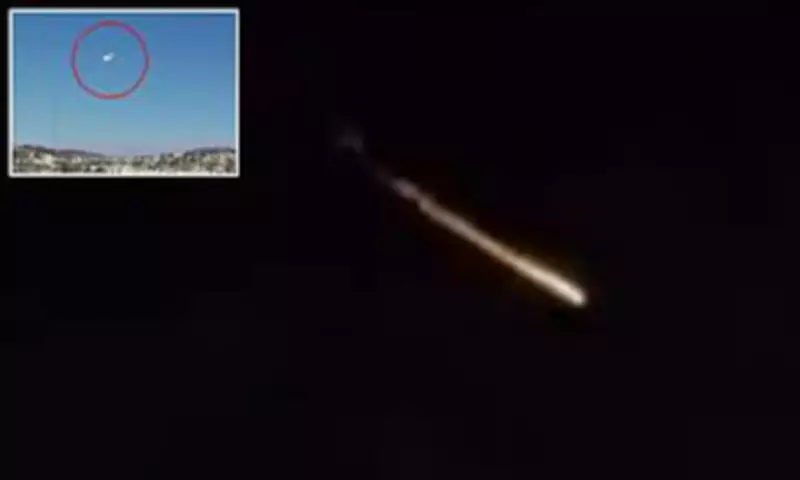
A mysterious fireball that appeared to defy the fundamental laws of physics was witnessed by multiple observers in Texas on Tuesday night. Videos capturing the unusual object over Red Oak quickly spread across social media platforms, showing an orange fireball that did not follow the predictable straight-line trajectory typical of shooting stars.
Unusual Flight Patterns Challenge Meteor Theory
Instead of moving in a conventional arc across the horizon, the object was seen performing erratic zigzag maneuvers through the night sky. Witnesses reported the fireball appearing to descend toward the ground before abruptly turning upward and changing direction, movements that would contradict the normal gravitational behavior of space rocks entering Earth's atmosphere.
While officials have not yet officially identified the phenomenon, described variously as a UFO, orb, or meteor, those who witnessed it reported it emitted a bright orange tail resembling either a rocket engine or the fiery trail of a meteor entering the atmosphere. The timing of this sighting proved particularly noteworthy, occurring just hours after a series of rare meteor sightings were reported worldwide.

Global Meteor Sightings Coincide With Texas Mystery
Residents across Pennsylvania and Ohio were startled Tuesday morning when a meteor was widely observed crashing to Earth. Just two days prior, witnesses captured footage of a large fireball streaking over buildings in the populated Turkish city of Uşak. Meanwhile, a bright green meteor was spotted burning through the night sky over Sydney, Australia.
Social media responses to the Texas incident reflected widespread bewilderment. One user commented, "Red Oak, Texas 'meteor' zigzagging like it's got a pilot? Up, down, hover – no straight drop," while another added, "Not your typical burn-up trajectory. UFO or space rock? You decide."
Alternative Explanations and Official Skepticism
Some observers suggested the strange fireball might represent a drone carrying fireworks rather than an extraterrestrial craft "moving with intent." Officially, the United States government has consistently maintained that no physical evidence of UFOs or alien life has ever been discovered, typically attributing unusual sightings to explainable phenomena such as shooting stars, balloons, birds, or manmade aircraft.
Significantly, neither NASA nor the American Meteor Society has classified the Red Oak fireball as another meteor sighting this month. As one skeptic noted on social media, "Meteors burn straight paths while fragmenting from atmospheric friction, yet this one moves with eerie precision, almost like it's piloted."
Recent Similar Sightings and Expert Analysis
The Texas incident follows a pattern of unusual aerial phenomena. On March 17, witnesses in Pittsburgh reported seeing what appeared to be a burning object streaking through the sky, describing it as "a rocket or something like a meteor." Just ten days before the Texas sighting, witnesses in New York City captured a similar event involving three lights swerving through the air, stopping and hovering as they appeared to chase each other.
Multiple residents in both Ohio and Texas claimed they observed the same lights performing erratic turns while maintaining a triangle-shaped formation. Investigative journalist Jeremy Corbell, documentary filmmaker and co-host of the WEAPONIZED Podcast, has previously identified such unusual flight movements as one of the "five observable" behaviors of UFOs – maneuvers that appear to defy basic physics.
Scientific Context and Statistical Perspective
According to the Meteoritical Bulletin Database, as of January 2026, there have been 1,270 officially confirmed "observed falls" – meteorites that were seen falling to Earth and later recovered. Scientists estimate approximately 17,000 meteorites strike the planet annually, though most land in oceans or remote areas. This means only about 1.8 percent of space rocks that survive atmospheric entry and impact Earth have actually been witnessed by humans.

The recent surge in meteor sightings proves particularly peculiar because no active meteor showers are currently passing Earth. The next scheduled event will be the Lyrids meteor shower, which does not begin until April 17. This timing further complicates conventional explanations for the Texas fireball and similar recent sightings.
As for the phenomenon observed over Texas, its erratic maneuvers continue to challenge normal expectations of what a shooting star should look like as it passes through Earth's atmosphere, leaving both witnesses and experts searching for plausible explanations.