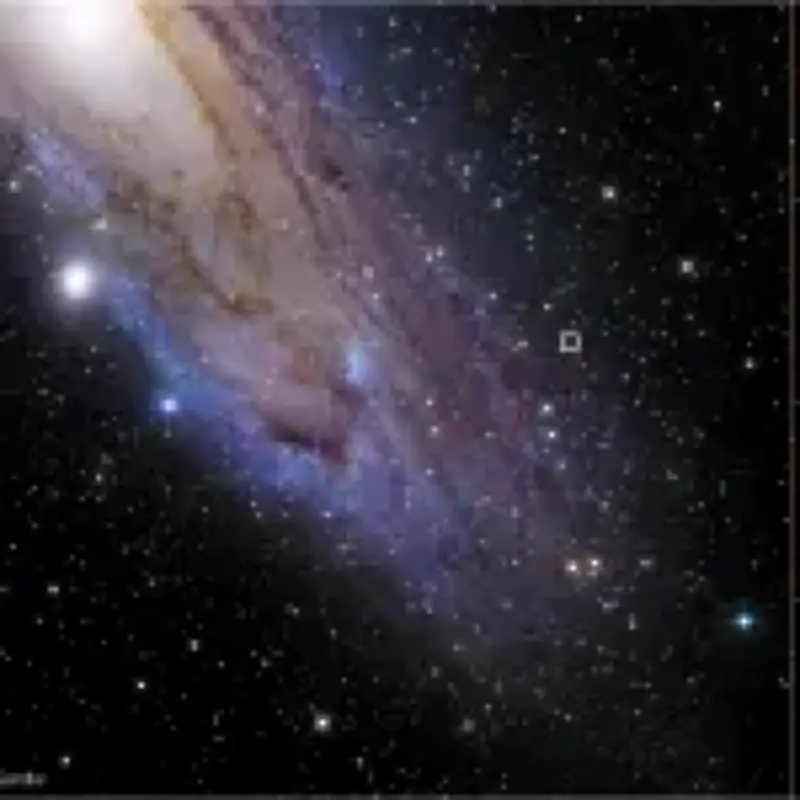
Astronomers have observed a giant star swallowing a smaller neighbour in a cosmic event resembling a game of Pac-Man, on the outskirts of the Andromeda galaxy. The newly formed star, nicknamed Bao, may have been rejuvenated by the encounter, which was confirmed using observations from the James Webb Space Telescope and other space-based and ground-based telescopes.
A Rare Stellar Merger
Scientists say the observations offer an unprecedented opportunity to understand how two stars can merge, a process that is notoriously difficult to witness. 'Stellar mergers are very, very difficult to observe in real time because they are hard to predict,' said Viraj Karambelkar, lead author of a paper published in the journal Nature.
'However, we noticed something unusual was going on in 2023 and continued to monitor the system to see what it would do. Then, in 2025, it erupted! Webb observed Bao only 47 days after the stars' eruption peaked, the earliest ever follow-up of an event like this,' Karambelkar added.
Orbits and Eruption
The two stars had spent thousands of years orbiting one another as a binary system before their collision. Once the smaller star contacted the surface of its giant companion, the merger happened relatively quickly, after just seven orbits, or about seven years. This is considerably faster than other known mergers involving smaller stars, which have taken place after thousands of orbits.
'We thought an outburst from such an extended star would take years,' said co-author Nadia Blagorodnova. 'One day, its brightness started rising and within a week, it peaked!'
Co-author Kishalay De, an assistant professor at Columbia University, said the researchers had observed signs of the smaller star interacting with its larger companion before the eruption. 'When a companion star begins to interact with the outer surface of the primary star, it produces a subtle effect — a slow brightening, which we clearly saw in Bao's data,' he said.
Common Envelope Evolution
The process is known as common envelope evolution, which occurs when a larger star engulfs its smaller companion, surrounding both objects in a shared layer of gas. In Bao's case, the smaller star spiralled towards the centre of its giant companion, losing orbital energy as it moved through the surrounding gas.
Although the Webb observations confirmed that the stars had merged, scientists say this is not always the outcome of such encounters. In other systems, both stars can survive, shedding large amounts of material while remaining separate objects in increasingly close orbits. Over time, these surviving pairs can evolve into neutron stars and black holes, explode as supernovae, produce gravitational waves, or form millisecond pulsars.
Simulations and Observations
To understand what happened to Bao, the researchers updated computer simulations of the system and compared the results with Webb's mid-infrared observations. These observations revealed details of the dust released by the larger star over hundreds of years. The team calculated that before the merger, the primary star was about seven times as massive as the Sun, had a radius 350 times greater, and was approximately 18,000 times brighter. The researchers nicknamed it Big Bao.
'It was an absolute beast of a star, completely outshining its companion in the data,' said co-author Karel Temmink, who led the simulations. The modelling also provided the first estimate of the mass of the smaller star, known as Little Bao, which had about 0.7 times the mass of the Sun. Initially, the simulations suggested Little Bao might have retained enough energy to escape, but further analysis indicated it had been dragged into the core of Big Bao. 'Their encounter was almost like a bomb exploding inside a living star,' said Dr De.
Bao first attracted attention in February 2023, when researchers identified an unusual variable star in data from Nasa's now-retired NEOWISE mission. Observations from the Wide-field Infrared Transient Explorer (WINTER) in September 2024 showed Bao beginning to brighten and release dust. In July 2025, Nasa's SPHEREx space telescope detected further unusual activity. The Zwicky Transient Facility detected the eruption on 17 October 2025. In November 2025, additional observations came from Nasa's now-retired Neil Gehrels Swift Observatory and the Gemini North telescope in Hawaii. The James Webb Space Telescope observed Bao on 24 December 2025 through a special rapid-response programme.
The observations enabled scientists to measure how much material had been expelled during the merger and assess how efficiently the common envelope process unfolded. The researchers say further observations will be needed to establish the precise properties of Bao following the merger and how its mass eventually settles.