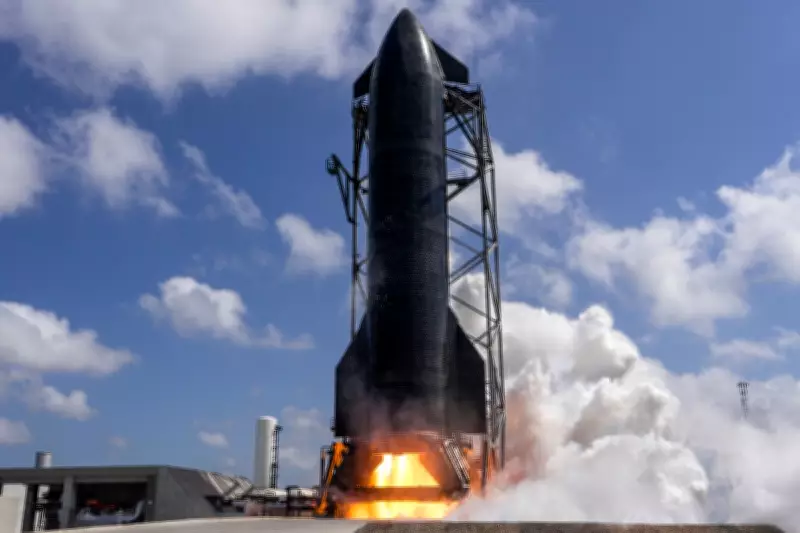
SpaceX Ignites World's Most Powerful Rocket in Critical Pre-Flight Test
SpaceX has successfully completed a pivotal static fire test of its Starship megarocket, described by CEO Elon Musk as "the most powerful object ever made." The test took place at the company's Starbase facility in southern Texas on Wednesday, 15 April 2025, setting the stage for a landmark flight scheduled for next month.
Test Details and Rocket Specifications
The static fire involved the Super Heavy booster, with its 33 engines igniting while the spacecraft remained securely tethered to the launchpad. This test followed a similar evaluation of the smaller upper stage rocket just one day prior. When fully assembled, the Starship rocket stands at an impressive 124 metres tall and boasts the capability to transport over 100 tons to low Earth orbit, according to Mr Musk.
Role in NASA's Artemis Program
Starship is a cornerstone of NASA's Artemis program, which aims to return astronauts to the lunar surface. SpaceX has been contracted to develop a lunar lander, collaborating with Jeff Bezos's Blue Origin on this ambitious endeavour. NASA recently achieved a significant milestone with a lunar flyby earlier this month, marking the first time in over 50 years that four astronauts travelled to the Moon.

The first crewed mission to the Moon's surface is anticipated for late 2028 as part of Artemis IV, contingent upon the readiness of both Starship and Blue Origin's Blue Moon lander. However, NASA has already faced setbacks, pushing back its lunar ambitions from an original December 2025 target due to delays with Starship's Human Landing System (HLS).
Safety Concerns and Competitive Pressures
Ahead of the last Starship flight test in October, safety advisers from NASA's Aerospace Safety Advisory Panel highlighted that fundamental challenges persist with the HLS. They emphasised that the next six months of Starship launches will be critical in determining whether the system can be crew-rated before the end of the decade.
Speaking at a Senate Committee hearing in September, former NASA chief Jim Bridenstine expressed concerns that Starship delays could allow China to surpass the United States in the race to the Moon. He noted, "Our complicated architecture requires a dozen or more launches in a short time frame, relies on very challenging technologies that have yet to be developed like cryogenic in-space refueling, and still needs to be human rated. Unless something changes, it is highly unlikely the United States will beat China's projected timeline to the Moon's surface."
Future Flight Plans
No specific date has been announced for the next flight test, which will represent the 12th suborbital mission for Starship. However, Mr Musk indicated on 3 April that the launch is "4 to 6 weeks away," suggesting it could occur as early as mid-May 2025. This upcoming test is viewed as a decisive moment for the program's timeline and its alignment with NASA's lunar objectives.