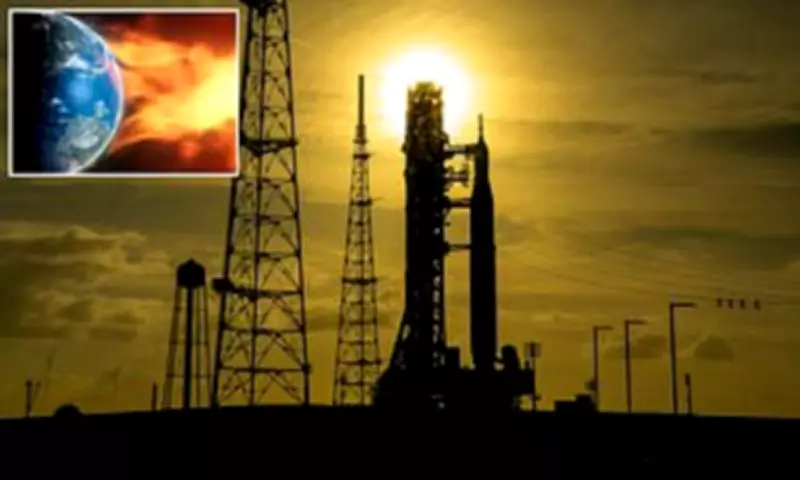
NASA on High Alert as Solar Flares Threaten Artemis II Moon Mission Launch
The historic Artemis II moon mission faces a potential delay due to the threat of solar flares, with NASA closely monitoring extreme radiation levels that could postpone the launch. Mark Burger, NASA's weather officer, disclosed on Tuesday that the sun has exhibited unusual activity in recent months, leading to an increase in moderate and strong flares erupting without warning.
A solar flare is defined as a sudden and powerful burst of radiation and light emitted from the sun's surface. These events are often accompanied by coronal mass ejections (CMEs), which are massive clouds of charged particles propelled into space at high velocities.
When these particles are directed toward Earth and impact the atmosphere, they can inflict damage on power grids, trigger blackouts, interfere with satellite operations, and disrupt communication systems such as GPS.

Radiation Risks for Spacecraft and Crew
For a spacecraft like Artemis II, launching into orbit and heading toward the moon, solar flares generate solar particle events. These act as dangerous radiation storms that could strike the rocket, potentially affecting onboard technologies and endangering the crew.
Burger noted that a strong solar flare occurred on Monday, but it is expected to have 'no or minimal impact' on the Artemis II flight scheduled for Wednesday night. However, NASA has issued a warning that there is a ten percent probability of a powerful 'X-class' solar flare causing a sudden surge in radiation levels, which would breach the agency's safety thresholds for an on-time launch.
Currently, the National Oceanic and Atmospheric Administration's Space Weather Center forecasts a 55 percent likelihood of minor to moderate flares on April 1, along with a 15 percent chance of a solar radiation storm that could influence the launch. Artemis II is poised for its final countdown at the Kennedy Space Center in Florida.
Unpredictable Solar Activity and Safety Measures
A recent study has uncovered a significant shift in solar activity that scientists did not anticipate for 2025 and 2026. Even if a solar radiation storm were to develop over Earth, NOAA indicates it would likely be classified as an 'S1'—the weakest level, resulting in only a slight increase in radiation exposure. This would not necessitate a launch delay or pose a threat to the crew.
Nevertheless, solar flares remain unpredictable, capable of emitting clouds of high-energy protons that arrive within minutes to hours. The sun is currently experiencing an unexpected peak in its 11-year cycle of solar flare activity. Scientists describe this cycle as the sun's natural rhythm, characterized by periods of increased activity followed by calm phases.
Heightened activity leads to more sunspots, solar flares, and potentially hazardous ejections of highly-charged material from the sun. A prior study by NASA's Jet Propulsion Laboratory in California suggested that the sun appears to be 'slowly waking up' after a prolonged period of low activity.
Following a weak cycle (number 24) from 2008 to 2019, research published in the Astrophysical Journal Letters found that the current cycle (number 25) is displaying notably more activity. Burger remarked during NASA's pre-launch press conference on Tuesday, 'Solar forecasting makes terrestrial forecasting look easy, the sun is an entity that almost has a mind of its own.'
He added, 'The sun has become a little bit more active here over the last day, and we had a solar flare erupt. Should there be additional ones, that will be something that we will have to monitor?'
Crew Preparedness and Mission Protocols
Burger further explained that even if increased solar activity is detected before Artemis II's scheduled launch at 6.24pm ET, NASA maintains a 'pretty high bar' that radiation levels must exceed to cancel the moon mission. Once Artemis II embarks on its journey, however, the four-member crew—NASA astronauts Reid Wiseman, Victor Glover, and Christina Koch, along with Canadian astronaut Jeremy Hansen—will be vulnerable to hazardous space weather.

The Artemis II mission will be most susceptible to solar radiation storms once the Orion spacecraft exits Earth's protective magnetic field. The astronauts will have reduced natural shielding from high-energy protons originating from the sun during the approximately four-day voyage to the moon and the four to five days required for the return trip to Earth.
In the unprotected void of space, elevated radiation levels could increase the crew's lifetime cancer risk or even cause immediate health issues if a solar storm is sufficiently intense. Radiation can also impair spacecraft electronics or disrupt communications.
NASA and space weather experts, including those from NOAA, will vigilantly monitor the sun for further eruptions this week. Additionally, the space agency has equipped the crew's Orion spacecraft with built-in radiation shielding to mitigate the impact of any storms during the journey.
If a major solar storm is detected while the Artemis crew is in space, they can swiftly construct a temporary 'storm shelter' inside the capsule by repositioning stored equipment and supplies to create additional mass that blocks incoming particles. NASA intends for the crew to conduct this safety drill irrespective of any space weather developments on the lunar journey.
Emily Nelson, the mission's chief flight director, stated, 'One of our test objectives is actually to set up the radiation shelter, so we’ll be doing that anyway, even without a radiation event.' She elaborated, 'Basically, we’ve got a section of the spacecraft that we would set up for the crew to stay in that area until we give them the all clear that the radiation event has passed.'