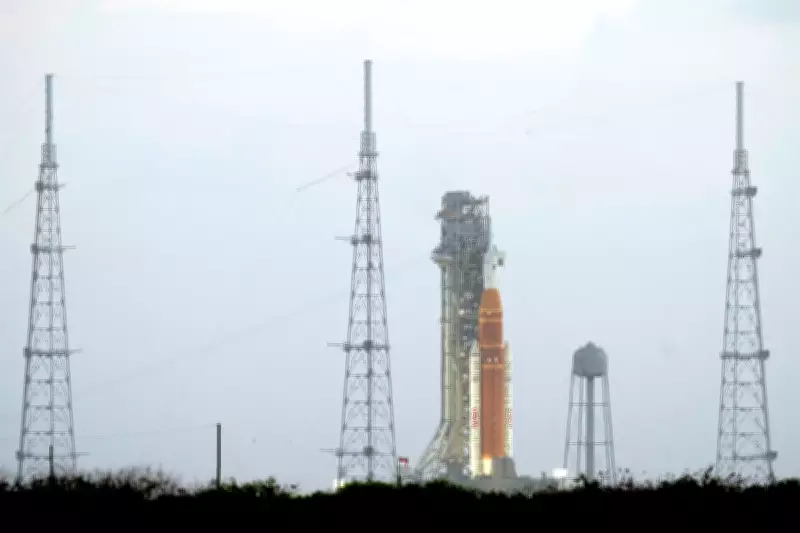
NASA Commences Fueling for Historic Crewed Lunar Mission
NASA has initiated the critical fueling process for its colossal moon rocket, marking a pivotal step towards humanity's first crewed lunar voyage in more than fifty years. The space agency is targeting an evening liftoff from the launch pad, with tensions running high as highly volatile hydrogen fuel began flowing into the rocket's tanks hours ahead of the scheduled departure.
Overcoming Technical Challenges for a Monumental Flight
This launch follows significant delays caused by dangerous hydrogen leaks that erupted during a countdown test earlier in the year, necessitating extensive repairs and adjustments. The launch team now faces the immense task of loading more than seven hundred thousand gallons of fuel, equivalent to 2.6 million liters, into the towering 32-story Space Launch System rocket before the four-member Artemis II crew can board their spacecraft.
Commander Reid Wiseman expressed the crew's readiness on the eve of launch, stating via social media platform X, "It is time to fly." Meteorological conditions are forecast to be favourable, providing a promising backdrop for this historic endeavour.

A Record-Breaking Journey Around the Moon
The mission will carry three American astronauts and one Canadian astronaut on a daring trajectory around the moon without entering lunar orbit or making a landing. Instead, the spacecraft will perform a flyby before heading directly back to Earth for a planned splashdown in the Pacific Ocean.
This path will set a new distance record, as the crew ventures approximately four thousand miles beyond the far side of the moon—some 6,400 kilometers farther from Earth than any humans have previously traveled—before executing a U-turn to begin their return journey. The last crewed mission to the moon was Apollo 17 in 1972, making this a landmark return to deep space exploration.
Launching a New Era of Lunar Exploration
Artemis II serves as the inaugural crewed mission of NASA's ambitious Artemis program, which aims to establish a sustainable human presence on the lunar surface. The space agency's long-term vision includes constructing a permanent moon base, with plans targeting a crewed landing near the lunar south pole by 2028.
NASA Administrator Jared Isaacman heralded the mission on social media, proclaiming, "The next era of exploration begins." The sentiment has been echoed globally, with messages of support pouring in from dignitaries and space enthusiasts alike.
An International and Historic Crew Composition
The diverse Artemis II crew includes Canadian Space Agency astronaut Jeremy Hansen, who will become the first non-American citizen to launch on a lunar mission. The team also features Christina Koch, set to be the first woman to travel to the moon, and Victor Glover, who will be the first Black astronaut on a lunar voyage.
In a poignant letter to Hansen, England's King Charles III wrote, "In this historic moment, you stand as a bridge between nations and generations, and I commend you for your courage, discipline and vision that have brought you to this threshold." This international collaboration underscores the mission's role in fostering global unity and advancing human exploration beyond Earth.