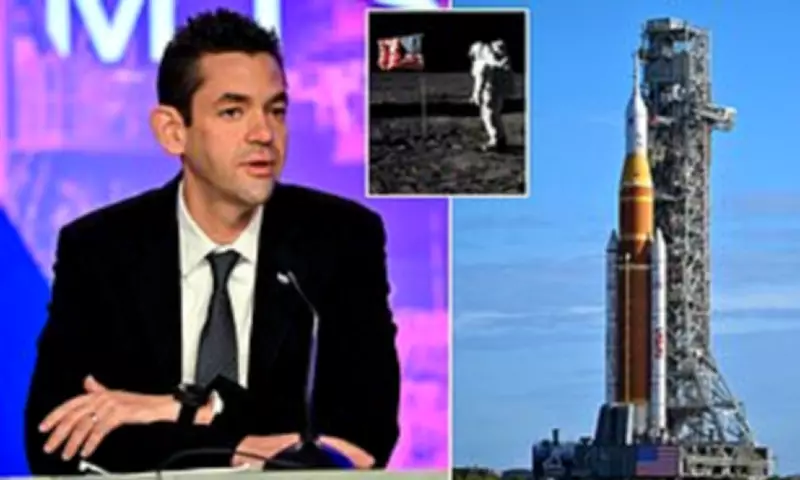
NASA Administrator Jared Isaacman has declared an unwavering commitment to returning American astronauts to the lunar surface, driven by a mission to honour the legacy of Apollo pioneers and reassert United States leadership in space exploration. In an exclusive interview with the Daily Mail at NASA's JFK centre in Florida, Isaacman emphasised that the historic moon landings of the 1960s were merely the beginning of a grand journey, not its conclusion.
Personal Passion and Access to Truth
As an entrepreneur, pilot, and veteran of two SpaceX missions—including the first all-civilian spaceflight in 2021—Isaacman brings a personal fervour for aviation and space. He directly addressed the persistent conspiracy theories alleging the Apollo moon landing was a hoax, stating he has definitive proof from his role as NASA chief.
'I literally have access to all the materials and the boots that were worn on the moon, and I've seen the Apollo 11 command module, and spoken to the astronauts, the heroes that actually did it. There's no question,' Isaacman asserted. He noted that such falsehoods have long angered those involved, recalling a 2002 incident where astronaut Buzz Aldrin punched a conspiracy theorist who accused him of faking the landing.

Why Doubts Persist and the Artemis Response
Isaacman suggested America's prolonged absence from the moon—over half a century—has fueled public scepticism. 'I don't blame people. Hey, it's been a long time, more than a half century, like, why is it so hard to get back?' he remarked. He attributed this gap to a reluctance to build upon past achievements, but vowed to change that with the Artemis program, scheduled to land humans on the moon by 2028.
The administrator described the original Apollo missions as 'near impossible' feats that united the nation during the Cold War space race with Russia. He stressed that returning to the moon is not about replicating past glories but pursuing ambitious new goals. 'Don't just go back to the moon to plant the flag and bring back rocks,' Isaacman explained, outlining plans for a lunar base and 'big, bold endeavors' in space.
The New Space Race with China
Isaacman confirmed the United States is engaged in a fresh space competition with China, whose program he called 'very robust' and not to be underestimated. 'They don't have what I would describe even, you know, a lot of the baggage right now. They are starting their program from scratch, and they're resourcing it. They have the expertise and the will, and they are pursuing those goals,' he warned.
This rivalry echoes the patriotic spirit of the Apollo era. 'This is what America does, and we do it at our best when we're up against a great competitor,' Isaacman added, highlighting the Artemis program as a critical response to China's advancements.
Artemis Challenges and Overhauls
The Artemis II mission, set for a ten-day voyage around the moon with four astronauts in April, has faced delays due to helium flow issues and hydrogen leaks in the Space Launch System (SLS) rocket. Isaacman acknowledged these setbacks, noting the SLS relies on 'really old' heritage equipment last launched in 2022, but said such problems were expected.
In February, he announced a major overhaul of Artemis, including an increased launch cadence for the SLS, promising two manned moon missions by 2028. 'The challenges we've had up to now should absolutely have been expected. When you consider the history of the program, what matters most is that we're going to do things differently. The status quo is unacceptable,' he declared.
Funding and Political Support
With costs exceeding $100 billion over 30 years, Isaacman credited former President Donald Trump for revitalising NASA's lunar ambitions. 'This is a president who appreciates space very much. He's given us the mandate. He's given us the funding … you combine that with the appropriations from Congress, we got all the ingredients to go out and change the world in air and space,' he said.

Isaacman concluded that failure is not an option, as it would send a damaging message globally. 'You come up short. That sends a message to the world,' he cautioned, reinforcing NASA's determination to succeed and honour the Apollo legacy while securing America's future in space.