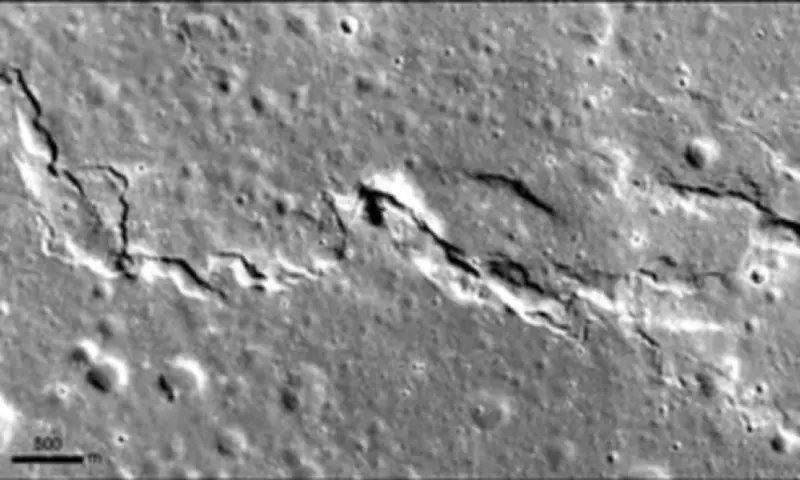
If you gaze up at the night sky and perceive the moon as appearing smaller, your observation is not mistaken. A groundbreaking new study has definitively confirmed that the moon is undergoing a process of shrinkage. Researchers from the National Air and Space Museum's Center for Earth and Planetary Studies have identified more than 1,000 previously unknown cracks scattered across the lunar surface, providing compelling evidence of this contraction and reshaping.
Lunar Contraction and Its Implications
Since 2010, scientists have been aware that the moon is gradually shrinking due to the cooling of its interior, which causes the surface to contract. This phenomenon has led to the formation of distinctive landforms known as 'lobate scarps' in the lunar highlands. These structures emerge when the moon's crust compresses, forcing material upward and over adjacent crust along fault lines, thereby creating ridges.
Discovery of Small Mare Ridges
In their latest research, the team observed unusual cracks in a different region called the lunar maria, the vast, dark plains on the moon's surface. They have termed these features 'small mare ridges' (SMRs). Cole Nypaver, the lead author of the study, highlighted the significance of this finding: 'Since the Apollo era, we've known about the prevalence of lobate scarps throughout the lunar highlands, but this is the first time scientists have documented the widespread prevalence of similar features throughout the lunar mare.'

The study revealed a total of 1,114 SMRs, increasing the overall count on the moon to 2,634. On average, these SMRs date back approximately 124 million years, while the lobate scarps are around 105 million years old. Although these ages might seem ancient, they actually classify SMRs and lobate scarps as some of the youngest geological features on the moon. Tom Watters, who first discovered these cracks in 2010, remarked, 'Our detection of young, small ridges in the maria, and our discovery of their cause, completes a global picture of a dynamic, contracting moon.'
Risks for Future Lunar Exploration
While these discoveries enhance our understanding of lunar geology, they also present significant hazards for space agencies with probes on the moon and those planning human missions. Notably, NASA aims to land astronauts on the lunar surface by 2028 as part of its Artemis III mission. The researchers cautioned in their study, published in The Planetary Science Journal, that 'The distribution of SMRs may also be of relevance to any long-term lunar habitation due to the hazards that shallow moonquakes pose to human-made lunar infrastructure.'
Artemis Mission Details
NASA's Artemis program is poised to advance lunar exploration, with Artemis II scheduled for launch in the coming months. Key facts about Artemis II include:
- Launch Date: Possible windows from February 6 to February 11, March 6 to March 11, or April 1 to April 6.
- Mission Objective: To complete a lunar flyby, passing the 'dark side' of the moon and testing systems for future lunar landings.
- Total Distance: 620,000 miles (one million km).
- Mission Duration: 10 days.
- Estimated Cost: $44 billion (£32.5 billion), with the NASA Space Launch System rocket costing $23.8 billion (£17.6 billion) and the Orion spacecraft $20.4 billion (£15 billion).
- Crew: Commander Reid Wiseman, Pilot Victor Glover, Mission Specialists Christina Koch and Jeremy Hansen.
Cole Nypaver expressed optimism about the future: 'We are in a very exciting time for lunar science and exploration. Upcoming lunar exploration programs, such as Artemis, will provide a wealth of new information about our moon. A better understanding of lunar tectonics and seismic activity will directly benefit the safety and scientific success of those and future missions.'
This research underscores the dynamic nature of the moon and highlights the critical need for thorough planning to mitigate risks associated with moonquakes, ensuring the safety of astronauts and the success of ambitious lunar endeavors.