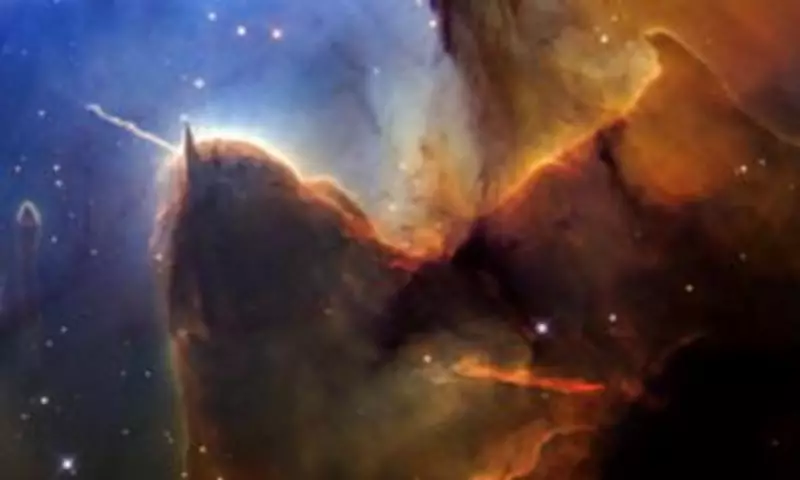
Space scientists have unveiled a truly astonishing celestial portrait, capturing what they describe as a cosmic 'sea slug' in stunning detail. This remarkable image serves as a fitting birthday tribute, released to commemorate the 36th anniversary of NASA's iconic Hubble Space Telescope this very week.
A Nebula Resembling Marine Life
Located approximately 5,000 light-years from our planet, the star-formation region known as the Trifid Nebula has been immortalised by Hubble in all its interstellar splendour. The breathtaking picture was acquired using the telescope's advanced Wide Field Camera 3, revealing a shimmering, expansive cloud composed of gas and dust where nascent stars are actively being born.
In visible light, the nebula's vibrant colours and intricate structures bear an uncanny resemblance to an underwater seascape. Fine particulate matter appears to drift languidly, much like sediment suspended in the ocean's depths. However, this latest observation specifically highlights a distinctive formation within the nebula that has captivated astronomers.

The 'Cosmic Sea Lemon'
Astronomers have affectionately dubbed this formation a 'Cosmic Sea Lemon', due to its striking visual similarity to a sea slug gracefully navigating the void. The NASA Hubble Mission Team elaborated, stating, 'Hubble's view of the Trifid Nebula, also catalogued as Messier 20 or M20, focuses on a 'head' and undulating 'body' of a rusty-hued cloud of gas and dust. It resembles a marine sea lemon, or sea slug, that appears as if it is gliding through the cosmos.'
The team further explained the dynamic processes at play: 'Several massive stars, positioned outside this particular field of view, have been sculpting this region for at least 300,000 years. Their powerful stellar winds continue to blow an enormous bubble. A small segment of this bubble is visible here, pushing and compressing the cloud's gas and dust, which in turn triggers new waves of star formation.'
Hubble's Enduring Legacy
Since its historic launch aboard the Space Shuttle Discovery in 1990, the Hubble Space Telescope has revolutionised our understanding of the universe. To date, it has conducted over 1.7 million observations and its data has been instrumental in the publication of tens of thousands of peer-reviewed scientific papers.
In recent years alone, Hubble's contributions have been profound. It has helped uncover critical evidence pertaining to early galaxy formation, observed exceptionally faint and distant galaxies, and even detected unexpected cosmic phenomena with the aid of artificial intelligence. Its portfolio also includes recording asteroid collisions in distant star systems and capturing the dramatic breakup of a comet within our own Solar System.
Future Operations and Longevity
Despite its age, Hubble's mission is far from over. Current projections estimate the telescope will remain fully operational for at least another four years, through to 2030. Optimistically, engineers believe it could potentially continue beaming invaluable images from thousands of light-years away back to Earth until 2040 or beyond, ensuring its legacy of discovery endures for years to come.
This celestial 'sea slug' image is more than just a beautiful picture; it is a testament to Hubble's unparalleled ability to reveal the hidden wonders of our universe, blending artistic beauty with profound scientific insight as it enters its 37th year of exploration.