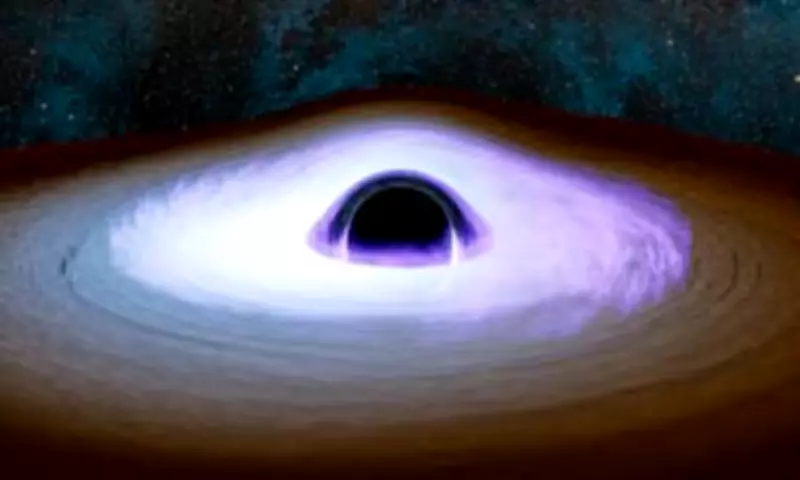
A groundbreaking theory suggests that dark matter, the elusive substance constituting about 27% of the universe's mass, might be even stranger than previously imagined. According to a scientist, it could be made of ancient black holes originating from a different universe, rather than undiscovered particles.
Rethinking Dark Matter's Composition
Astronomers have long believed that dark matter acts as gravitational glue, holding galaxies together. Most conventional theories posit that this mysterious material consists of an unknown particle that does not interact with light. However, Professor Enrique Gaztanaga from the University of Portsmouth proposes a radical alternative: dark matter might actually be comprised of relic black holes from a universe that existed before the Big Bang.
These black holes, described as small yet mass-packed entities, would be entirely invisible except for their gravitational influence, making them a prime candidate for dark matter. Professor Gaztanaga explains, 'The idea is that dark matter may not be a new particle, but instead a population of black holes formed in a previous collapsing phase and bounce of the Universe.'

The Bouncing Universe Hypothesis
Central to this theory is the concept of a 'bouncing' universe, which challenges the traditional singularity model of the Big Bang. Instead of an infinitely dense point marking the absolute beginning, Professor Gaztanaga suggests our universe emerged from a collapse of a prior universe. This collapse reached an enormously dense state before bouncing outward in a rapid expansion, forming the cosmos we observe today.
'The Big Bang corresponds to a bounce from a previous collapsing phase, rather than the absolute beginning of everything,' he states. 'So it is the start of the expansion we observe, but not necessarily the beginning of time itself.' In this scenario, black holes from the earlier universe could have survived the transition, persisting into our current era and behaving exactly like dark matter—interacting gravitationally without emitting light.
Addressing Cosmic Puzzles
This relic black hole theory offers elegant solutions to several persistent problems in cosmology. Firstly, it avoids the need to explain the infinite density of a singularity, which conflicts with known physics. Secondly, it eliminates the requirement for hypothetical dark matter particles, simplifying our understanding of the universe's composition.
Moreover, the theory could explain recent puzzling discoveries by the James Webb Space Telescope (JWST). The telescope detected very bright, red dots—likely rapidly growing black holes—just a few hundred million years after the Big Bang. Current models struggle to account for how these black holes grew so quickly, but if relic black holes were already present from the start, they would have had a significant head start, allowing for accelerated growth.
Testing the Theory
Professor Gaztanaga acknowledges that substantial work is needed to confirm this idea. Scientists must test the theory against data from gravitational wave backgrounds and precise measurements of the Cosmic Microwave Background. 'The key question is which idea matches observations—and that's something we can test,' he emphasizes.
If proven, this theory would simultaneously resolve two major cosmic enigmas: the nature of dark matter and the origin of early supermassive black holes. It represents a bold step forward in our quest to understand the fundamental workings of the universe.
Understanding Dark Matter
Dark matter is a hypothetical substance estimated to make up roughly 27% of the universe. It is invisible because it does not reflect or absorb light, and it has never been directly observed. However, astronomers infer its existence through its gravitational effects on visible matter, such as stars and galaxies.

The European Space Agency analogizes, 'Shine a torch in a completely dark room, and you will see only what the torch illuminates. That does not mean that the room around you does not exist. Similarly, we know dark matter exists but have never observed it directly.' Calculations indicate that without dark matter's gravitational influence, many galaxies would be torn apart rather than rotating cohesively. In contrast, known matter—like atoms and subatomic particles—comprises only about 5% of the observable universe.