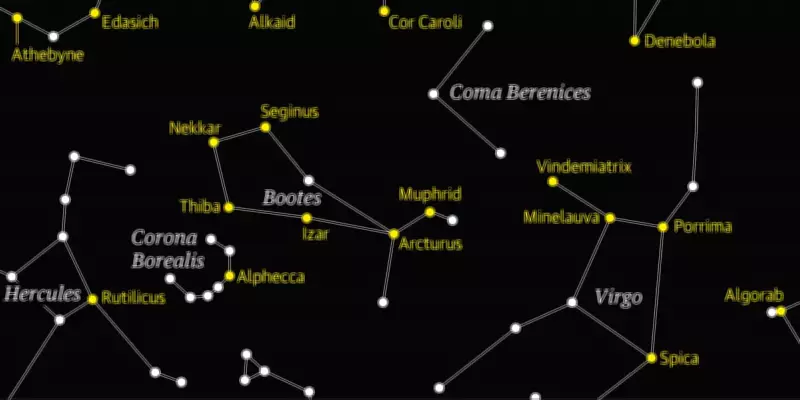
The northern spring constellation of Boötes, known as the herdsman, is currently ascending to prominence in the eastern sky after dusk, offering a captivating celestial spectacle for stargazers. Several weeks following the spring equinox, this constellation becomes increasingly visible, with its brightest star, Arcturus, shining brilliantly against the darkening night.
How to Locate Boötes in the Night Sky
The most straightforward method to find Boötes is to start with the well-known asterism, the Plough, which is part of the larger Ursa Major constellation. From the Plough, trace the gentle curve of its handle downwards in a sweeping arc. This arc will lead your eye directly to the distinctive orange glow of Arcturus, the fourth-brightest star visible in the entire night sky. Arcturus serves as the anchor point for the Boötes constellation.
For observers in London and across the UK, the optimal viewing time is around 21:00 BST. The accompanying chart illustrates the eastern view at this time on 6 April, though the positioning remains largely consistent throughout the week. By this hour, twilight has fully receded, providing ideal dark conditions for observing the constellation's features.

Historical and Mythological Significance
Boötes holds a rich historical legacy, being one of the original 48 constellations catalogued by the ancient astronomer Ptolemy in the second century. However, its origins extend far deeper into antiquity, reaching back thousands of years to ancient Babylonian civilization. In Babylonian astronomy, this constellation was linked to the god Enlil, a deity credited with separating heaven from Earth and rendering the world suitable for habitation.
Within Greek mythological tradition, Boötes is predominantly depicted as a herdsman or ploughman. Numerous tales surround this figure, with a common theme casting him as a guardian or protector of rural and agricultural life. These stories underscore the constellation's enduring association with pastoral themes across different cultures.
Observational Details for Both Hemispheres
During the spring months in the northern hemisphere, Boötes begins its ascent during twilight hours, becoming optimally positioned for observation by late evening. Its prominence makes it an excellent target for both novice and experienced astronomers.
For stargazers located in the southern hemisphere, Boötes appears relatively low in the northern sky. While its elevation may be less pronounced, it remains identifiable, particularly through the bright beacon of Arcturus, which can guide viewers to the broader constellation pattern.
This seasonal appearance of Boötes not only offers a chance to engage with practical astronomy but also connects observers to millennia of human storytelling and celestial interpretation. Whether you are tracing the arc from the Plough or pondering its ancient mythological roles, Boötes provides a compelling window into the night sky's wonders.