First Accurate Measurements Reveal Immense Power of Black Hole Jets
Astronomers have achieved a groundbreaking milestone by making the first precise measurements of the powerful jets erupting from a distant black hole. Using a global network of radio telescopes, scientists have quantified the astonishing energy output of these cosmic phenomena located approximately 7,000 light-years from Earth.
The Dancing Jets of Cygnus X-1
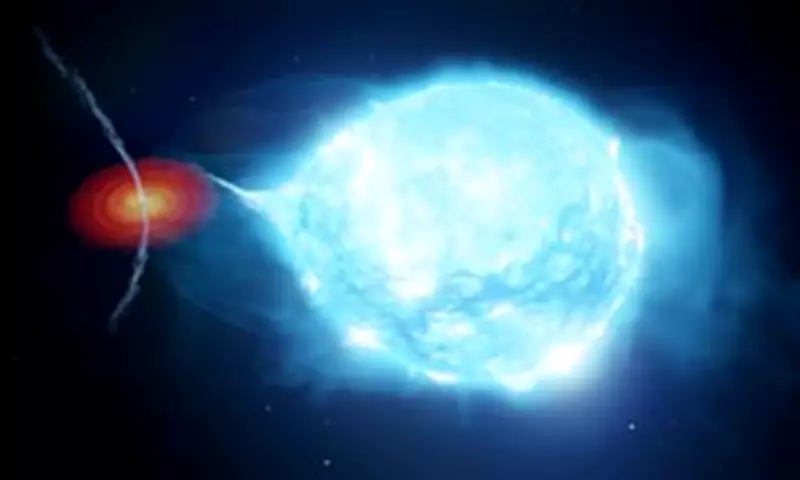
The remarkable discoveries originate from the binary system known as Cygnus X-1, which hosts both a supermassive star and a neighboring black hole. Researchers observed what they describe as "dancing jets" - fountains of superheated matter that erupt from the black hole with incredible force. These jets unleash power equivalent to the combined output of 10,000 suns while traveling at approximately 150,000 kilometers per second, which represents nearly half the speed of light.
Professor James Miller-Jones, co-author of the study from Curtin University, explained the significance of these measurements to the Daily Mail: "Since we know how strong the wind from the star is, we know how much force it creates on the jet. This allows us to figure out how powerful the jet is."

Solar Winds Bend Black Hole Jets
The supermassive companion star in the Cygnus X-1 system produces solar winds of extraordinary magnitude, ejecting approximately 100 million times more mass every second than our sun at velocities three to four times greater. These powerful stellar winds actually bend the black hole jets by about two degrees, similar to how wind affects water emerging from a fountain.
Scientists utilized this bending effect to calculate the energy contained within the jets. By measuring how much the solar wind deflected the jets over time, researchers determined that these cosmic fountains release the equivalent power of 10,000 suns while consuming only about 10 percent of the energy absorbed by the black hole during its feeding process.
Understanding Black Hole Energy Budgets
Black holes represent some of the most enigmatic objects in the universe, containing matter so dense that not even light can escape their gravitational pull. While these super-dense entities absorb light, they simultaneously generate spectacular bursts of energy through their jets. As matter spirals toward a black hole, it accelerates to velocities approaching light speed while carrying magnetic fields that help launch the powerful jets.
Professor Miller-Jones elaborated on this process: "As matter spirals in towards a black hole, it carries magnetic fields with it, and as these magnetic field lines get wound up, they help launch the jet." The largest black hole jets can extend several light-years from their source, injecting vast amounts of energy into surrounding cosmic regions.
Understanding the true power of these jets is crucial for determining how rapidly black holes feed and grow. Scientists typically measure X-rays released by falling matter to estimate feeding rates, but they also need to quantify how much matter gets expelled through jets. Together, these measurements provide what Professor Miller-Jones describes as "a bit like counting calories, only for a black hole" - essentially creating an energy budget for these cosmic phenomena.
Breakthrough Measurement Technique
Previous attempts to measure black hole jet energy relied on observing how jets inflate bubbles in surrounding gases over tens of thousands of years. However, this method proved unreliable for comparing with current feeding rates measured through X-rays. The new measurement technique finally enables accurate determination of what fraction of energy from falling matter gets channeled into the jets.
Dr. Steve Raj Prabu, lead author from the University of Oxford, emphasized the importance of this breakthrough: "Our result provides the first direct observational measurement of this efficiency, giving these simulations a much firmer observational foundation."

Universal Implications of Black Hole Research
This single accurate measurement serves as an anchor for future studies of black holes across all scales, from those five times the sun's mass to supermassive black holes five billion times larger. According to astrophysical theories, the fundamental physics governing black holes should remain consistent regardless of size.
The implications extend far beyond individual black holes. Jets from supermassive black holes play a critical role in cosmic evolution through a process called "feedback," which regulates how galaxies grow and develop. In some instances, black hole jets can inflate gas bubbles exceeding the size of their host galaxies, profoundly influencing galactic evolution.
Dr. Prabu explained this cosmic significance: "This process, known as 'feedback,' plays a crucial role in regulating how galaxies grow and evolve. In large-scale simulations of the Universe, scientists have had to assume how efficient black holes are at converting infalling energy into jets."
These discoveries ultimately contribute to a better understanding of how the universe reached its current state, shedding light on the formation of planets, stars, and galaxies throughout cosmic history.