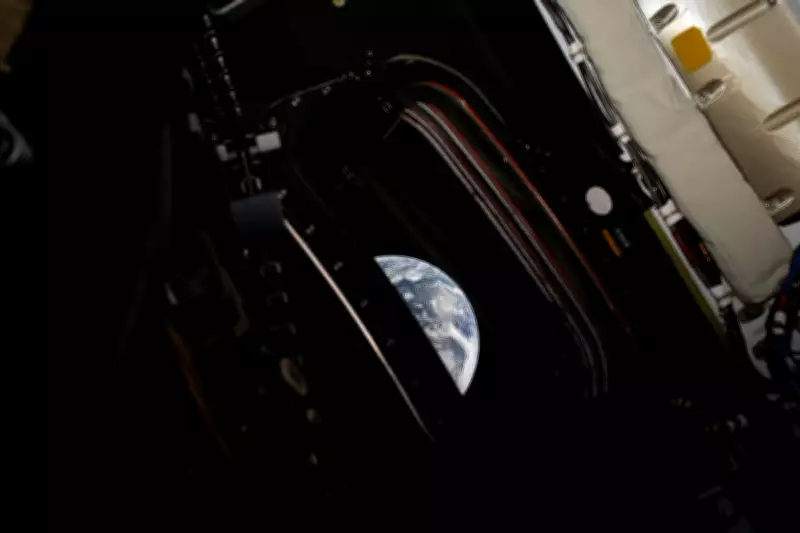
NASA's Artemis II Mission Achieves Historic Lunar Flyby Today
In a landmark event for space exploration, NASA's Artemis II mission has successfully conducted a lunar flyby today, marking the first close encounter with the moon by astronauts in over five decades. The four crew members aboard the Orion spacecraft are set to break the record for the farthest distance humans have traveled from Earth, a feat last achieved during the Apollo era.
Historic Milestone in Space Exploration
The Artemis II mission, commanded by Reid Wiseman with pilot Victor Glover and mission specialists Christina Koch and Jeremy Hansen, embarked on this journey around the moon at approximately 1:30 p.m. Eastern Time on Monday afternoon. This mission represents a significant step forward in NASA's efforts to return humans to the lunar surface, building on the legacy of the Apollo program.
For the first time since the Apollo 17 mission in 1972, astronauts are witnessing the moon up close, providing invaluable insights for future lunar landings. The crew's trajectory includes a flyby of the far side of the moon, an area that has long fascinated scientists and explorers alike.

Breaking Distance Records
As part of this mission, the Orion spacecraft is expected to surpass the previous record for the farthest distance from Earth achieved by humans. According to NASA, the record-breaking moment is scheduled for 1:56 p.m., with the spacecraft reaching its maximum distance of 252,760 miles from Earth at 7:07 p.m. This surpasses the record set by Apollo 13 in 1970, which saw astronauts reach 248,655 miles from Earth.
The mission utilizes a "free-turn trajectory" maneuver, the same technique employed by Apollo 13 after its infamous oxygen tank explosion. This strategic path ensures a safe and efficient journey, highlighting the advancements in spaceflight technology since the Apollo missions.
Mission Timeline and Coverage
The Artemis II test flight is set to conclude with a splashdown in the Pacific Ocean on Friday, following a four-day return journey. NASA has been providing continuous coverage of the mission through a livestream, with a dedicated stream for the lunar flyby starting at 1 p.m. Eastern Time on Monday. This allows viewers worldwide to witness this historic event in real-time.
In a touching moment, an Apollo astronaut sent an inspirational message to the Artemis crew, underscoring the continuity and camaraderie within the space exploration community. This mission not only pushes the boundaries of human achievement but also inspires future generations to look toward the stars.
The success of Artemis II paves the way for subsequent missions, including planned lunar landings, as NASA aims to establish a sustainable human presence on the moon. Today's flyby is a critical test of the spacecraft's systems and crew readiness, setting the stage for even more ambitious endeavors in the years to come.