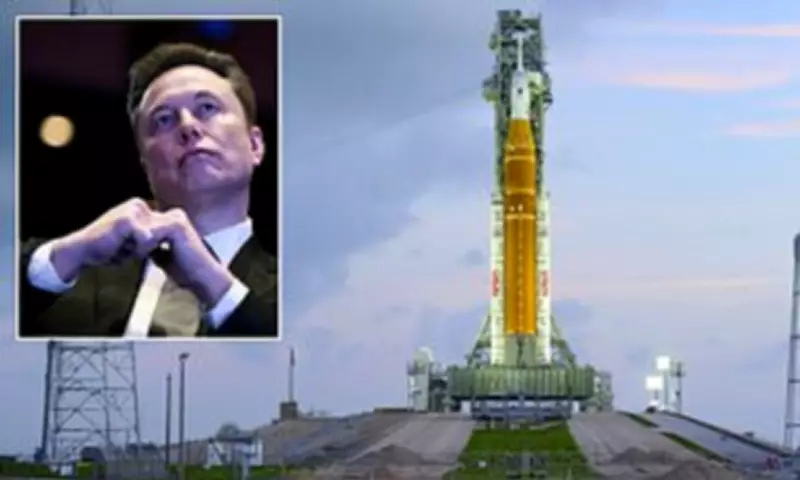
Artemis II Launch: A New Chapter in US-China Space Competition
When NASA's Artemis II spacecraft ascends from Cape Canaveral, Florida this Wednesday evening, it will be heralded as America's symbolic return to lunar exploration after decades of absence. However, beneath this historic moment lies a far more concrete and consequential reality: the United States is reigniting the space race, this time with China as its primary competitor, in a battle for extraterrestrial supremacy that extends far beyond mere scientific discovery.
Return to the Moon: More Than Symbolism
Artemis II represents the first crewed test flight toward the moon since Apollo 17's lunar landing in December 1972. NASA officially frames the Artemis campaign as establishing groundwork for future Mars missions, harnessing space's economic potential, and creating sustainable human presence beyond Earth. Yet, in today's geopolitical climate, the mission carries an unmistakable strategic dimension: Washington aims to maintain leadership against Beijing's own plans to land astronauts on the moon by 2030.
This lunar endeavor appears to be the opening gambit in a much broader infrastructure competition between the two superpowers—a giant leap toward what experts are calling an extraterrestrial AI future. The program has even attracted an unlikely new advocate who once criticized its very premise.

Elon Musk's Dramatic Reversal on Lunar Priorities
Elon Musk's perspective on lunar exploration has undergone significant transformation in recent months. Last year, the SpaceX founder publicly maligned the Artemis mission as "extremely inefficient" and "a jobs-maximizing program, not a results-maximizing" one. He previously dismissed moon efforts as distractions from his vision of establishing a human colony on Mars.
What a difference a year makes. Musk now describes Artemis as a vital step in spaceflight development. In February, he posted to his millions of followers that establishing presence on the moon represents a practical priority. "SpaceX has already shifted focus to building a self-growing city on the Moon, as we can potentially achieve that in less than 10 years, whereas Mars would take 20+ years," he wrote, adding that while Mars colonization remains important, "the overriding priority is securing the future of civilization and the Moon is faster."
The Emergence of Space-Based AI Infrastructure
Around the same time, Musk began publicly advocating for space-based AI data centers, arguing that energy, land, and cooling constraints plaguing terrestrial facilities—including his own Memphis operation accused of illegally operating gas turbines—make orbital locations increasingly attractive. AI data centers are integral to technological advancement, housing computer chips essential for AI operations, training sophisticated models, and enabling inference capabilities. However, their enormous energy and water requirements already strain power grids and national budgets.
NASA's own language hints at this potential future, discussing systems needed to support sustained lunar operations. Transform the moon into a workplace for servicing hardware, warehousing supplies, and testing power systems, and it rapidly evolves from scientific outpost to strategic foothold. If space-based data centers become reality in the coming decades, establishing presence on this new frontier becomes essential for competing against China, which possesses similar astronaut launch capabilities.
China's Parallel Ambitions in Space AI
Like Musk, Chinese authorities harbor grand ambitions for space-based AI programs, perhaps even more aggressively. In January, China Aerospace Science and Technology Corporation—Beijing's primary space contractor—announced plans to directly challenge Musk and SpaceX by developing "gigawatt-class space digital-intelligence infrastructure." Their objective involves constructing industrial-scale "space clouds" by 2030 that would utilize space-based solar power to fuel AI generation, storage, and transmission.

Thanks to SpaceX's successful Falcon 9 reusable rocket program, Musk currently maintains advantage over Chinese competitors, who have yet to develop rockets capable of the repeat launches required to reliably and affordably deploy AI infrastructure into orbit. However, with China making "space clouds" a centerpiece of their latest five-year plan, the Artemis launch sends an unambiguous message that the United States—and its private sector partners—refuse to concede leadership to what they perceive as a rogue competitor regime.
Practical Challenges and Long-Term Vision
Realistically, neither American astronauts nor Chinese taikonauts will be floating past space-borne data centers anytime soon. Beyond technical hurdles like solar radiation protection and interstellar debris mitigation, maintenance and launch demands make repairing hyperscale computers in orbit substantially more complex than replacing server components on Earth. Even by optimistic estimates, operational space-based AI data centers remain at best a decade away, despite China's shorter-term ambitions.
Yet Musk's history of transforming seemingly fanciful infrastructure claims into realities cannot be dismissed. Reusable rockets once appeared improbable, yet SpaceX now launches and recovers them with remarkable regularity. The Starlink satellite internet constellation seemed like science fiction until it became accessible even during cross-country flights. Even if space-based AI data centers materialize later than projected, their underlying logic remains compelling: AI's insatiable appetite for electricity, land, and water continues to explode, while space offers seemingly limitless locations for power centers without environmentally-sensitive communities and with theoretically endless solar energy.
Building the Lunar Ecosystem for Tomorrow's Technology
Multiple motivations exist for returning to the moon, and Artemis long predates Musk's current lunar fixation. However, constructing a future where vast amounts of reliable AI computing capacity exist beyond Earth requires more than occasional rocket launches from Cape Canaveral. It necessitates reliable logistics chains, fuel supplies, power systems, maintenance capabilities, robotic systems, communications networks, access regulations, and permanent operational bases beyond low Earth orbit.
In essence, it requires exactly the type of ecosystem Artemis is slowly, expensively, and publicly attempting to create. NASA states that Artemis aims to build a lunar economy and support an expanding space economy. Just last week, the agency shelved plans for a revolving lunar space station (the Lunar Gateway) in favor of a $20 billion permanent surface base. "It should not really surprise anyone that we are pausing Gateway in its current form and focusing on infrastructure that supports sustained operations on the lunar surface," explained NASA administrator Jared Isaacman.
Investors are already committing substantial resources to off-planet AI infrastructure projects. While Artemis certainly represents America's return to lunar exploration, while it undoubtedly addresses China's increasingly aggressive advances, and while it advances scientific knowledge, it may also represent the first serious public investment in a science-fiction-style future where the race for AI supremacy extends beyond our planet's atmosphere.