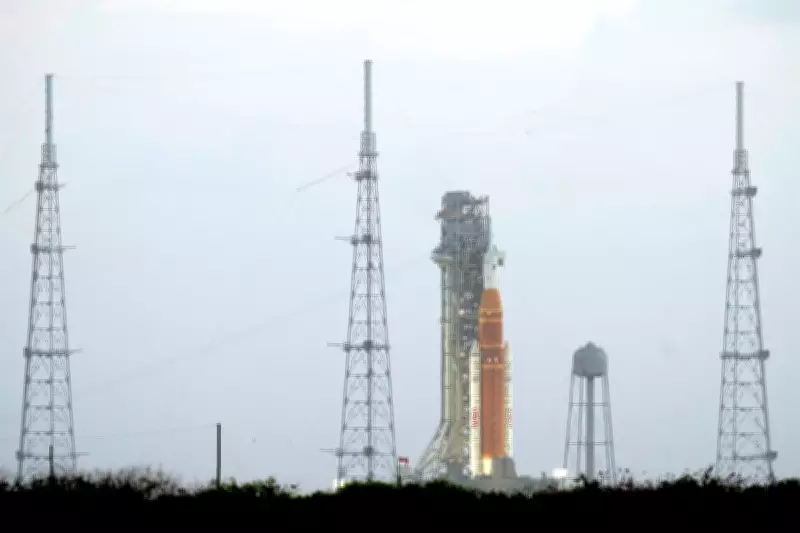
Historic Launch for NASA's Artemis II Moon Mission
NASA has successfully launched its first crewed Moon mission in more than five decades, marking a monumental return to deep space exploration. The Artemis II mission blasted off from Cape Canaveral, Florida, at 6:36 PM local time, carrying four astronauts further into space than any humans have traveled before.
The Crew and Their Journey
The 322-foot rocket launched with an elite team of three American astronauts and one Canadian crew member. Commander Reid Wiseman expressed the significance of the moment, shouting to well-wishers, "It's a great day for us. It's a great day for this team." The astronauts had entered their capsule hours earlier, where they will remain for approximately ten days in quarters comparable to a small camper van.
Prior to boarding, ground crews loaded more than 700,000 gallons (2.6 million litres) of fuel into the spacecraft. As the crew traveled to the launch pad, they waved and formed heart shapes with their hands for supporters gathered to witness this historic event.

Breaking Records and Paving New Paths
The lunar flyby mission will send the Orion module approximately 252,000 miles (406,000 kilometres) into space before returning to Earth. This distance surpasses the current record of about 248,000 miles set by the Apollo 13 mission in 1970. As the spacecraft passes approximately 4,600 miles beyond the far side of the Moon, it will lose communication with Earth for up to fifty minutes.
While the Artemis II astronauts will not land on the lunar surface, this mission establishes critical groundwork for future Moon landings and represents a foundational step toward sending human crews to Mars. NASA aims to return astronauts to the lunar surface by 2028, ahead of China's planned Moon missions around 2030.
International Collaboration and Technical Challenges
The United Kingdom contributes significantly to this ambitious technical operation through the Goonhilly Earth Station near Helston, Cornwall, which helps track the capsule during its celestial voyage. The mission faced previous delays of two months due to technical issues including hydrogen fuel leaks and clogged helium lines.
The last NASA crewed Moon mission occurred in 1972 with Apollo 17, making Artemis II a historic return to lunar exploration after more than half a century.
Royal and Presidential Support
King Charles conveyed heartfelt good wishes to the astronauts alongside an impassioned environmental plea. In a message to Canadian crew member Colonel Jeremy Hansen, the monarch expressed hope that the mission would renew conviction about protecting Earth from over-exploitation and pollution.
The King emphasized that the Moon should remain "a beacon of peaceful scientific discovery rather than a theatre of exploitation," referencing his Astra Carta initiative launched in 2023 to promote sustainable and ethical space exploration.
Meanwhile, former US President Donald Trump celebrated the launch on his Truth Social platform, declaring, "We are WINNING, in Space, on Earth, and everywhere in between" and praising American dominance in space exploration.
This historic mission represents not only a technological achievement but also a renewed commitment to international cooperation and responsible exploration beyond Earth's atmosphere.