Artemis II Crew Celebrates 'Golden Age of Space Travel' Ahead of Return
With the Artemis II crew set to return to Earth on Friday following a historic 10-day lunar flyby mission, the astronauts have celebrated their expedition and hailed the "golden age of space travel," expressing hope that this groundbreaking journey will inspire future generations. Speaking from aboard the spacecraft on Thursday evening, the crew fielded questions from members of Congress as they prepared for their splashdown, with a jubilant press conference highlighting bipartisan support and the mission's inspirational impact.
Inspiring the Next Generation
The mood was overwhelmingly positive as politicians from both sides of the aisle congratulated the astronauts, inquiring about their experiences and the mission's potential to motivate others. Commander Reid Wiseman emphasized the record-breaking nature of the expedition, stating, "It is unbelievable to think that we could build an international team led by the United States of America and set our sights on a sustained presence on the moon and onto Mars and then we can go and achieve it." He called the mission "incredible" and added, "There is nothing this nation cannot do when it has a vision." Wiseman further declared, "We are in the golden age of space travel right now. There's just limitless potential here."
Several congresspeople, including Congresswoman Zoe Lofgren of California, asked how the Artemis II trip could serve as an inspiration, particularly for younger audiences. Lofgren described the expedition as "unifying in so many ways," prompting the four-person crew to share their hopes for public takeaways. Pilot Victor Glover, the first Black man to travel beyond low-Earth orbit, responded, "I hope that we connect back to when we went to the moon the first time and we started calling big things humanity accomplished 'moon shots' and we take ownership of this 'moonshot.' There's nothing that we can't accomplish when we pull all of our differences together ... and when we work on something big for the good of everyone."

Precision Logistics for Safe Return
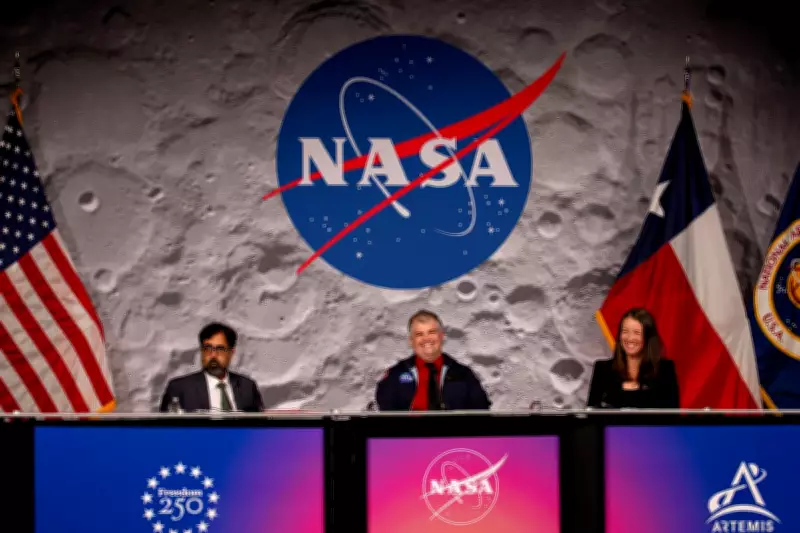
As the crew began repacking for re-entry, NASA leaders detailed the precise logistics required for a safe return to Earth. The Orion capsule will travel at nearly 24,000mph before splashing down several miles off the coast of San Diego, a complex operation demanding multiple teams and careful coordination. At a press conference, NASA's associate administrator Amit Kshatriya stated, "To every engineer, every technician that's touched this machine, tomorrow belongs to you. The crew has done their part. Now we have to do ours."
Jeff Radigan, lead flight director for Artemis II, underscored the critical precision needed for re-entry, noting the team has "less than a degree of an angle" to hit the correct flight path. "Let's not beat around the bush. We have to hit that angle correctly – otherwise we're not going to have a successful re-entry," he warned. Radigan outlined the timeline: the Orion crew module and service module will separate at 4.33pm PT, with the service module burning up in Earth's atmosphere. A crew module raise burn follows at 4.37pm PT, and Orion's entry interface at 4.53pm PT will cause a brief blackout. Drogue parachutes deploy at about 5.03pm PT, followed by main parachutes, leading to a final splashdown at 5.07pm PT.
Radigan added that the splashdown will occur far off the southern California coast, cautioning the public to avoid the area due to safety concerns. "The path that we're coming in, I don't expect it to be visible from the folks in California ... We're working with the Department of War to recover the capsule out there and it is a fairly large exclusion zone so I would caution folks ... please avoid the area," he said. He explained that debris poses risks, requiring recovery teams to maintain a safe distance initially. "There's a lot of debris that comes down and we work with our recovery forces in order to ensure that it doesn't hit them," Radigan noted.

Recovery Operations and Post-Mission Plans
The USS John P Murtha is prepared to assist with recovery operations, which are expected to take between an hour and an hour and a half. Radigan detailed the process: "There's a number of systems that we have to begin an orderly shutdown, and the crew then has to orient themselves and begin 'safing' the spacecraft so they can open the hatch, and that takes a little bit of time." Once safety is confirmed, teams will approach the spacecraft to extract the crew, who will then undergo post-mission medical evaluations before being flown to NASA's Johnson Space Center in Houston, Texas.
Personal Reflections and Future Hopes
During the Thursday night session, crew members shared personal messages with their children and young space enthusiasts. Glover expressed his anticipation of "chasing and catching [the] dreams" of his four children, telling "future citizens," "I hope this mission is giving you something you can take and put in your pocket or in your heart or mind, that you keep with you ... we want you to take this and build a vocabulary to explain the world to us."
Multiple crew members highlighted the awe-inspiring experience of witnessing a lunar eclipse in person. Christina Koch, mission specialist, said the sight "rendered us speechless," while Jeremy Hansen, the Canadian Space Agency mission specialist, echoed her sentiment, adding, "I know you saw some pictures, but it really was something." This moment underscored the profound impact of the mission, reinforcing the crew's message of unity and limitless potential in space exploration.