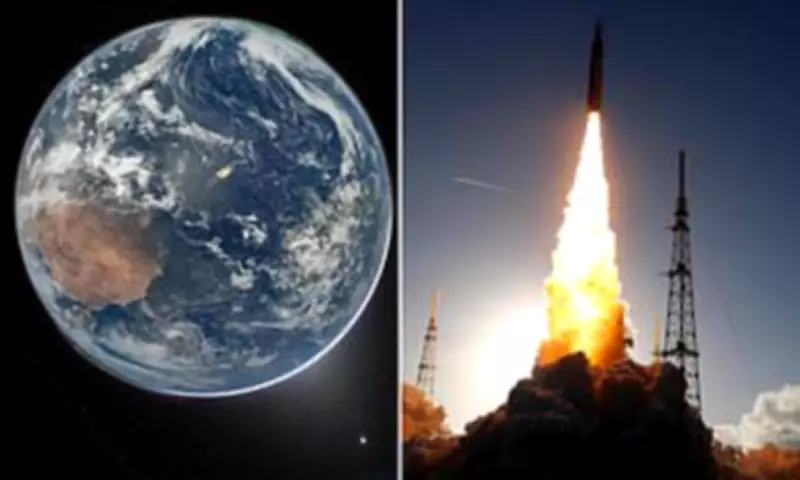
Artemis II Astronauts Capture Dazzling Earth Views on Historic Lunar Journey
Astronauts aboard NASA's Artemis II mission have captured a series of breathtaking new images of Earth as they speed toward the Moon, marking the first crewed lunar journey in more than half a century. The stunning photographs, released just 36 hours into the mission, offer a rare and spectacular glimpse of our planet from deep space.
Spectacular Imagery from Deep Space
The images reveal a curved slice of the blue planet glowing brilliantly through the Orion spacecraft's window, alongside a full view of Earth wrapped in swirling white clouds and illuminated by vibrant green auroras. Commander Reid Wiseman took these photographs following a crucial engine burn that propelled the spacecraft toward the Moon, with the crew approximately 100,000 miles from Earth at the time and rapidly gaining distance.
One particularly striking image shows two auroras glowing at opposite edges of the planet, with faint zodiacal light also visible in the background. Another photograph presents the entire globe almost suspended in darkness, viewed from an unusual 'upside-down' angle where West Africa appears to the left as seen from the capsule.

'It was the most spectacular moment, and it paused all four of us in our tracks,' Wiseman remarked, describing the view after Mission Control adjusted the spacecraft's position so the entire Earth filled their windows.
The Crew and Mission Details
On board the Orion capsule, named 'Integrity' by its crew, are NASA astronauts Reid Wiseman, Victor Glover, and Christina Koch, alongside Canadian Space Agency astronaut Jeremy Hansen. The spacecraft launched from Kennedy Space Center on April 1 and is expected to complete a 10-day mission that will see the crew loop around the Moon before returning to Earth.
After launch, Orion deployed its solar panels and entered a high Earth orbit before performing a powerful translunar injection burn to begin its journey into deep space. Several CubeSats were also released during the early stages of the mission to conduct scientific experiments and test new technologies.
Historic Significance and Tense Moments
This mission represents the first time humans have traveled to the Moon since Apollo 17 in 1972, serving as a major step in NASA's Artemis programme to establish a long-term human presence on the lunar surface and eventually send astronauts to Mars. NASA Administrator Jared Isaacman hailed the launch as a 'defining moment' for space exploration.
However, the mission has not been without tense moments. Approximately 20 minutes after completing the key engine burn that set Orion on its course to the Moon, the crew received a warning message indicating a suspected cabin leak. 'This grabs your attention,' Hansen recalled in a live interview from space, noting how the alert raised fears they might need to abort and return to Earth within hours.
Ground teams in Houston quickly confirmed the reading was an anomaly and cabin pressure remained stable. 'Houston helped us out. They confirmed they were seeing good cabin pressure and so were we on-board,' Hansen said. 'We did the burn and now we're heading to the moon and feeling good.'
Mission Progress and Future Plans
The astronauts are expected to reach the Moon on Monday, where they will swing around its far side, observing and photographing terrain rarely seen by human eyes, before heading back home for a planned Pacific Ocean splashdown. The 10-day mission will see the astronauts complete a roughly 685,000-mile round trip, traveling as far as about 250,000 miles from Earth and pushing further into deep space than any crewed mission in decades.
At its furthest point, Orion will travel around 6,400 miles beyond the Moon before turning back toward Earth. The launch itself faced minor issues, including a temporary communications glitch and a reported controller problem with the spacecraft's toilet, though all major systems continued to function properly.
In the first 24 hours, the spacecraft orbited Earth while the crew carried out safety checks and rested before firing its engine for approximately six minutes to generate roughly 6,000 pounds of thrust, officially beginning the journey toward the Moon.