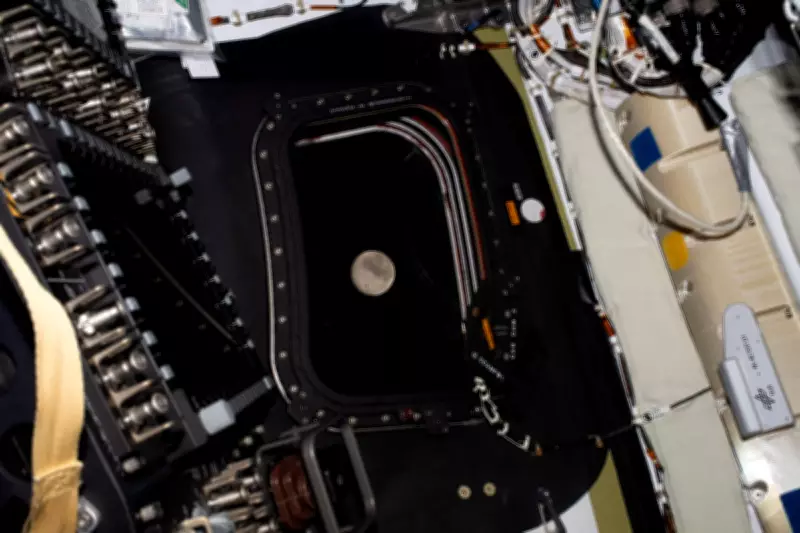
Artemis II Astronauts Achieve Historic Distance Milestone During Lunar Flyby
With the moon dominating their view, the crew of NASA's Artemis II mission raced to establish a new distance record from Earth on Monday during a spectacular lunar fly-around that promised breathtaking vistas of the far side, never before witnessed directly by human eyes.
A Record-Breaking Journey Beyond Apollo 13's Mark
The six-hour flyby represents the centerpiece of NASA's inaugural return to lunar proximity since the Apollo era, featuring three American astronauts and one Canadian crew member. This critical mission serves as a precursor to planned boot prints near the moon's south pole within just two years.
Less than sixty minutes before initiating their intensive lunar observations, the four astronauts were poised to become the most distant humans in recorded history. They surpassed the longstanding record of 248,655 miles (400,171 kilometers) established by Apollo 13 back in April 1970.

Mission Control projected that Artemis II would exceed that historic distance by more than 4,100 miles (6,600 kilometers), securing both a technical prize and considerable bragging rights for the international crew.
Following Apollo 13's Trajectory with Modern Precision
Artemis II is employing the identical maneuver utilized by Apollo 13 following its infamous oxygen tank explosion, which famously dashed lunar landing hopes. This approach, known as a free-return lunar trajectory, cleverly harnesses the gravitational forces of both Earth and the moon to minimize fuel consumption.
The celestial figure-eight path will guide the astronauts homeward after they emerge from behind the moon on Monday evening. Commander Reid Wiseman, pilot Victor Glover, mission specialist Christina Koch, and Canadian astronaut Jeremy Hansen were tracking to pass within 4,070 miles (6,550 kilometers) of the lunar surface.
Their Orion capsule will whip past the moon, execute a U-turn maneuver, and commence its four-day return journey to Earth, culminating in a Pacific Ocean splashdown scheduled for Friday.
Scientific Observations and Cosmic Vistas
Wiseman and his crew dedicated years to studying lunar geography in preparation for this monumental event, recently incorporating solar eclipse observations into their training regimen. By launching last Wednesday, they positioned themselves to experience a total solar eclipse from their unique vantage point behind the moon.
Primary scientific targets include the Orientale Basin, an expansive impact formation featuring three concentric rings, with the outermost spanning nearly 600 miles (950 kilometers) across. Additional sightseeing objectives encompass the Apollo 12 and 14 landing sites from 1969 and 1971, along with the fringes of the south polar region designated for future landings.
Beyond lunar features, the astronauts anticipate visible celestial bodies including Mercury, Venus, Mars, Saturn, and their home planet Earth. NASA geologist Kelsey Young, serving as their lunar mentor, anticipates thousands of photographic captures from the mission.
"People across the globe connect with the moon. This represents something every single person on our planet can comprehend and relate to," Young remarked on the eve of the flyby, adorned with symbolic eclipse earrings.
Historical Context and Future Missions
Artemis II marks NASA's first crewed lunar mission since Apollo 17 in 1972, establishing foundational work for next year's Artemis III mission. That subsequent flight will involve another Orion crew practicing docking procedures with lunar landers in Earth orbit.
The program's culmination will arrive with Artemis IV in 2028, when two astronauts are scheduled to execute a landing near the moon's south pole. While Artemis II traces Apollo 13's trajectory, its spiritual resonance most closely echoes Apollo 8's historic Christmas Eve 1968 lunar orbit, when astronauts read from the Book of Genesis.
Pilot Victor Glover reflected that journeying to the moon during Christianity's Holy Week emphasized for him "the beauty of creation." He described Earth as an oasis amidst "a vast expanse of nothingness we call the universe," where humanity exists as a unified entity.

"This experience provides an opportunity to recall our location, our identity, and our shared existence, reminding us that we must navigate challenges collectively," Glover observed, clasping hands with his fellow crew members in a gesture of unity.