Artemis 2 Splashdown Time Revealed – How to Watch NASA Mission Land on Earth
The final and most thrilling phase of NASA's Artemis 2 mission to the Moon is imminent, with the four astronauts poised to re-enter Earth's atmosphere at a staggering speed of nearly 25,000 miles per hour. This historic return marks the culmination of a journey that has captivated global audiences, promising a spectacular and technically demanding landing sequence.
Artemis 2 Landing Will Generate Extreme Temperatures
After launching on April 1 and traveling farther from Earth than any humans in recorded history, the Orion spacecraft is now racing toward our planet. It will smash into the atmosphere while traveling at an astonishing 11 kilometers per second, equivalent to 25,000mph or forty times the velocity of a commercial passenger jet. As it crashes through the atmospheric barrier at more than thirty times the speed of sound, the craft will generate a powerful shockwave, heating the surrounding air to temperatures exceeding 10,000 degrees Celsius.
To protect the human crew inside, Orion's heat shield is constructed from Avcoat, a specialized blend of silica, epoxy, and resins that NASA previously utilized during the original Apollo lunar missions. Following the initial shockwave, the heat shield itself will endure temperatures around 2,700 degrees Celsius as the crew module plummets through the atmosphere on re-entry. The coating consists of approximately two hundred Avcoat tiles, each just a few inches thick, designed to ablate or burn away gradually, thereby transferring intense heat away from the spacecraft and ensuring astronaut safety.

Artemis 2 Astronauts Face Intense Gravity During Descent
The astronauts will descend approximately 400,000 feet through Earth's atmosphere, experiencing a complete communications blackout with mission control as superheated plasma enveloping the capsule disrupts all radio signals. During this critical descent phase, the crew will be subjected to 3.9Gs, nearly four times normal gravity, making their bodies feel four times heavier than usual. NASA astronauts undergo rigorous training to withstand these high g-forces during re-entry. As Orion decelerates, it will begin to cool, and radio communications will be restored, allowing for renewed contact with ground teams.
Time of Artemis 2 Landing and How to Watch Live
At an altitude of around 35,000 feet, similar to the cruising height of a passenger aircraft, Orion will deploy its first set of two parachutes to initiate the final slowdown. The main parachutes will open at approximately 6,000 feet, with full deployment occurring at 1,500 feet to ensure a gentle and controlled landing. Orion is scheduled to splash down in the Pacific Ocean off the coast of San Diego at 8:07 PM Eastern Time on Friday, which corresponds to 1:00 AM UK time on Saturday morning.
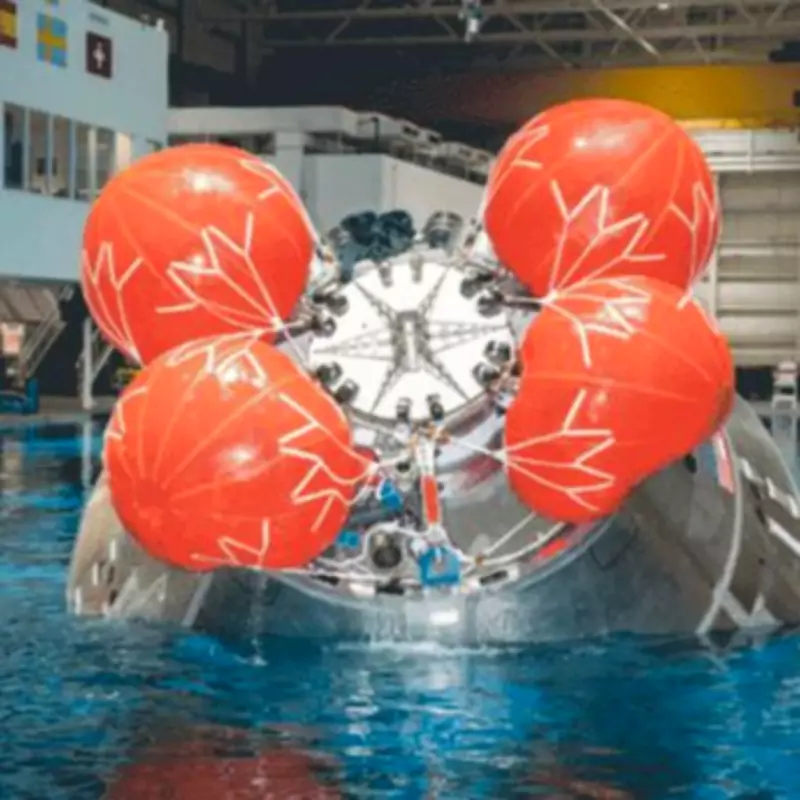
A system of five airbags mounted on top of the capsule will automatically inflate upon impact, righting the spacecraft if it lands upside down. Subsequently, helicopters from the US Navy vessel John P. Murtha will execute a rescue operation, retrieving the astronauts from their space capsule and transporting them to the ship. There, they will receive a hero's welcome and undergo immediate post-mission medical evaluations. The entire splashdown and recovery process will be broadcast live, offering viewers worldwide a front-row seat to this monumental event in space exploration history.