Europe's Most Powerful Rocket Readies for Historic First Flight
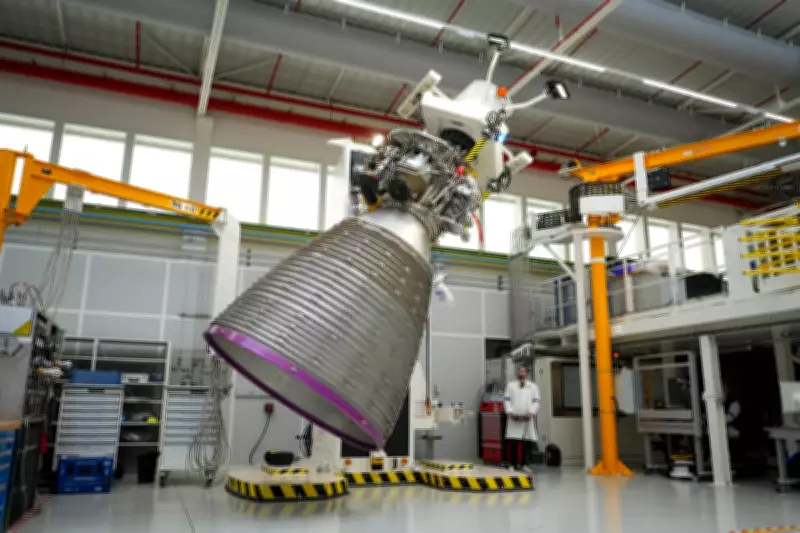
In a tightly controlled manufacturing facility west of Paris, engineers are applying the final touches to a massive silver-coloured engine. Within days, an identical powerplant will help propel the most formidable version of Europe's Ariane 6 rocket ever flown – the inaugural Ariane 64 configuration featuring four boosters.
Countdown to a New Era in European Spaceflight
Scheduled for Thursday from the European spaceport in Kourou, French Guiana, the Ariane 64's maiden mission aims to deploy 32 satellites for Amazon Leo's broadband constellation. Named for its quartet of boosters, this launch represents a significant milestone for European space independence and industrial capability.
"It's a special launch – something new for us on Ariane 6," declared ArianeGroup Chief Technical Officer Hervé Gilibert. "This flight marks the debut of the four-booster configuration, making the rocket roughly twice as powerful as the version flown since 2024."

Gilibert cautioned observers: "Don't be surprised if you see it accelerate much more than Ariane 62, the version we have already launched five times. It delivers significantly more power, allowing much heavier payloads to be sent into space."
Pan-European Collaboration and Transatlantic Journey
The Ariane 6 program represents a remarkable collaboration across 13 European Space Agency member nations who have jointly financed and developed the heavy-lift launcher. Components are manufactured throughout Europe before converging at two primary integration sites.
"We are working with more than 600 subcontractors," Gilibert explained. "Everything comes together at two main sites – Bremen in Germany for the upper stage, and Les Mureaux in France for the lower, or main stage of the launcher."
All components have completed their trans-Atlantic journey to French Guiana for final assembly ahead of Thursday's launch. Standing approximately 62 metres tall – equivalent to a 20-storey building – the rocket represents Europe's ambitious entry into an increasingly competitive global launch market dominated by SpaceX.
Engineering Precision and Emotional Investment
At ArianeGroup's Vernon facility, where the Vulcain 2.1 engines are designed, integrated and tested, engineers work under strict security protocols. Emmanuel Viallon, director of the Vernon site, detailed the launch sequence: "For a few seconds, we verify that it is functioning properly. Once we are fully confident it will operate correctly for the eight minutes that follow, we ignite the solid boosters and the rocket lifts off."
The four boosters will consume 142,000 kilograms of solid propellant in just over two minutes, providing the tremendous thrust needed for liftoff. According to Viallon, Ariane 6 was specifically engineered to halve operating costs compared to its predecessor, Ariane 5, which concluded its program in 2023 after decades of service.
Rigorous Testing and Future Ambitions
Engines produced in Vernon undergo exhaustive testing in reinforced structures deep within surrounding forests, firing at full power while teams monitor from underground control rooms. Laurence, the engine firing test director at Vernon (whose surname was withheld for security), described the intense preparation: "The full testing cycle takes two to three weeks, before the engines return to the assembly facility for final adjustments."
For the dedicated teams, each launch represents both professional achievement and personal investment. "When an engine arrives here, those are really important moments for the team," Laurence shared. "And then, seeing that the launch goes well... that brings a great deal of gratitude."
At the Les Mureaux facility, engineers have already begun preparing components for upcoming missions. Massive white cylinders form the rocket's 5.4-metre-wide main stage, containing tanks for supercooled hydrogen and oxygen that will fuel the Vulcain engine.

Commercial Prospects and Strategic Importance
Caroline Arnoux, business unit director at ArianeGroup, revealed ambitious plans: "We have a very strong order book, equivalent to about 30 launches. Roughly one-third are institutional missions and two-thirds commercial. And our commercial customers are all waiting for the Ariane 64 version, which will be extremely important in the coming years."
Hermann Ludwig Moeller, director of the European Space Policy Institute, emphasised the configuration's significance: "Ariane 64 is an additional level of performance. In itself, this is an important step in the whole program, hoping to demonstrate that this configuration works as reliably as Ariane 6 has been working so far."
Arnaud Demay, the Ariane 6 project manager, stressed the program's core objective: maintaining Europe's independent access to space. Looking ahead, ArianeGroup is developing technologies for component reusability, with Demay revealing: "We do it so rarely, and it's so majestic when it takes off: that little touch of magic inevitably overwhelms me with emotion every time."
With seven to eight launches planned this year and a robust order book, the Ariane 64's maiden flight represents not just a technical achievement but a strategic statement about Europe's ambitions in the new space race.