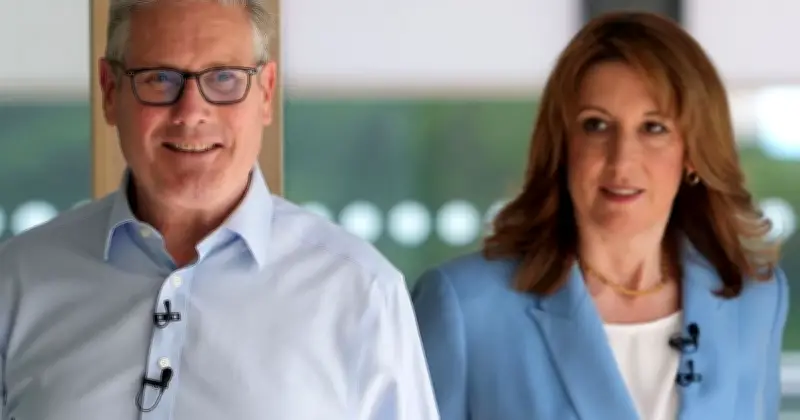
Former Prime Minister Sir Keir Starmer and former Chancellor Rachel Reeves have been accused of leaving Britain a 'parting gift' that amounts to a 'poison pill' by signing the UK into the European Union's £77 billion (€90 billion) Ukraine support loan scheme. The warning comes from Bob Lyddon, a specialist in euro-area and EU financing mechanisms and a regular contributor to the Global Britain think tank.
UK 'locked into EU processes'
In exclusive remarks accompanying his detailed analysis published on the Global Britain website, Mr Lyddon told Express.co.uk: "Keir Starmer and Rachel Reeves left a parting gift for the UK - a poison pill - by signing the UK into the EU's €90 billion Ukraine loan scheme." He described the move as taking the United Kingdom "beyond any reset of relations with the EU into a permanent lock-in to EU processes, finances, and policies".
His full assessment, titled 'On the hook: how Starmer made the UK liable for €21bn of EU ‘loans’ to Ukraine', sets out how the scheme, greenlit by the former PM and Chancellor, embeds the UK once more in the EU's Multiannual Financial Framework, subjects related legal questions to EU law and the European Court of Justice, and constrains British foreign policy autonomy.
Alternative options ignored
According to Mr Lyddon, Britain could have channelled assistance to Kyiv through direct loans, grants or a modern lend-lease arrangement. Instead, ministers opted for a structure that he argues strips the country of key autonomies secured by the 2016 referendum.
In Mr Lyddon's view, foreign policy independence is affected. He contrasts Britain's independent leadership in 2022, when it moved faster and further than many EU states after Russia's full-scale invasion, with the constrained position of 2014, when policy was subordinated to an EU approach dominated by Germany's priority of securing cheap Russian gas.
He said: "Now once again the UK becomes bound into the EU's process of foreign policy formulation towards Ukraine. That creates a precedent for coordinated foreign policy formulation in other areas: the US, Israel, China..."
Financial autonomy compromised
He believes financial autonomy is equally compromised. The scheme raises funds on international markets under the EU Budget ceiling. Participating states, including Britain, become jointly and severally liable to prevent any deficit in the Multiannual Financial Framework. Ukraine has no unconditional obligation to pay interest or repay capital. Interest falls on the backers; capital repayment is conditional on Russian reparations and the possible release of blocked assets—outcomes Mr Lyddon rates as highly improbable, especially within a decade.
Mr Lyddon states: "The UK's liability, in the first instance, for the capital amount of the scheme's funding will be around 16% of the €90 billion or €14 billion, but because the scheme is bound into the EU Budget (the Multiannual Financial Framework or MFF), the legal ceiling is the entire €90 billion. As the scheme has no source of repayment from Ukraine but only from reparations from Russia... the UK's exposure needs to be regarded as unlimited in time, as well as in amount."
Potential bill for UK taxpayers
In practice, he contends, the British share is likely to rise. While reliable partners such as Germany, the Netherlands, Sweden and Austria may meet their obligations, the UK would still need to monitor the fiscal health of France, the condition of Italian banks and Greece's bailout history.
He warns: "We should prepare ourselves for having to pick up a bill of €21 billion for the capital amount, and for €737 million of interest every year until the capital amount has to be written off." Mr Lyddon's published analysis expands on these risks, noting that three EU member states—Hungary, Slovakia and Czechia—have already opted out, increasing the proportional burden on remaining participants, and that several others carry credit ratings below the threshold the EU itself treats as 'safe assets'. Adjusting for these factors produces the €21.1 billion capital exposure figure, plus the annual interest cost.
In his assessment, these are precisely the joint-and-several liabilities, Budget mechanisms and policy constraints that British voters decided should end in 2016. Mr Lyddon says: "These are all things that UK voters determined should be stopped, in the 2016 Brexit Referendum, but the Labour Party has unilaterally decided to reimpose them on us."
According to Mr Lyddon, the arrangement therefore does more than channel support to Ukraine, re-importing permanent entanglement with EU finances, legal processes and policy formulation. In his assessment, the decision by Sir Keir and Ms Reeves represents a structural reversal of the post-referendum settlement—one that leaves British taxpayers permanently exposed to an open-ended European liability.