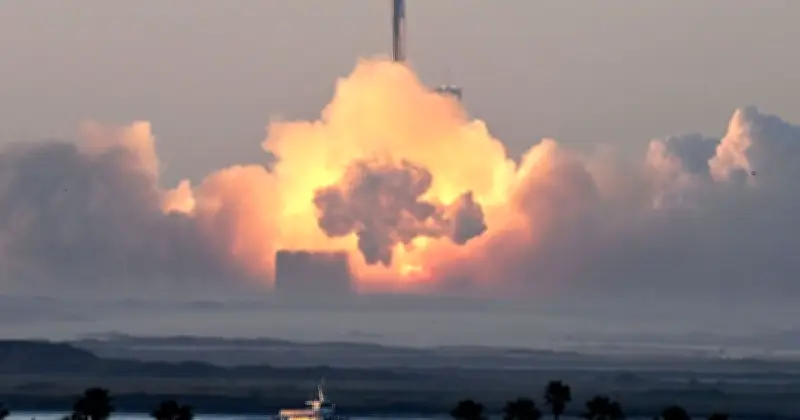
NASA's plan to return astronauts to the Moon relies heavily on Elon Musk's Starship rocket despite development setbacks, according to astrophysicist Professor Chris Lintott. Prof Lintott warned that the lunar landing remains a major hurdle for the Artemis programme, saying NASA's "Plan A" depends on Starship – which he described as "politely still in development, and less politely keeps blowing up".
Public imagination captured but landing is tough
The Sky at Night presenter told Express.co.uk the recent Artemis mission had captured the public imagination but cautioned that actually putting astronauts on the lunar surface was a complicated challenge.
He said: "That's when it gets really tough. It feels like they went further than ever before – they went round the far side of the Moon, and we must be nearly there."
"But the whole landing system's being developed, and Plan A depends on Elon Musk's Starship, which is politely still in development, and less politely keeps blowing up."
Starship central to Artemis plans
NASA has been developing SpaceX's Starship Human Landing System to carry astronauts from lunar orbit down to the Moon and back as part of Artemis. The agency has also been working with Blue Origin on an alternative lunar lander.
The programme has already faced delays and technical challenges. NASA's Office of Inspector General warned earlier this year that delays in Starship's development had left little margin for completing the work needed before a planned lunar landing, while SpaceX had previously indicated it might not be able to meet the original schedule.
NASA has since reshaped Artemis III. Rather than attempting an immediate crewed lunar landing, the mission planned for 2027 will test rendezvous and docking between Orion and commercial lander systems in Earth orbit. The agency says this will help prepare for the first planned crewed lunar landing on the Moon's south polar region with Artemis IV in 2028.
However, Starship remains central to NASA's plans, with the agency saying the SpaceX lander is being developed to carry astronauts between lunar orbit and the surface.
At least five years away
Prof Lintott believes the timescale could stretch considerably further. He said: "I think that's going to be a while. They've got some alternatives, but we're at least five years away, I think."
His comments come as he prepares to speak at New Scientist Live in London, where he will discuss the mystery of the "little red dots" spotted by the James Webb Space Telescope. The event, at ExCeL London from October 10-12, will see Prof Lintott examine competing explanations for the mysterious objects, including the possibility of so-called "zombie stars" containing black holes at their centres.
Prof Lintott said Artemis had nevertheless demonstrated the enduring appeal of human spaceflight. He said: "I think it really captured people's attention," adding that there was still a desire to follow astronauts as they ventured into unusual places.
He said the fact that Artemis was a NASA government mission also mattered because it felt like something "we all felt part of". But he stressed that sending humans to the Moon involved a fundamentally different level of difficulty from simply sending robotic spacecraft.
He said: "If what you wanted to do was take pictures of the lunar far side, you could do that much more cheaply with a robot. However, there was something special about sending people there."