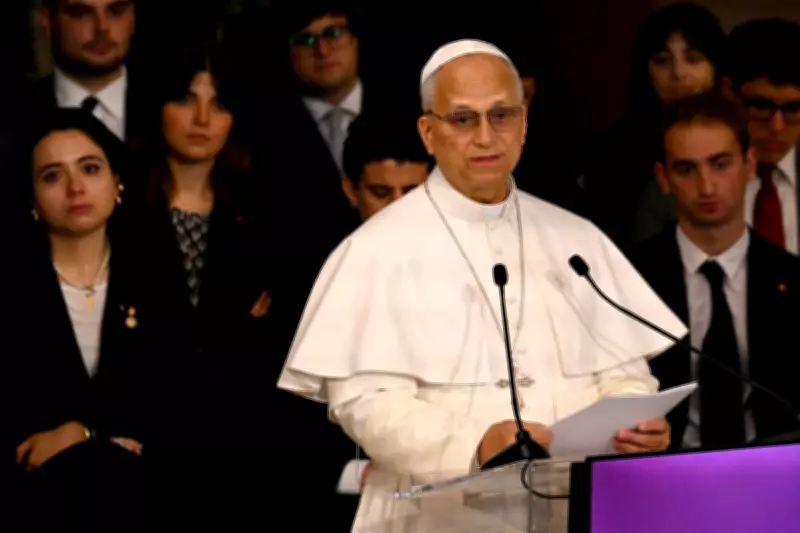
Pope Leo XIV has established a new internal study group dedicated to artificial intelligence, the Vatican announced on Saturday. This initiative comes as the Pontiff prepares to issue his inaugural encyclical, which is expected to underscore the critical need for an ethics-driven approach to AI, prioritising human dignity and global peace.
Vatican's Concern Over AI's Impact
The Vatican stated that Leo's decision to form the in-house group was prompted by the rapid acceleration in AI's deployment, citing "its potential effects on human beings and on humanity as a whole (and) the church's concern for the dignity of every human being." This announcement followed the signing of the encyclical, precisely 135 years after his namesake, Pope Leo XIII, dated his seminal encyclical, "Rerum Novarum," or Of New Things. That historic document addressed workers' rights, the limitations of capitalism, and the duties owed by states and employers to workers amidst the burgeoning Industrial Revolution.
The new encyclical is expected to place the AI question in the context of the church's social teaching, which also covers issues such as labor, justice and peace. Meghan Sullivan, a philosophy professor at the University of Notre Dame who directs its ethics institute, commented: "I think that the Catholic Church in many ways is going to be the adult in the room on some of these debates about how we are going to integrate AI into the rest of our society. For sure, the pope is going to be one of the most forceful advocates for human dignity in these discussions."

Political Implications
The public release of the encyclical, expected in the coming weeks, will likely become a new flashpoint between the Chicago-born Leo and the Trump administration, which has made the rapid development of AI a matter of vital national economic and security strategy. The United States has strongly rejected international regulatory efforts to rein in AI and the Trump administration has removed bureaucratic roadblocks slowing its development domestically. The flurry of Vatican activity came as U.S. President Donald Trump wrapped up a visit to China that included AI business. Traveling with Trump on Air Force One were, among others, Elon Musk, whose social media platform X features his AI chatbot Grok, and Nvidia CEO Jensen Huang, who recently secured federal approval to sell H200 AI chips to Chinese buyers.
Vatican's Role in AI Ethics
Since the AI boom kicked off with ChatGPT's debut, the technology's breathtaking capabilities have amazed the world. Tech companies have raced to develop better AI systems even as experts warn of its risks, from existential but far-off threats like rogue AIs running amok to everyday problems like bias in algorithmic hiring systems. The United Nations last year adopted a new governance architecture to rein in AI after previous multilateral efforts, including AI summits organized by Britain, South Korea and France resulted only in nonbinding pledges. In 2024, the EU adopted its own Artificial Intelligence Act, applying a risk-based approach to its AI rules.
The Vatican has sought to add its voice to the debate, offering ethical guidelines for the application of AI in sectors from warfare to education and healthcare. The underlying call has been that the technology must be used as a tool to complement, and not replace, human intelligence. The Vatican has also warned of the environmental impact of the AI race, noting the "vast amounts of energy and water" required by AI data centers and computational power. Thomas Harmon, theology professor at the University of St. Thomas in Houston, remarked: "There are almost a billion and a half Catholics in the world, so that alone is reason to pay attention. But beyond the numbers, the Catholic Church has a deep and sophisticated tradition of thinking through what it means to be human."

Previous Vatican Initiatives
In 2020, the Vatican enlisted tech companies to sign on to an AI pledge, known as the Rome Call for AI Ethics, which, among other things, outlined core principles for AI regulation, including inclusiveness, accountability, impartiality, and privacy. Microsoft, IBM and Cisco were among the private sector companies that signed on. In his final years, Pope Francis called for an international treaty to regulate AI, saying the risks of technology lacking human values of compassion, mercy, morality and forgiveness were too great to merely trust in the morality of AI researchers and developers. He also brought his authority to bear on the Group of Seven, addressing a special session on the perils and promises of AI in 2024. There, Francis said politicians must take the lead in making sure AI remains human-centric, so that decisions about when to use weapons or even less-lethal tools always remain made by humans. He called ultimately for a ban on the use of lethal autonomous weapons, colloquially known as "killer robots."
Pope Leo's Concerns
In-house, Leo has warned priests against using AI to write their homilies. But the math major pope, who does spend free time scrolling on his phone, has also raised his voice on the broader implications of AI on world peace, labor and the very meaning of reality. For the Augustinian pope, generative AI's ability to misinform and deceive through deepfake imagery is particularly worrisome, given that the search for truth is a fundamental element of his religious order's spirituality. In a June 2025 speech to an AI conference, Leo acknowledged generative AI's contributions to healthcare and scientific discovery. But he questioned "its possible repercussions on humanity's openness to truth and beauty, on our distinctive ability to grasp reality." Leo, who has emphasized a constant appeal for peace, has also called for monitoring how AI is being used and developed in warfare in the Middle East and Ukraine, where automated weapons systems are using everything from aerial drones and maritime and ground platforms. "What is happening in Ukraine, in Gaza and the Palestinian territories, in Lebanon and in Iran illustrates the inhuman evolution of the relationship between war and new technologies in a spiral of annihilation," he said this past week at La Sapienza, Europe's largest university.