GPS Warfare Escalates in Middle East as Iran Tightens Strait of Hormuz Control
GPS jamming and spoofing are rapidly becoming defining features of modern conflict in the Middle East, creating widespread chaos as Iran strengthens its grip on the strategically vital Strait of Hormuz. These electronic warfare tactics are not only targeting military assets but are having devastating cascading effects on civilian transport and the global economy.
An Invisible Battlefield
Since the US and Israel struck Iran on 28 February, GPS interference across the Middle East has spiked dramatically, plunging both sides into what analysts describe as an "electronic warfare arms race." While the primary targets remain military, the disruption is severely impacting commercial shipping off the coasts of the UAE, Qatar, Oman, and Iran itself. This technological chaos fortifies Tehran's ability to choke the Strait of Hormuz, where Iranian attacks have already reduced commercial activity by as much as 95 percent in just three weeks.
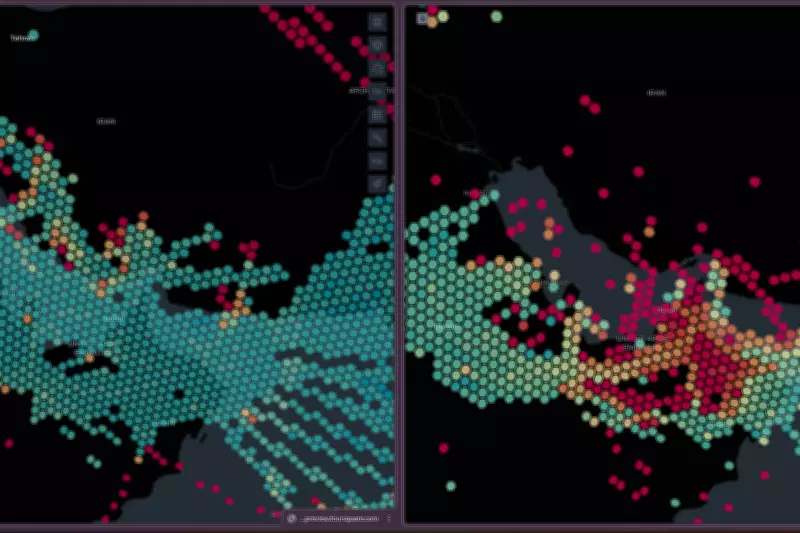
Comparative mapping data from January 15 to March 12 reveals a sharp rise in jamming incidents across the region following the eruption of conflict at the end of February. This invisible war, waged by land, air, and sea through the distortion of satellite signals, is sowing confusion and presenting a grave threat to navigation safety.

How GPS Manipulation Works
Jamming and spoofing represent the two most common forms of GPS interference, capable of affecting any device that uses satellites to determine location—from a smartphone to an aircraft carrier.
- Jamming works by overwhelming the genuine signals from Global Navigation Satellite Systems (GNSS) with electromagnetic noise, disrupting their reception. On a consumer device, this might manifest as a frozen or erratically jumping map.
- Spoofing is a more sophisticated and deceptive technique. It involves transmitting counterfeit satellite signals designed to mimic real ones, tricking the receiver into accepting a false location.
The consequences for civilian and military operators can be catastrophic. A stark example occurred last May when the container ship MSC Antonia, transiting the Red Sea, began displaying positions hundreds of miles from its true location. The disoriented crew eventually ran the ship aground, causing millions in damages and a salvage operation lasting over five weeks.
The Military Electronic Arms Race
Philip Ingram, a former British Army colonel and intelligence expert, notes that jamming has been integral to warfare since World War II. "It's an integral part of your planning. You plan it the same way as you plan the ammunition you're going to put in your rifle," he stated.
Iran, described as "prolific" in spoofing, is using interference in the Gulf to "add confusion and disrupt any of the allied intelligence gathering." Other forms of jamming can sever aircraft communications and cut electronic signals to incoming projectiles.
Alex Lungu, co-founder of aviation intelligence firm Wingbits, explains that GPS interference is "an efficient tool for confusing your adversaries and then also protecting yourself." He asserts that all conflict parties have an interest in deploying the technology to deny navigation capabilities to their opponents.
This has ignited a significant electronic warfare arms race. Intelligence experts believe Iran has markedly strengthened its offensive capabilities since the conflicts of last June, potentially by procuring China's advanced BeiDou satellite navigation system. This technology, described by military analyst Patricia Marins as "essentially unjammable," uses complex frequency hopping and Navigation Message Authentication (NMA) to prevent spoofing.
Impact on Civilian Transport
The fallout for commercial aviation and shipping is severe and costly. Most Middle Eastern countries have closed their airspace since the war erupted, with airlines citing safety risks. This has cost the travel industry an estimated £450 million per day.

Flights that do operate, such as those from Muscat, Oman, face risks from "indiscriminate" interference. "GPS jamming is inherently difficult to contain within precise geographic boundaries," warns Lungu, noting that spillover into neighbouring airspace is common.
For maritime traffic, the risks are compounded in narrow channels like the Strait of Hormuz. Charlie Brown, a senior advisor to United Against Nuclear Iran and former US Navy officer, explains that GPS disruption "causes extra confusion and hampers safe navigation." While mariners can navigate without GPS, it requires greater skill, awareness, and reliance on multiple data sources.
"It is serious. It adds complexity. It adds risk. And it adds inconvenience both to the people on the ships, but also the people ashore trying to understand what's going on at sea," Brown emphasised. At least 22 civilian ships have been attacked in the conflict, with unreliable GPS data increasing the danger of groundings or collisions.
The Future of Electronic Conflict
GPS interference has been a vital intelligence tool for decades, and the Iran conflict is merely the latest to drive innovation as adversaries strive to outmanoeuvre each other. "Looking at the data from what happened in the conflict with Israel and Gaza, and what's happening in Russia, my guess is that it will keep going on while the conflict is in progress," assessed Lungu.
Ingram points to the conflict in Ukraine as a precedent, where electronic warfare through drones has continually reshaped the battlefield as new technologies emerge to counter each other. "It hasn't quite got to that level in the Middle East yet," he concluded, "but the arms race is on." The Pentagon's recent reactivation of A-10 Warthogs to target Iranian vessels underscores the high-stakes, multi-domain nature of this confrontation, where control of information is as critical as control of territory.