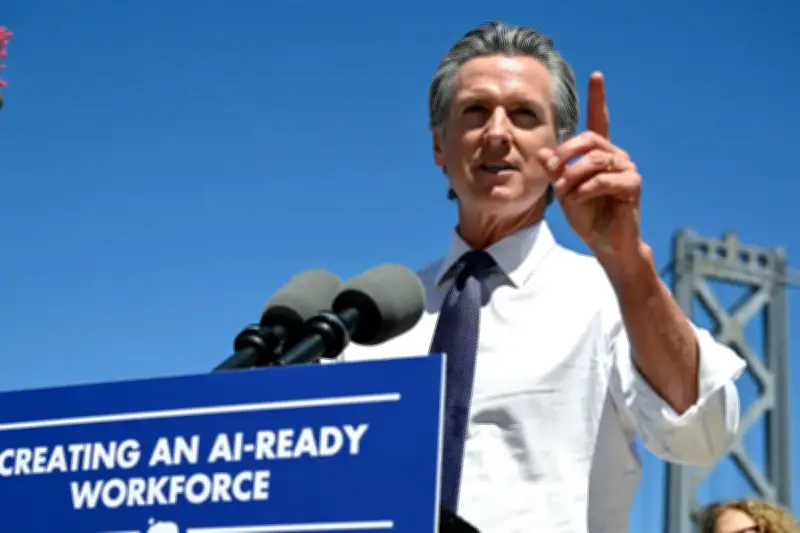
California Governor Gavin Newsom has signed a suite of new laws aimed at protecting workers from the impacts of artificial intelligence, marking one of the first comprehensive state-level efforts to regulate the technology in the workplace. The laws, announced on Thursday, ban employers from relying entirely on AI to decide whether to fire workers, using it to predict employees' emotional states, or collecting neural data—information derived from electrical signals of the brain or nerves. Companies are also required to notify workers if layoffs were caused by AI and are prohibited from using AI surveillance in workplace bathrooms.
Addressing Workers' Fears
These regulations come as workers increasingly worry about AI taking their jobs, leading to discrimination, and increasing workplace surveillance. Unions, worker advocates, and some lawmakers pushed for the new rules, representing a regulatory shift for a technology that has largely developed unchecked. California, home to many leading AI companies, is among the first states to roll out a broad set of workplace regulations targeting the technology.
“It’s a turning point,” said Lorena Gonzalez, president of the California Federation of Labor Unions, AFL-CIO, who has been helping leaders across the country write regulations. “It’s really the first time we’re seeing California workers showing the country that we don’t have to accept [this].”
Scope and Impact
Other states, including Colorado, Connecticut, Illinois, and Texas, have passed individual laws aimed at AI's use in the workplace, but these are narrower in scope than California's. Gonzalez noted that more bills are being lined up for consideration across the country.
California's laws target workplace surveillance measures like heat maps that track employees' movements, including time spent in the bathroom, or monitoring emotional states. Amazon warehouse workers have previously complained about being timed on their bathroom breaks, and nurses at Kaiser Permanente have said automated systems rated their tone of voice in patient interactions. The laws could also prevent future unexpected harms. “We don’t know all the places companies are using AI, and that is and should be scary,” Gonzalez said.
Enforcement and Reactions
Worker advocates and union groups have been following AI companies' latest products to anticipate potential uses. “If it’s being sold, that’s a good indication” it could be in use, Gonzalez said. The federation plans to use the momentum to revive issues like requiring employers to disclose when they're using AI in the workplace, a bill that died in the state's assembly appropriations committee this year.
Robin Feldman, director and founder of the AI Law & Innovation Institute at the University of California College of the Law, San Francisco, called the new laws a key step in gaining regulatory ground. However, she noted limitations in implementation. “The bills have no private enforcement,” Feldman said. “In other words: workers can’t sue. Only the government can enforce the laws.”
The regulations come amid record AI spending at big tech companies and massive job cuts. Workers have started pushing back: in June, Meta paused a program that tracked workers' computer activities to train its AI models, and a month later, dozens of employees filed a lawsuit claiming the company's AI tools targeted those with disability accommodations or on medical or parental leaves for layoffs. Safety concerns, including fears that AI could destroy humanity, have prompted OpenAI and Anthropic to call for slowing the pace of development.
“Workers are increasingly part of that movement, speaking up about the fear of job loss and the dehumanizing experience of being surveilled and controlled by an algorithm,” said Annette Bernhardt, senior tech policy adviser at UC Berkeley Labor Center.
Danielle Ochs, shareholder at employment law firm Ogletree Deakins' San Francisco office, said the new laws “have teeth,” but it's unclear how sweeping the change will be. Ochs noted that employers generally aren't grappling with the AI uses outlined in the regulations and are more interested in how to responsibly implement AI across their systems. “Having 10 hoops you have to jump through per tool is not reflective of reality,” she said, adding that it would be better to have “guardrails that are more aligned” with employers' wider use of AI. Opponents worry the new rules could unexpectedly prohibit helpful AI, such as systems that ensure truckers don't fall asleep at the wheel.
While it's too soon to gauge the laws' effectiveness, worker advocates see positive momentum. Gonzalez said the measures are only the beginning of addressing AI's potential impacts. “We have so much work to do,” she said. “But this should give us all hope we can win … against the tech lobby, against big corporations, because we are the majority.”