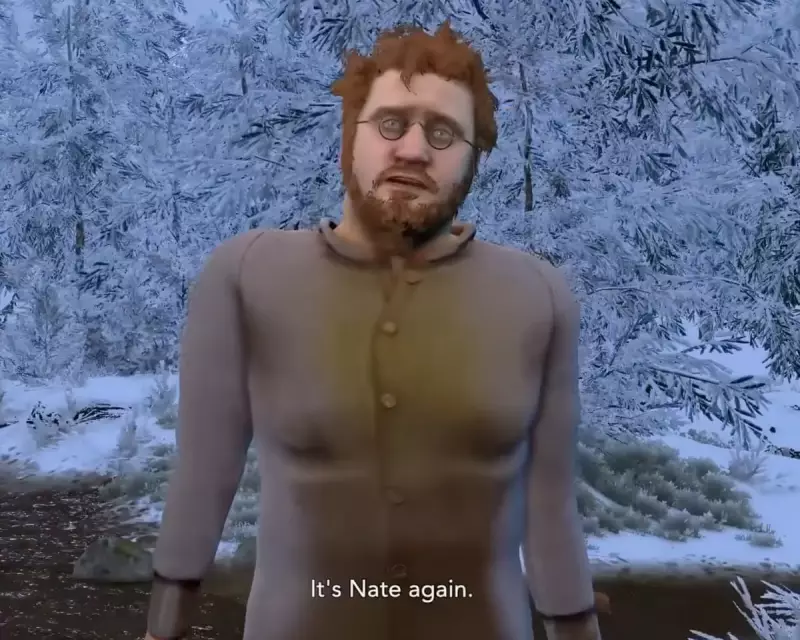
In the world of video games, heroes are typically muscular, capable, and destined for greatness. The indie title Baby Steps, however, flips this convention on its head with its protagonist, Nate – a profoundly incompetent, grumbling 35-year-old who embarks on a hiking trip from hell. Developers Bennett Foddy, Gabe Cuzzillo, and Maxi Boch have crafted what they describe as a "loving mockery" of a certain type of personality, one that has unexpectedly resonated with players.
From Stickman to 'Shy Urinator': The Birth of a Manbaby
The journey to creating Nate began, like many game characters, with a simple stick figure. Bennett Foddy and Gabe Cuzzillo cycled through nearly a dozen prototypes before landing on the core concept: individually controlling a character's feet to create an awkward, laborious walking simulation. The blocky placeholder model eventually evolved into a helicopter pilot asset, and years later, into the final character.
"I thought it would be cute," says Foddy of Nate's final design, which features a large, bearded man in a onesie. Cuzzillo, who also provides Nate's voice, admits a deep personal connection to the character. "Nate is one manifestation of my personality," he reveals. "He's not a made-up guy. I totally have refuse-the-map guy within me." This is referenced in-game when Nate petulantly rejects a helpful hiker's map, a moment that encapsulates his stubborn, self-sabotaging nature.

A Journey of Painful Identification
Nate is a socially awkward, "shy urinator" who lives in his parents' basement and is pathologically averse to help. Initially, the game feels like a cruel joke, revelling in his suffering. Yet, a fascinating shift occurs for many players. "We've had a lot of people say they hated him at the outset," notes Foddy. "And then they started either identifying with him or identifying him with other people in their lives."
This identification is the core philosophy of Baby Steps. The game intentionally starts as arduous, awkward, and hostile, mirroring Nate's own feelings about the hike. The design deliberately gives players an unprepared avatar. "Having an unprepared character gives the player an excuse if they're feeling like they're insufficient. They can blame him," Foddy elaborates.
Fruit, Masculinity, and the Search for Meaning
Beyond the physical struggle, the game explores themes of modern masculinity through Nate's experiences. Playable flashbacks reveal formative humiliations, and the environment is littered with phallic imagery. Crucially, this introspection happens in a vacuum. "Men can have problems with masculinity just by themselves," Foddy states, offering a refreshing take separate from the often toxic online discourse.
One of Nate's few pure joys is fruit. Shiny pieces dangle in hard-to-reach places, rewarding strenuous effort with a ridiculous cutscene of Nate noisily devouring it and screaming its name. "It's funniest when you've tried hardest for it," says Cuzzillo. The over-the-top camera angle was inspired by trainspotter Francis Bourgeois, representing a "vein of culture that emerges when people are critically bored."
The game's ultimate joke is that, in persevering with this frustrating experience, the player shares something with Nate. After many hours, a potential ending sees Nate finally learning to ask for help by knocking on a cabin door. For the developers, this moment of vulnerability is profound. Cuzzillo, reflecting on his previous game Ape Out, sees a parallel. "Nate is a microcosm of the whole game, where it's both a piss-take and sincere at the same time. It's not one or the other."
From a stubborn stickman to a beloved, pathetic hiker, Nate's journey up the mountain mirrors the player's journey towards understanding – and perhaps even embracing – their own occasional incompetence and stubborn pride.